
On this page
A visitor opens your pricing page at 11:40 p.m., reads two case studies, and types "can this handle 300 seats?" into the chat. No rep is awake. A decade of response-time research says the odds of ever qualifying that person start dropping by the minute. By the time someone reads the transcript at 9 a.m., the buyer has already booked demos with two competitors who answered first.
Real-time AI qualification is built for that exact moment. Instead of scoring a form overnight, a model watches the session as it unfolds, reads the behavior and the answers, grades fit and intent in the moment, and routes the strong ones to a person while the visitor is still on the page. This piece is about how that works under the hood, what signals it reads, how it hands the winners to a rep, and how much of the score you can actually believe.
Here is the path: how AI qualifies leads automatically, what "real time" changes about the math, the signals it evaluates, how it routes the qualified ones, how accurate the score is, and where a human still has to step in.
How does AI qualify leads automatically?
AI qualifies leads automatically by watching a visitor's data and behavior, comparing that against patterns from your past deals, producing a fit-and-intent score, and acting on the score without a person touching it. In the real-time version, all of that happens inside a single live session rather than in a scoring queue the next morning.
Five moves run in a loop while the visit is happening. The model observes live events, the pages viewed, the clicks, and the messages typed into chat. It enriches the thin signal, turning a bare email or an anonymous session into a company, a headcount, and a role. It scores the enriched profile against your historical conversions to get a probability, usually expressed as a 0 to 100 grade. It decides by checking that score against a threshold you set. Then it acts, routing the lead, asking a qualifying question, or holding.
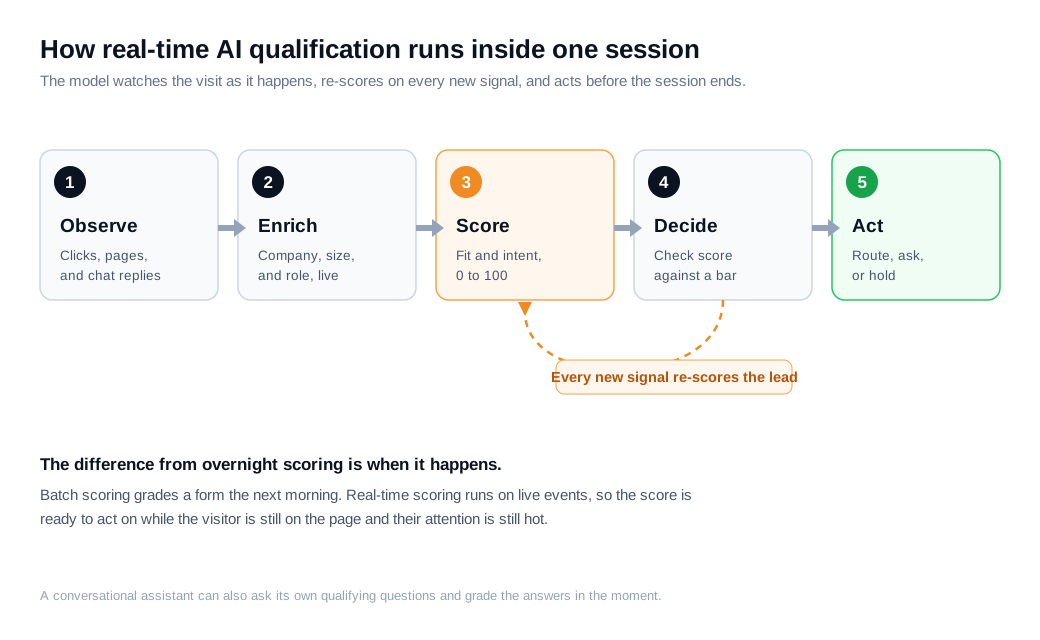
The loop is what makes it real time. A batch model scores a lead once, hours after the form submit. A live model re-scores on every new event, so the grade climbs as the visitor moves from a blog post to the pricing page to a question about seat counts. Warmly, which scores anonymous website visitors at the person level, describes updating the score instantly while the visitor is still active, per its guide to AI lead scoring. The score is ready to act on at the peak of interest, not after it.
There are two flavors, and many teams run both. Background scoring silently ranks every session against your criteria. Conversational qualification puts an AI chat assistant into the session, so instead of only reading behavior, it asks two or three qualifying questions and grades the answers on the spot. That captures a signal a form never gets: what a person says when you ask directly, while they are motivated to answer.
What does real time actually change about qualification?
Real time changes the economics, because inbound intent decays within minutes and a score you act on during the session is worth far more than the same score delivered the next morning. The model is the same. The window is the difference.
The decay is well documented. Contacting a new lead within five minutes rather than thirty makes you about 21 times more likely to qualify it, according to a review of lead-response research at Casey Response. Speed-to-lead benchmark data tells the same story from the close-rate side: firms that answer in under five minutes post a 32% close rate, against 24% for a reply inside an hour, per DigitalApplied's 2026 benchmark playbook. The buyer's calendar explains why. Gartner found that B2B buyers spend only 17% of their total purchasing time meeting with any potential supplier, split across a buying group of six to ten people and every vendor on the shortlist. That sliver of attention is the entire opportunity.
A batch model cannot use that window. It scores the form after the visitor has closed the tab, and a rep works the ranked list the next day, by which point the buyer is somewhere else. A real-time model spends its score while the visitor is still on the page.
Here is the speed math on a small site. Say 500 sessions turn into chats in a month and 60 are genuinely high intent. Reach those 60 the next morning and the response-time research says you convert a fraction of what you could. Flag them mid-session and get a rep into the conversation inside five minutes, and the same 60 leads sit in the highest-converting response band instead of the lowest. The leads did not change. The clock did.
What signals does it evaluate?
It evaluates three families of signal, behavioral, fit, and intent, then weights them into one score, with live behavior usually carrying the most weight. Behavioral covers what the visitor does. Fit covers who they are. Intent covers whether they are in-market right now.
A practical 100-point model weights behavioral engagement around 50 points, firmographic fit around 30, and third-party intent around 20, a split laid out in Warmly's compound-score framework. Behavior leads because it is first-party and hard to fake. A demo click, three pricing visits in two days, and a stop on your comparison page are the strongest tells there are, and intent-data guides rank those active behaviors well above passive ones like a newsletter sign-up, as ZoomInfo lays out in its work on buyer intent signals.
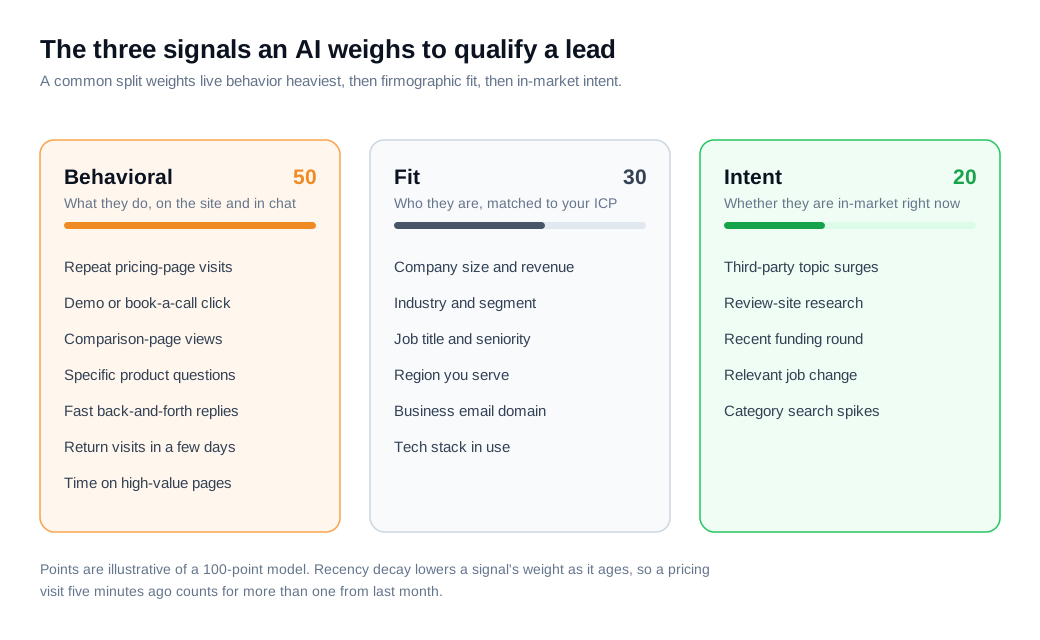
In a live session the model reads those signals as they happen. Fit signals ride alongside: a business email domain, a company size or role the visitor mentions, and a region you serve tell the model whether the intent is worth a rep's time, because high intent from a poor-fit account rarely closes. Intent data fills the third bucket, flagging accounts researching your category off your own site through review-site activity or a topic surge.
One detail separates real-time scoring from a static point total: recency decay. A signal loses weight as it ages, so a pricing visit five minutes ago counts for more than one from last month. That is why a live score can jump during a session and settle back down later, and why acting on it quickly matters. A conversational assistant adds a fourth input the other three cannot capture, the visitor's own answers. Ask "how big is the team that would use this?" and a reply of "about 300 people" is a fit signal, a timing signal, and a qualification all at once.
How does it route qualified leads?
It routes qualified leads by comparing the live score to a threshold, matching the lead to the right rep by territory and fit, and firing an instant notification so a person can join the session in seconds. A score that never turns into a conversation is wasted work, so routing is the step that actually earns the return.
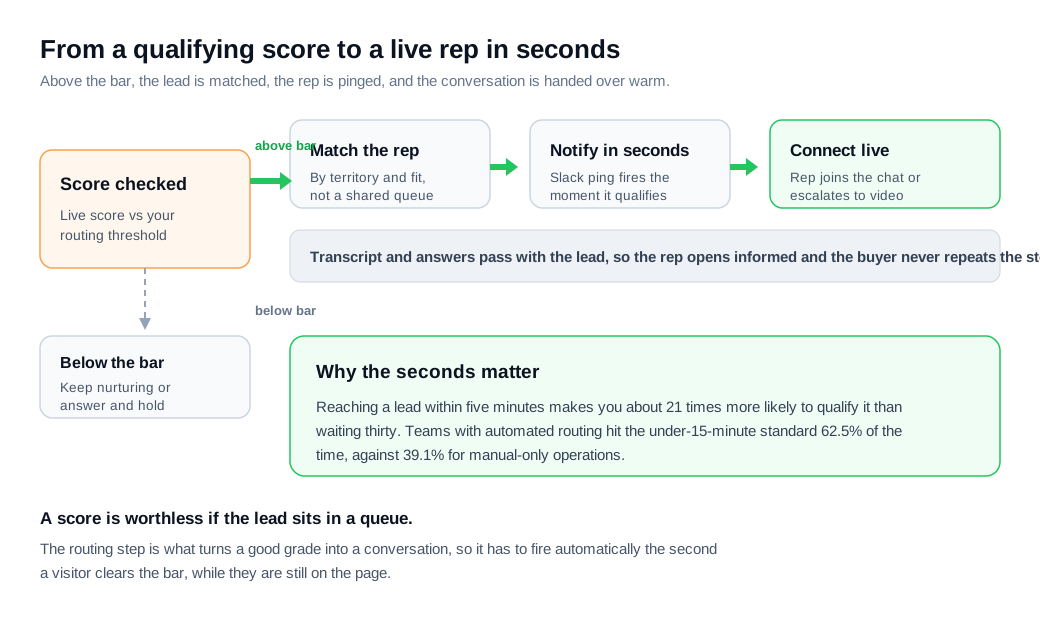
Four moves make the handoff clean. First, match by fit and territory rather than dropping everyone into a shared queue, so a mid-market demo request and a free-tier question do not land on the same person. Second, notify the right rep the moment the lead clears the bar. A Slack ping is what turns a five-minute service-level agreement into a real one, and it is the job of a routing and notifications setup. Third, pass the transcript and the collected answers, so the rep opens already informed and the buyer never repeats the story. A cold handoff, where the rep asks "how can I help?" after the visitor already explained everything, is where good conversations stall. Fourth, connect in the same window, dropping the rep into the live chat or escalating to a live video call or screen share when the question is easier to show than to type.
Automation is what makes the seconds achievable. Teams using AI or automated routing hit the under-15-minute response standard 62.5% of the time, against 39.1% for manual-only operations, per DigitalApplied's benchmark data. A human router cannot match that, because both the qualification and the assignment wait on a person being free. When the model routes the moment the score crosses the line, the lead that qualified at 11:40 p.m. gets an answer while the intent is still live, which is the whole point of treating your site as an inbound sales channel rather than a form that files leads for morning.
How accurate is AI qualification?
AI qualification runs a few points ahead of human qualification in head-to-head benchmarks, roughly 87% versus 76% in one large study, but a curated benchmark flatters the model, and the number that matters in production is precision on the leads you actually act on. Treat the headline figure as a ceiling, not a promise.
Start with the comparison. Optifai's benchmark of 939 companies found AI qualification hitting 87% accuracy against 76% for human qualification, as summarized in its analysis of AI versus human lead qualification. Cleaner still, a 2025 peer-reviewed study in Frontiers in Artificial Intelligence tested fifteen classifiers on a B2B lead dataset and found a Gradient Boosting model reaching 98.4% accuracy, per the published results.
The catch is that a curated dataset is a friendlier place than your live pipeline. A more honest production target is the conversion rate from qualified lead to opportunity, and top implementations reach 60% to 70% only after a year or more of tuning on their own outcome data.
Here is a worked example that keeps the accuracy claim grounded. Say 1,000 sessions qualify in a month and the model flags the top 20%, so 200 leads, as high intent. If precision on that slice is 70%, then 140 of those 200 are worth a rep's time and 60 are false positives your team chases for nothing. Meanwhile the model deprioritizes 800 leads, and if 5% of those, so 40 leads, would have converted, they are false negatives you may never call. A 98% headline accuracy tells you nothing about those 40 missed deals, which is why the number to watch is precision on the slice you act on, not the lab score.
Two things protect real-world accuracy. Clean data comes first, because a model trained on duplicates and stale enrichment is confident and wrong. Then there is the training window: real-time scoring still leans on a model trained on your history, and most predictive models need six to twelve months of your own outcomes before their scores get reliable. Before that, the live grade is borrowing patterns from generic data and its confidence is thinner than it looks.
Where does AI still need a human?
AI still needs a human on complex, high-stakes, or ambiguous conversations, which is why the durable pattern is a hybrid split rather than full automation. The model is good at speed, coverage, and consistency. People are good at judgment, and buyers still want them for the parts that matter.
The demand for a human is measurable. Gartner found that 69% of B2B buyers turn to sales reps to validate AI-generated insights during their research. A model can grade fit and route a hot lead in under a second, but it misses hesitation in a reply, does not notice that the real decision-maker is someone the chat never mentioned, and cannot navigate a committee of four stakeholders with competing agendas. The score says who to call first. A rep decides what the call actually means.
That is why teams settle on a division of labor rather than picking a side. Optifai's benchmark found roughly 70% of companies running a hybrid model, with AI handling about 60% of qualification and humans the other 40%, per the same analysis. The AI triages the whole queue, scores every session, and routes the high-intent leads fast. The human takes the conversation from there. Grounding the assistant in your real product docs, following an AI assistant setup that keeps it from inventing answers, is what keeps the automated half honest enough to trust with the first touch. The result is a model that makes sure the leads worth a same-day human conversation actually get one, and a person who spends the reclaimed hours on deals that can close.
Key takeaways
- Real-time qualification runs inside the live session, observing behavior, enriching the profile, scoring fit and intent, and acting before the visitor leaves, instead of grading a form the next morning.
- Speed is the reason it beats batch scoring, because reaching a lead within five minutes makes you about 21 times more likely to qualify it, and buyers spend only 17% of their time with any supplier.
- The score weighs three signal families, live behavior at roughly 50 points, firmographic fit at 30, and third-party intent at 20, with recency decay lowering a signal's weight as it ages.
- Routing is what turns a score into a deal, so match by fit, ping the right rep in seconds, pass the transcript, and connect in the same window over chat or video.
- Lab accuracy oversells production, so a 98% benchmark or an 87% head-to-head result should be read against a real target of a 60% to 70% qualified-lead-to-opportunity rate on the leads you act on.
- Keep a human on the hard conversations, because 69% of buyers want a rep to validate what the AI tells them, and roughly 70% of teams run a hybrid split for exactly that reason.
TAGS

Written by
Nilas MylerCo-founder & CTO, Glimpze
Nilas is the co-founder and CTO of Glimpze, an inbound sales tool that turns high-intent website visitors into live conversations. A former SEO consultant for some of the largest companies in Denmark, he writes about speed-to-lead, inbound sales, and conversion rate optimization — the technical and operational mechanics of turning traffic into pipeline.


