
On this page
- What is an AI voice agent?
- How is an AI voice agent different from a chatbot or a phone menu?
- How does an AI voice agent handle a call?
- Why does latency matter for an AI voice agent?
- What use cases fit an AI voice agent?
- What are the current limits of an AI voice agent?
- How do you deploy an AI voice agent responsibly?
- Key takeaways
- Sources
A patient calls a dental clinic at 7:10 p.m. to move an appointment. The line rings, a recorded menu offers five options, none of them fit, and after ninety seconds on hold the call drops. The patient does not call back. The clinic never learns it lost the booking.
An AI voice agent is built to answer that call. It picks up on the first ring, hears "I need to move my Thursday cleaning," checks the schedule, offers two open slots, books the change, and texts a confirmation, all in a spoken conversation that sounds close to human. That is the pitch. The 2026 reality is more capable than a phone menu and more fragile than the demos suggest, and it pays to understand both before you put one on your main line.
This guide covers what an AI voice agent is, how it differs from a phone menu and a text chatbot, how it runs a live call, why latency decides whether it feels human, the use cases that fit, the limits worth taking seriously, and how to deploy one without losing calls or trust.
What is an AI voice agent?
An AI voice agent is software that holds a spoken conversation over the phone or another voice channel, understanding what a caller says, deciding what to do, and answering out loud in real time, with no human on the line.
Three technologies do the work, chained together. Automatic speech recognition, also called speech-to-text, transcribes the caller's audio into words. A large language model reads that text, works out what the caller wants, and decides how to respond, often calling a tool to look something up or book something. Text-to-speech then turns the reply back into spoken audio. AssemblyAI describes this chain of speech-to-text, a language model, and text-to-speech as the core of how a voice agent works.
The word agent carries weight. IBM frames conversational AI as technologies "which users can talk to" that lean on machine learning and natural language processing to imitate human interaction. A voice agent goes a step past talking. Given a goal, say a rescheduled appointment, it can take actions to reach it: query a calendar, write to a database, send a text, or route the call. That is what separates it from a voicemail box or a recorded phone tree, which can only play back fixed options.
How is an AI voice agent different from a chatbot or a phone menu?
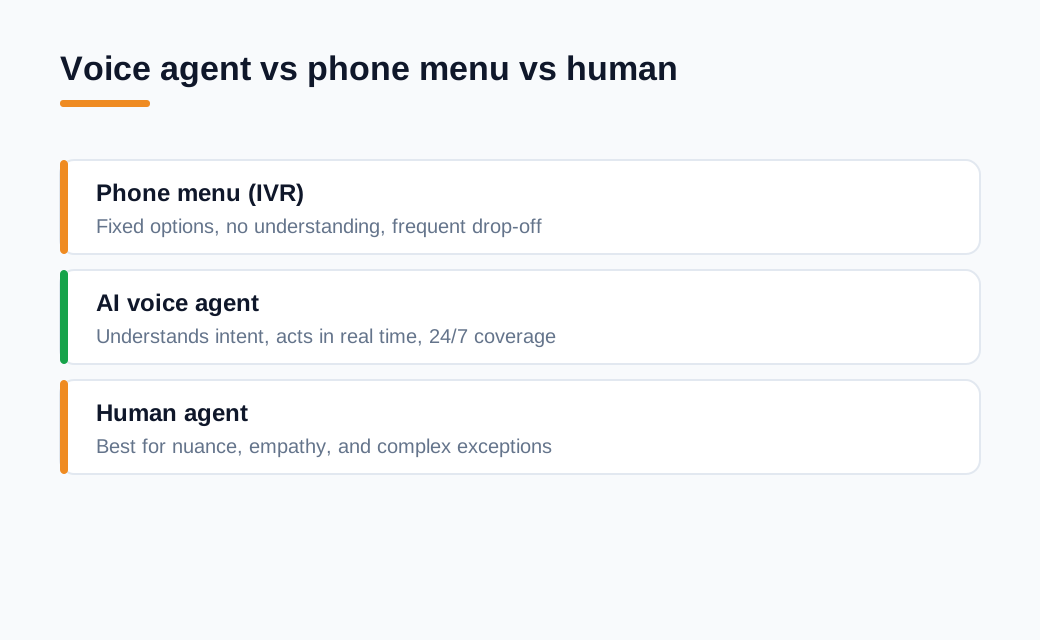
An AI voice agent differs from a phone menu in that it understands natural speech and can act on it, and it differs from a text chatbot in that it works over voice in real time, where every extra half-second of silence is audible to the caller.
Start with the phone menu, the interactive voice response (IVR) system most people know. It runs on a fixed script and keypad presses: press one for billing, press two for support. Say something it did not anticipate and it loops or drops you into a queue. It cannot parse a sentence, and it cannot do anything a designer did not wire in advance.
A text chatbot is smarter about language but lives in a different medium. It reads typed messages and can take a beat to answer without anyone noticing, because a reader will wait a second or two for a chat reply. A voice agent has no such grace. Speech is synchronous, so a pause that reads as normal in chat reads as a glitch on a call. The AI chat assistant that qualifies visitors on a website does much of the same reasoning as a voice agent, minus the hard real-time constraint that voice adds.
How does an AI voice agent handle a call?
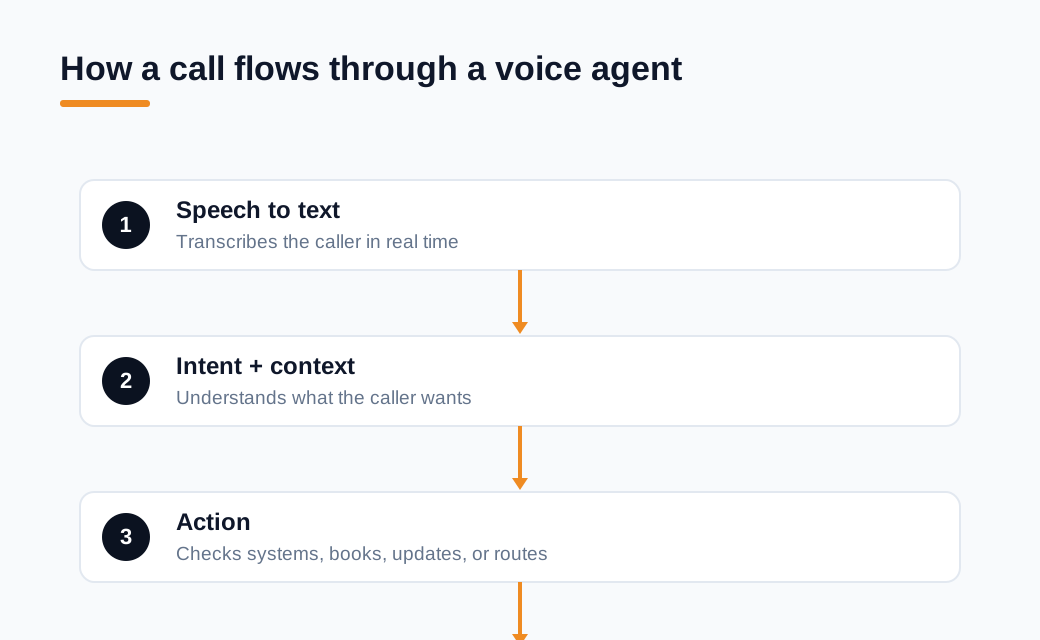
An AI voice agent handles a call in a fast loop: it listens and transcribes speech to text, works out the caller's intent, decides on an action, often calling a tool or database, then speaks a reply, and repeats until the request is resolved or it hands the call to a person.
Four stages run in sequence, over and over. Listening and transcription turns the audio into text as the caller talks. Understanding is the language model reading intent and pulling out details like a date, a name, or an account number. Action is the step where the agent does something real: it checks availability, updates a record, or looks up an order. Speaking voices the reply. A fifth job runs underneath all of it, endpointing, which is the agent detecting when the caller has actually finished a sentence so it knows when to answer and when to stay quiet.
Here is one turn, concretely. The caller says, "Can I move my Thursday cleaning to next week?" The agent transcribes the sentence, reads the intent as a reschedule, and marks "Thursday" and "next week" as the anchors. It calls the scheduling tool, finds two open slots, and says, "I can do Tuesday at 2 or Wednesday at 10, which works?" The caller picks Tuesday. The agent books it, writes the change to the calendar, and confirms out loud while a text goes out. If the caller instead says, "actually I want to dispute a charge," the agent recognizes the request is out of scope and routes the call to a human with the context attached.
A good voice agent also handles interruptions. If the caller talks over the agent mid-sentence, a capability called barge-in lets the agent stop speaking and start listening at once, the way a person would. Without it, the agent talks past the caller and the exchange feels robotic.
Why does latency matter for an AI voice agent?
Latency matters because voice is a real-time medium, and human conversation runs on gaps of roughly 200 milliseconds between turns, so an agent that takes a full second to answer feels broken in a way a text bot never does.
The timing is not a matter of taste. A study of ten languages published in PNAS found that turn-taking is fast and consistent across cultures, with the gap between a question and its answer clustering near 200 ms and varying only within a range of about 250 ms around the cross-language mean. People often start replying before the other speaker has fully stopped. We are wired to expect that rhythm, and we notice when it breaks.
Voice AI teams have turned this into a design rule. AssemblyAI calls it the 300ms rule: once a response takes longer than about 300 milliseconds, callers start to perceive the system as slow or broken, and they begin talking over it. The trouble is that a voice agent has a lot to do inside that window.
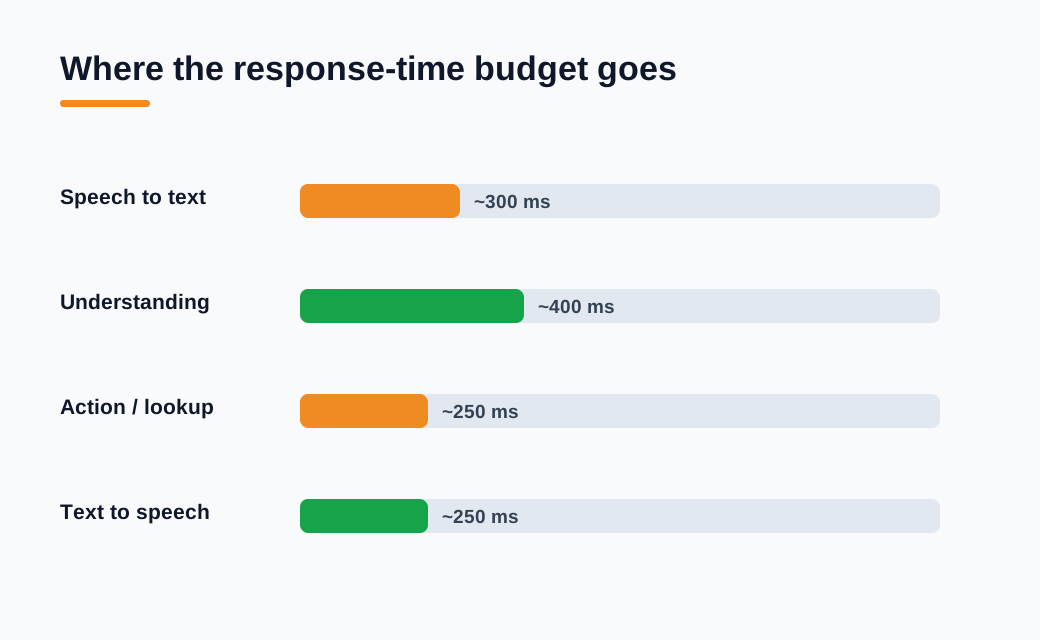
Add up the budget. Telnyx breaks down a typical pipeline into speech-to-text at 100 to 300 ms, language model inference at 350 to 1,000 ms, text-to-speech at 90 to 200 ms, and network round trips between services at 50 to 200 ms. Stitched together, a naive setup spends 600 milliseconds to 1.7 seconds per turn, well past the 300 ms where speech still feels natural. The language model is usually the largest single cost.
Two moves close the gap. Streaming means each stage starts working on partial input instead of waiting for the whole thing, so the model begins reasoning as the transcript arrives and the voice starts speaking as the first words are generated. Co-locating the models on one network removes the slow hops between separate vendors. Together they can pull a turn back under the threshold where a caller stops noticing the machine.
What use cases fit an AI voice agent?
The use cases that fit are high-volume, repeatable phone conversations with a clear goal: appointment scheduling and reminders, inbound customer service and FAQs, call triage and routing, order and reservation status, lead qualification, and after-hours coverage.
The pattern across all of them is the same. The call is common, the caller's goal is narrow, and the answer lives in a system the agent can reach. Booking a slot, checking an order, resetting a password, or reciting your hours are each a good fit. A tangled billing dispute or an upset customer is not.
The scale is why the category draws money. Gartner has projected that conversational AI will cut contact center agent labor costs by $80 billion in 2026, with one in ten agent interactions automated, up from an estimated 1.6% in 2022.
Put numbers on a single clinic. Say it takes 2,000 calls a month and four front-desk staff field them between other work. Roughly 60% are routine: booking, rescheduling, confirming, and asking hours. That is 1,200 calls a voice agent can own end to end, day or night, including the third of them that land after the office closes. The staff keep the other 800, the insurance questions and the judgment calls, now without a stack of voicemails on top. The agent did not replace the desk. It cleared the repetitive 60% so the desk could handle the rest.
On a website rather than a phone line, the same job runs in text. A high-intent visitor who might have dialed instead opens a chat, and an AI chat assistant answers the product question, qualifies the fit, and routes a hot lead to a rep, which is the core of an inbound sales motion built on speed. Voice and text are two front doors to the same work.
What are the current limits of an AI voice agent?
An AI voice agent still runs into three hard limits: understanding messy real-world speech, staying accurate under pressure, and the judgment that a difficult or emotional call demands.
The first is recognition. Speech-to-text degrades on strong accents, background noise, cross-talk, and callers who interrupt or trail off. A drive-through order, a crying baby, a speakerphone in a warehouse: each pushes the transcript toward errors, and an error early in the pipeline poisons everything downstream. Barge-in, where a caller cuts in mid-sentence, is especially hard, because the incoming audio arrives garbled and truncated.
The second is accuracy. The language model at the center can hallucinate, stating a price, a policy, or an availability that is simply wrong, and it delivers the mistake in the same confident voice it uses for correct answers. On a recorded, time-pressured phone call that is expensive, because the caller acts on it. The standard fix is grounding, tying the agent to a verified knowledge base and having it decline rather than guess, though no grounding is perfect.
The third is judgment. An agent follows patterns well and reads a room poorly. An angry customer, a grieving caller, a negotiation, or a request that bends the rules all sit past what current models handle, and pushing the script in those moments makes matters worse. Oversight is still catching up. Deloitte's 2026 State of AI in the Enterprise report found that only about one in five organizations has a mature model for governing autonomous AI agents, even as usage climbs.
How do you deploy an AI voice agent responsibly?
Deploy it as a grounded, bounded assistant that owns the routine calls, escalates fast on anything hard or high-stakes, and gets judged on calls resolved rather than minutes automated.
A short set of guardrails covers most of the risk:
- Ground it in real answers. Tie the agent to a verified knowledge base so it speaks from your actual policies and hours, and have it say it does not know instead of inventing an answer.
- Escalate on clear triggers. A billing dispute, a repeated failure, a distressed caller, or a direct request for a person should route to a human at once, with the transcript attached. A tight routing and notifications setup gets the call there in seconds.
- Bound what it can do. Give it a narrow set of tools. An agent that can read a calendar and book a slot is useful. An agent with open write access to payments and contracts is a liability.
- Be honest that it is AI. Callers dislike being fooled, and a clear handoff to a named person builds more trust than a bot pretending to be human.
- Measure outcomes, not activity. Judge it on resolved calls, booked appointments, and clean handoffs, the way you would judge a person, and grounding it through a proper AI assistant setup is what keeps those numbers honest.
Set up that way, an AI voice agent earns the routine phone volume and protects your team's time for the calls that actually need a person.
Key takeaways
- An AI voice agent holds a spoken conversation and acts, chaining speech-to-text, a language model, and text-to-speech so it can understand a caller, decide what to do, and answer out loud with no human on the line.
- It is a step past a phone menu and the voice cousin of a chatbot, understanding free speech and taking real actions, under a real-time constraint that text never faces.
- Latency is the make-or-break constraint, because human turn-taking runs near 200 ms and callers begin to feel a system is broken once replies pass about 300 ms, which streaming and co-located models exist to fix.
- The best-fit calls are high-volume and narrow, covering scheduling, FAQs, triage, status checks, and after-hours coverage, where the goal is clear and the answer lives in a system the agent can reach.
- The limits are recognition, accuracy, and judgment, since speech-to-text stumbles on accents and noise, the model can state wrong facts with confidence, and hard or emotional calls still need a person.
- Responsible deployment is a workflow, meaning grounded answers, fast escalation, bounded tools, honesty that it is AI, and measurement on calls resolved rather than minutes automated.
TAGS

Written by
Nilas MylerCo-founder & CTO, Glimpze
Nilas is the co-founder and CTO of Glimpze, an inbound sales tool that turns high-intent website visitors into live conversations. A former SEO consultant for some of the largest companies in Denmark, he writes about speed-to-lead, inbound sales, and conversion rate optimization — the technical and operational mechanics of turning traffic into pipeline.


