
On this page
- What objections come up in a sales demo?
- How should you respond to an objection in real time?
- How do you address pricing objections?
- How do you handle feature gaps?
- How do you handle a competitor objection?
- How do you keep momentum after objections?
- What does handling an objection in a demo look like start to finish?
- Key takeaways
- Sources
Halfway through the demo, the buyer stops nodding and says the thing you were hoping they would not say. "This looks more expensive than what we run now." The room goes quiet, and you can feel the deal tilt on your next sentence.
That sentence is the job. A demo without objections is usually a demo where the buyer already decided to pass and is being polite. The pushback is the buyer telling you exactly what stands between them and a yes, while you are still in the room to answer it. Reps who treat that moment as an attack lose the deal in the defending. Reps who treat it as information tend to close.
This guide covers the objections that show up in demos, how to respond in real time, how to handle price, feature gaps, and competitors, and how to keep the deal moving once you have cleared the concern. Each section gives you a move for the next call.
What objections come up in a sales demo?
The objections that come up in a sales demo almost always sort into four buckets: price, timing, need and fit, and authority or trust. Gong's team labeled tens of thousands of recorded conversations and found nearly every pushback lands in one of those four, so you can prepare for the category even when you cannot predict the exact words.
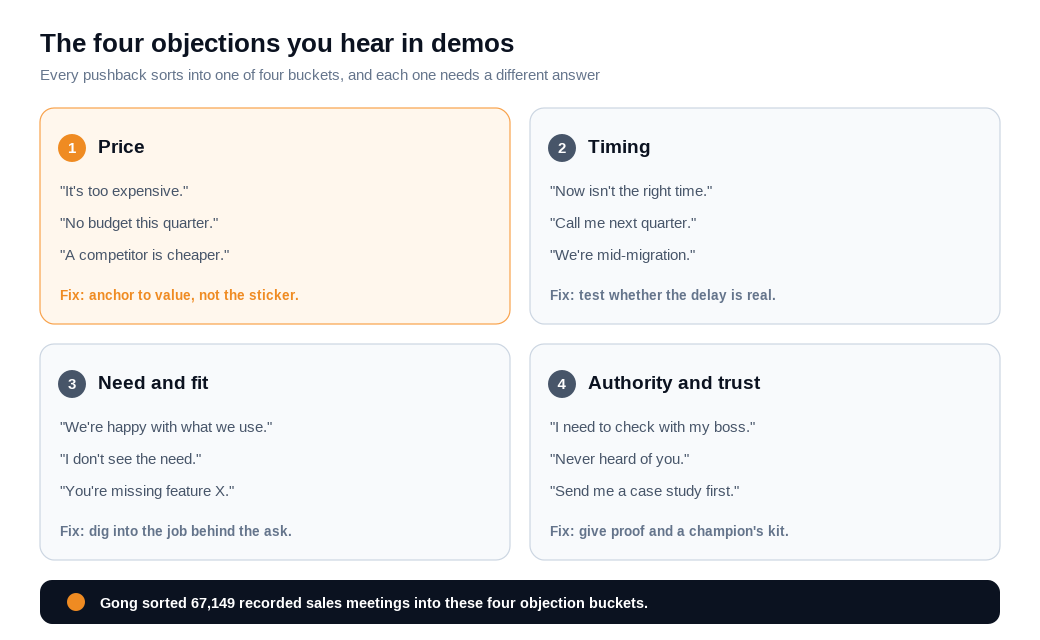
Price objections cover "too expensive" and "your competitor is cheaper." Timing objections cover "now is not the right time" and "call me next quarter." Need and fit objections cover "we are happy with what we have," "I do not see the need," and the feature-gap complaint "you are missing X." Authority and trust objections cover "I need to check with my boss" and "I have never heard of you." HubSpot's guide to common sales objections sorts the field the same way.
The useful reframe is that an objection raised during the demo is a gift compared to the same doubt raised after it. A concern you hear in the room is one you can answer while the buyer watches. A concern the buyer keeps to themselves becomes a silent reason to stall. That is why the strongest demos feel like working sessions where the buyer interrupts and pushes, rather than polite screen tours where nobody says anything real.
How should you respond to an objection in real time?
Respond by pausing, probing for the real concern, answering that one issue with proof, then confirming you cleared it before you move on. The order matters, and the first step is the one most reps skip.
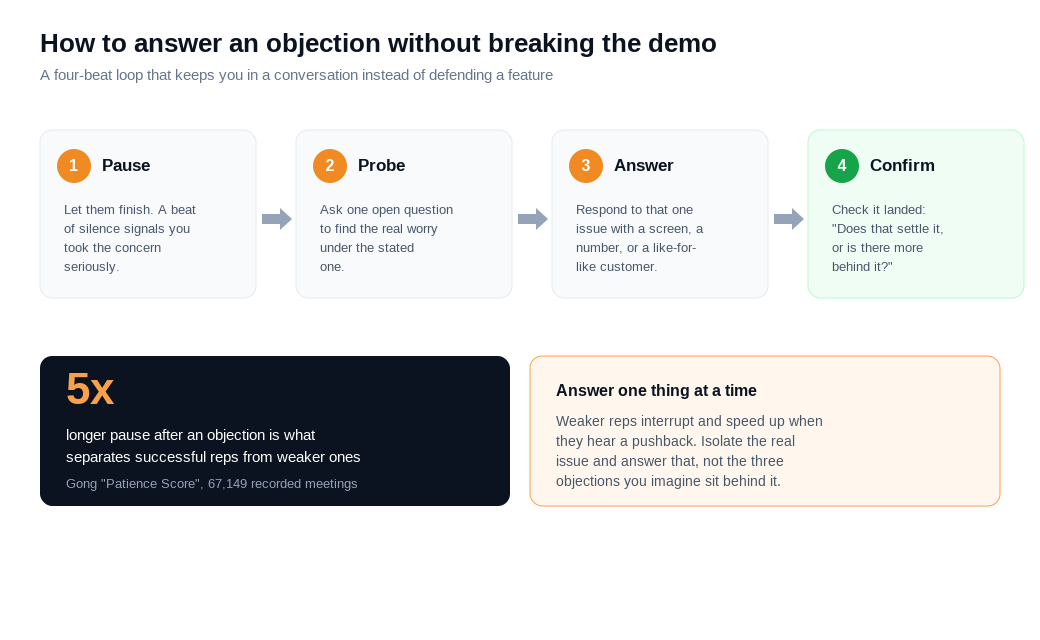
Gong studied 67,149 recorded sales meetings and found successful reps pause about five times longer after an objection than their less successful peers, a gap the team named the Patience Score. Weaker reps interrupt and speak faster when they hear pushback, which reads as defensiveness. The extra beat of silence signals you took the concern seriously and buys you a second to answer the real problem instead of the first thing that comes to mind.
Probing comes before answering because the stated objection is often a stand-in for a deeper one. "It is too expensive" can mean the budget is real, or that the buyer does not yet see enough value to justify any number. One open question separates the two: "Help me understand, is it the total, or is it that the value is not clear yet?" You answer whichever they name, and only that one, then confirm it landed with a direct check: "Does that settle it, or is there more behind it?" A confirmed objection is off the table. An unconfirmed one comes back at the close.
How do you address pricing objections?
Address a pricing objection by separating the sticker reaction from the real question underneath it, then reframing the number against the outcome the buyer already told you they wanted. Price is the objection you will hear most, because every purchase carries financial risk, so it deserves a deliberate approach rather than a reflex discount.
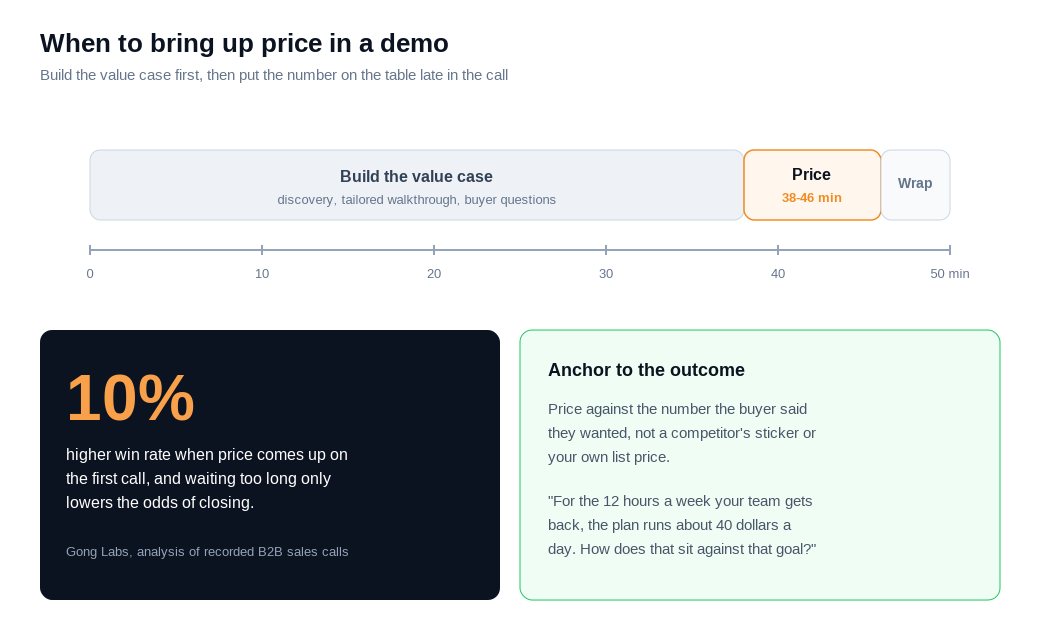
Timing is half the battle. Gong's analysis of long-form calls found top performers, the reps with the highest win rates and shortest cycles, tend to introduce price between the 38 and 46 minute mark, after they have built the value case. The same research found win rates run about 10 percent higher when price comes up on the first call, and that raising budget early deepened the relationship, lifting buyer and seller interactions from two calls to four. Surfacing price is healthy. Doing it before the value is clear is what turns it into an objection.
When the number does land badly, resist the on-the-spot discount, which trains the buyer to expect more and signals the price was never real. Isolate the concern first: "Fair, it is a real number. What are you comparing it against?" A cheaper competitor puts you in a competitor conversation; a budget limit puts you in a value one. Then anchor the price to the outcome they described in discovery. If the buyer said the current process costs their team twelve hours a week, price against those twelve hours rather than against a rival's sticker. HubSpot reports that sellers who successfully defend their product against objections can reach a close rate as high as 64 percent, and price is where that defense is tested most.
How do you handle feature gaps?
Handle a feature gap by acknowledging it plainly, digging into the job the buyer is trying to do, and then showing whether an existing capability, a workaround, or a dated roadmap item covers that job. Denying the gap or talking past it costs you more trust than the missing feature ever would.
Start by understanding the why behind the request. A buyer who asks for a specific integration is usually trying to accomplish something, and the feature is their guess at how. Ask what they would do with it: "What would that integration let your team stop doing manually?" Often the job is already covered by a capability you did not show, or a simpler workaround. When it is not, say so.
For real gaps, a tiered roadmap keeps the conversation honest. Guidance from Building Momentum on roadmap objections suggests splitting the roadmap into "landing shortly," "near term," and "planned," so you set expectations without overpromising. A dated commitment you can keep builds trust; a vague "it is on the roadmap" that never ships burns it, and buyers have heard that line before. If the feature is not coming, use a balance-sheet move: acknowledge the limitation openly, weigh it against the several problems the product does solve, and let the buyer decide with full information. Keep the focus on the outcome they came in for rather than letting a single checkbox derail a demo that was otherwise landing.
How do you handle a competitor objection?
Handle a competitor objection by welcoming the comparison, learning the one gap the buyer wishes their current tool closed, and setting the buying criteria in your favor without ever trashing the rival. A competitive deal is a sign the buyer is educated about the category, which works in your favor if you win the framing early.
Gong's research on competitive deals found that raising the competitive discussion early, during prospecting, discovery, and the first demos, gives you a 49 percent greater chance of closing than deals where competitors never come up. The rep who raises the comparison first gets to define the criteria the buyer uses to judge every option. Wait until the competitor sets those criteria and you spend the rest of the cycle playing catch-up on their terms.
The move is to open a gap, not to attack. "Plenty of teams start there. What is the one thing you wish it did that it does not?" That question surfaces the exact weakness you can show against, and it keeps you from badmouthing the incumbent. HubSpot's research is blunt that derogatory competitor talk kills deals, because it makes the buyer defensive about a choice they already made. Acknowledge the competitor is a fine tool, then demonstrate the one workflow where the difference is obvious and tied to a problem the buyer named out loud.
How do you keep momentum after objections?
Keep momentum by confirming out loud that the objection is resolved, then locking a concrete next step with a date and an owner before the call ends. An objection you answered but never closed the loop on will resurface, and a demo that ends with "we will be in touch" almost never becomes a deal.
The next step is the receipt that the demo worked. Gong's work on what advances deals found reps who focus on value-based topics are far more likely to earn a follow-up than reps who dwell on features, and that concrete next steps with mutual commitment are a defining behavior of top performers. So after you clear the last objection, name the next action, put a time on it, and assign it to a person: "Let us get your security lead on a 20-minute call Thursday to close out the compliance question." That is a step, not a sentiment.
Momentum also depends on who is in the room, and usually it is not everyone. Gartner's research on the B2B buying journey puts the typical buying group at six to ten stakeholders, and buyers spend only about 17 percent of the purchase timeline meeting with all suppliers combined. Every objection you handle well is ammunition your champion needs to answer the same question when you are not there, so send a short recap that arms them for the stakeholders who never saw the demo. For inbound teams, the moment a buyer raises a hand on your site is when this momentum is cheapest to capture, and opening a live video call and screen share while the intent is fresh lets a rep run discovery and demo in one motion, often worth more to an inbound sales team than a polished session booked for next week.
What does handling an objection in a demo look like start to finish?
Here is one demo, with numbers attached, showing how the buckets and the four-beat loop connect. A revenue leader named Priya books a demo after comparing plans on the pricing page, and the rep can see she viewed it twice first.
Nine minutes into the core walkthrough, Priya says the product looks pricier than her current tool. The rep pauses, then probes: "Fair, what are you comparing it against?" She names the incumbent, so this is a competitor objection wearing a price costume. The rep welcomes it, asks the gap question, and Priya admits her current tool cannot route leads to the right rep in real time, the exact workflow the rep leads with next. Fourteen minutes in, Priya raises a feature gap: no native integration with her data warehouse. The rep acknowledges it plainly, digs into the job, learns she only needs a nightly export, and shows the capability that already covers it. Two objections, both answered in the room, neither deferred to a follow-up email where they would have festered.
Now the math on why the close matters. Say the team runs 40 demos a month and closes 22 percent of them, which is roughly 9 deals. Tighten the objection handling so more buyers leave with their concerns resolved and a next step booked, and suppose the rate climbs to 30 percent. Those same 40 demos now produce 12 deals. At an 8,000 dollar average contract, three extra deals a month is 24,000 dollars, and across a year about 288,000 dollars, with no increase in demo volume. Before the call ends, the rep confirms both objections are settled, books Priya's data lead for a Thursday review, and routes the recap to the account owner through the team's lead routing and notifications setup so nobody makes her repeat herself. The demo did not win by dodging the hard questions. It won by answering them while she watched.
Key takeaways
- Nearly every demo objection is price, timing, need and fit, or authority and trust, so you can prepare a response for each category even when you cannot predict the exact wording.
- Pause before you answer, because Gong found successful reps wait about five times longer after an objection than weaker ones, then probe, answer that one issue, and confirm it landed.
- Build value before you name a price, since top reps introduce it around the 38 to 46 minute mark and win rates run about 10 percent higher when price comes up on the first call.
- Acknowledge feature gaps openly and dig into the job behind the request, then use a dated, tiered roadmap instead of a vague promise, and weigh the one gap against the problems you do solve.
- Raise the competition early, because a competitive discussion in the first deal stages carries a 49 percent greater chance of closing, and never badmouth the rival.
- Close the loop and book a concrete next step, confirming each objection is resolved and arming your champion for the six to ten stakeholders who never saw the demo.
TAGS

Written by
Daniel SemeckyCo-founder & CEO
Daniel is the co-founder and CEO of Glimpze. He spends his days talking to revenue teams about how to catch high-intent visitors before they bounce, and writes about inbound sales, lead conversion, and building a motion where marketing and sales actually share a number.


