
On this page
A visitor spends six minutes on your pricing page, opens the comparison tab, and types one line into your chat widget: "Does this support SSO for 150 seats?" That message is worth more than most of the records in your CRM, because the person asking is ready to move now.
What usually happens next is the problem. The chat gets a canned reply, a promise that someone will follow up, and the thread dies in a shared inbox. The interest that took months of marketing to create leaks out in the ten seconds it takes the widget to go quiet.
This guide covers how to turn website chat into sales pipeline: how a chat becomes a qualified opportunity, how to read buying signals, how to hand hot conversations to sales before they cool, and how to attribute the pipeline that chat creates.
What does it mean to turn website chat into sales pipeline?
Turning website chat into sales pipeline means treating each qualifying conversation on your site as a potential opportunity, then moving it through qualification, routing, and a booked meeting until it becomes a tracked deal in your CRM. The chat is the top of the process. Pipeline is the outcome you hold it to.
Most teams stop at "we added a chat widget" and count messages. That number tells you nothing about revenue. A website chat pipeline is the discipline of connecting each conversation to a stage in your sales funnel: a qualified lead, a scheduled call, an open opportunity, and eventually closed revenue. Every message either advances that journey or it does not.
The gap this closes is a timing gap. Gartner's research on the B2B buying journey found that buyers spend only about 17 percent of their total purchase time meeting with all potential suppliers combined, and the journey loops rather than running in a straight line, which Gartner describes as a non-linear buying process. The few minutes a buyer spends on your pricing page, asking a real question, is a slice of that 17 percent. Website chat is one of the few channels that lets you use the slice while it is still open.
How do chats become qualified opportunities?
Chats become qualified opportunities when you attach a light qualification step to the conversation, confirm fit and intent in a few questions, and convert the good-fit visitors into a booked meeting or an open opportunity in your CRM. The conversation does the work that a form and a follow-up call used to do, in one sitting.
Qualification in chat works best when it feels like help rather than an interrogation. Ask two or three things that actually change what you recommend: role, team size or company, the problem they are solving, and rough timing. A visitor who says "I run RevOps at a 200-person company and we are switching next quarter" has handed you everything a BANT or MEDDIC checklist wants, without filling out a single field. On-site live chat on your pricing and product pages is where most of these conversations start, because that is where high-intent buyers already are.
An AI chat assistant can run that first pass around the clock, so a visitor at midnight gets qualified the same way as one at noon, then hand a hot conversation to a rep. Keep the flow short. Every extra question loses people, and the goal is to separate a good-fit buyer from a browser fast enough to act while they are still on the page.
Here is a simplified worked example.
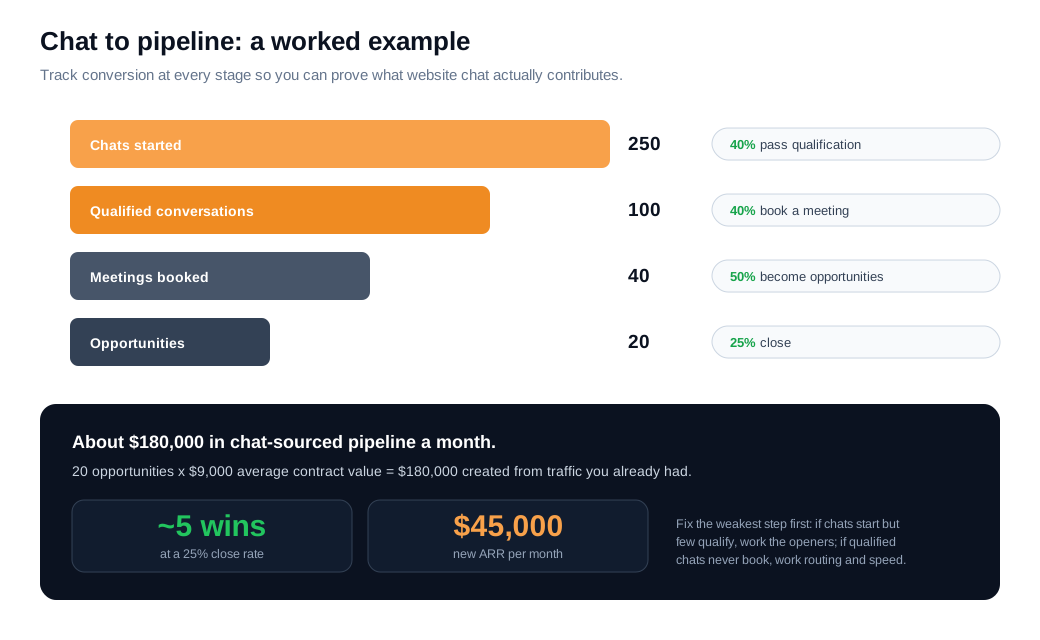
Suppose a B2B SaaS site runs chat on its pricing, product, and comparison pages and starts 250 qualifying conversations a month. If 40 percent pass a short qualification, that is 100 qualified conversations. If 40 percent of those book a meeting, that is 40 meetings, and if half of the meetings become open opportunities, that is 20 opportunities. At a 9,000 dollar average contract value, those 20 opportunities are 180,000 dollars of chat-sourced pipeline a month. At a 25 percent close rate, about 5 of them become customers, or roughly 45,000 dollars in new annual recurring revenue from traffic you already had.
The funnel makes the leak visible. If chats start but few qualify, the openers or the flow need work. If qualified chats never book, the problem is routing or response time. Fix the weak step, then look at the next one.
How do you capture buying signals in chat?
You capture buying signals in chat by reading three things together: the page the conversation starts on, the words the visitor uses, and the behavior on your site before they typed. Each raises or lowers the odds that this is a real buyer, and the combination tells you how hard to lean in.
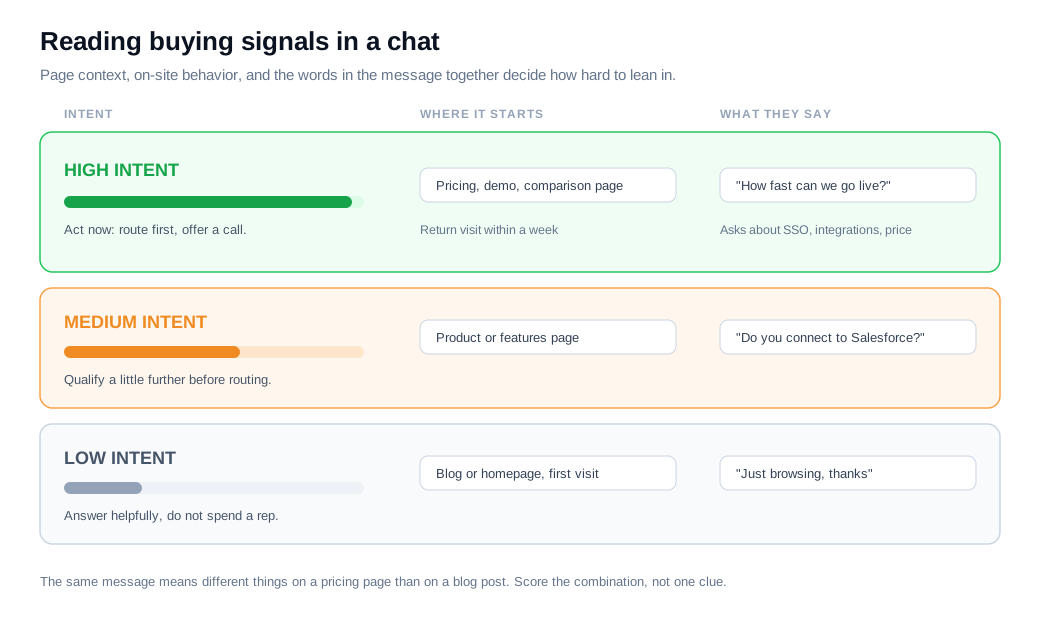
Page context is the strongest single signal. A chat that opens on a pricing, demo, or comparison page carries far more intent than one on a blog post, which is why revenue teams score pricing-page activity, demo requests, and comparison searches as high-intent buyer signals. Behavior stacks on top of that: repeat visits within a week, time on product pages, and a return from a comparison query all push a conversation up the ladder.
The language in the message is the third layer. Questions about specific features, pricing tiers, security, integrations, or implementation timelines are overt signals, because a casual reader does not ask how your API handles rate limits. Phrases like "we are currently using [competitor]" or "how fast can we go live" mark someone in active evaluation, and they deserve a faster, warmer response than a general question about what your product does.
You can work with these signals two ways. React to them, by prioritizing and routing high-signal chats first. Or trigger them, by using proactive outreach nudges that open a relevant message when a visitor lands on a high-intent page or lingers on pricing, so the conversation starts at the moment interest peaks instead of waiting for the visitor to find the widget. A signal you never act on is the same as a signal you never saw.
How do you hand chats to sales fast?
You hand chats to sales fast by qualifying in the widget, then routing the good-fit conversation to the right rep through an instant alert the moment it qualifies, ideally while the visitor is still typing. Speed is the whole game here, and the data on it is blunt.
The MIT and InsideSales.com Lead Response Management study found that contacting a lead within five minutes rather than thirty made a rep about 21 times more likely to qualify it, across six companies and more than 15,000 leads, in a widely cited analysis of lead response time. Most companies miss that window badly. A Harvard Business Review audit of 2,241 firms found an average first response of 42 hours, with 23 percent that never responded at all. Website chat has the tightest window of any channel, because a visitor who gets no reply usually closes the widget within about 30 seconds.
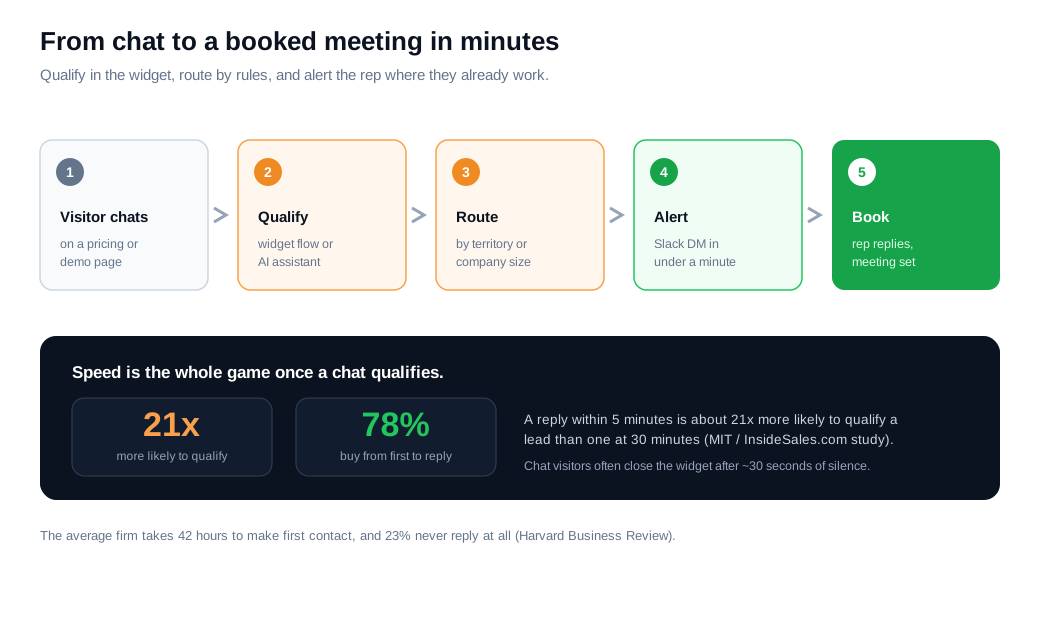
Four mechanics make a fast handoff work.
- Qualify before you route. A short flow, or an AI assistant, confirms fit so reps only get pinged for conversations worth their time.
- Route by rules. Send the conversation by territory, company size, or product line so the right rep gets it, using routing and notifications instead of a shared inbox that everyone assumes someone else is watching.
- Alert where reps already are. Push the qualified chat to a Slack channel or a direct message with a claim button, so it reaches a rep in seconds rather than sitting in an email digest.
- Offer to jump on a call. For questions text cannot resolve, let a hot visitor move straight to a live video call or screen share without leaving the page.
The payoff for closing that window is direct. Industry data widely holds that 78 percent of buyers purchase from the vendor that responds first, a figure repeated in guidance on using Slack alerts to raise speed to lead. A qualified chat that reaches the assigned rep in under a minute is the difference between that first-responder advantage and a lead a competitor answers while yours waits in a queue.
How do you attribute pipeline to chat?
You attribute pipeline to chat by tying each conversation to a CRM record and separating chat-sourced pipeline (deals the chat created) from chat-influenced pipeline (deals the chat only touched), then reporting both against revenue rather than chat volume. That distinction is what keeps the channel honest and fundable.
ZoomInfo's guidance on chatbot metrics draws the line clearly: chat-sourced pipeline, chat-influenced pipeline, and chat-sourced revenue tell you what the channel does for the business, while resolution rate and raw message counts tell you how the widget runs, a split it frames as the KPIs that actually drive pipeline. Report the first set to your revenue leaders. Keep the second set for tuning the tool.
Three habits make the reporting work in practice.
- Create or update a CRM record from the chat, so every qualifying conversation becomes a lead or contact with the source stamped as chat.
- Capture first-touch and last-touch, so a chat that opened a relationship and a chat that closed the loop both get credit under a multi-touch model instead of the last click taking everything.
- Tie the conversation to the opportunity, so when a deal reaches closed-won you can trace it back to the chat that started it.
Using the funnel from earlier, 20 opportunities a month at 9,000 dollars is 180,000 dollars of chat-sourced pipeline you can defend line by line. If chat conversations also appear somewhere in the journey of another 15 deals worth 135,000 dollars that were sourced through other channels, that 135,000 dollars is chat-influenced pipeline. Reported together, chat is accountable for real numbers rather than a vague sense that it helps. Wiring the widget into your CRM through integrations is what makes that reporting automatic instead of a monthly reconstruction in a spreadsheet.
How do you build a website-chat-to-pipeline process?
You build a website-chat-to-pipeline process by starting on your highest-intent pages, adding one qualifying conversation, routing it fast, and instrumenting each stage before you scale. This is a setup you can stand up in an afternoon and refine over a quarter.
- Put chat where intent is highest. Pricing, product, demo, and comparison pages first, and keep it off low-intent pages until the high-intent ones prove out, so every conversation is worth acting on. This matters most for inbound sales, where speed decides the deal.
- Write the openers and a short qualifying flow. A page-specific prompt for each high-intent page, plus the two or three questions that separate a buyer from a browser.
- Set routing and handoff. Decide who gets which conversation, how an assistant hands off to a human, and where the alert lands so a rep sees it in seconds.
- Staff your peak hours honestly. Cover the busy windows with real people, and let an assistant or an offline form catch the rest. A widget that promises a fast reply and then goes silent does more harm than no widget at all.
- Instrument every stage. Track chats started, qualified, meetings booked, opportunities, and chat-sourced pipeline from day one. Many tools offer a free plan so you can test the channel before you commit budget to it.
- Fix the leak, then expand. Solve the weakest step first, then add more pages once the early ones perform.
Start narrow, keep response times honest, and let the channel earn more pages once the first ones pull their weight. A website chat pipeline rewards discipline more than reach.
Key takeaways
- A website chat pipeline connects conversations to CRM stages, moving a chat through qualification, routing, and a booked meeting until it becomes a tracked deal you can measure against revenue.
- Chats become opportunities through light qualification, confirming role, company, problem, and timing in a few questions rather than a long form, then converting good-fit visitors into meetings.
- Buying signals come from three layers, the page the chat starts on, the words the visitor uses, and their prior behavior, and you score the combination rather than any single clue.
- Speed decides the handoff, since a five-minute reply is about 21 times more likely to qualify a lead than a thirty-minute one, yet the average firm still takes 42 hours to respond.
- Attribution splits sourced from influenced pipeline, stamping each conversation to a CRM record so you report chat-sourced and chat-influenced pipeline against revenue, not raw message counts.
- Start narrow and instrument early, putting one qualified conversation on your highest-intent page, staffing it honestly, measuring each stage, then expanding to more pages.

Written by
Daniel SemeckyCo-founder & CEO
Daniel is the co-founder and CEO of Glimpze. He spends his days talking to revenue teams about how to catch high-intent visitors before they bounce, and writes about inbound sales, lead conversion, and building a motion where marketing and sales actually share a number.


