
On this page
A rep blocks thirty minutes, preps the account, joins the call, and waits. The prospect who asked for the demo three days ago never joins. One empty slot is a nuisance. A pipeline full of them is one of the quietest, most expensive leaks in sales.
No-shows are also one of the most fixable problems on the board. Most of them trace back to a few causes you can control: a booking process that makes people wait, a gap that lets interest cool, and reminders that never land. Tighten those and the same pipeline produces more attended demos without adding a single lead.
This guide covers what a normal no-show rate looks like, why prospects skip demos, how scheduling speed changes show rate, which reminders actually cut no-shows, how qualification moves the number, and how to re-book the demos that slip.
What counts as a normal demo no-show rate?
Most B2B SaaS teams run demo no-show rates between 20% and 40%, so one in five to two in five booked demos quietly fall off the calendar. The exact number swings with lead source, deal size, and how the meeting was booked, which is why a single benchmark can mislead you.
Framed as show rate, the picture is clearer. Growthspree's 2026 benchmarks put the median B2B SaaS demo show rate at 55% to 65%, with top-quartile teams reaching 75% to 85% and bottom-quartile teams stuck at 38% to 48%. RevenueHero lands in the same territory, with most teams clustering around a 30% no-show rate.
Treat anything under 20% no-shows as healthy and anything over 35% as a signal that something upstream is broken, usually booking speed or reminders rather than the demo itself. The number only means something if you measure it the same way every month: attended demos divided by scheduled demos, segmented by source. Inbound demos from a high-intent inbound sales motion behave very differently from cold outbound meetings, and blending them hides the problem you actually need to fix.
Why do prospects skip demos?
Prospects skip demos for a short list of reasons, and nearly all of them come down to fading intent or a booking that was too easy to make and too easy to forget. The demo request is a moment of interest, and anything that lets that moment cool works against you.
The common causes, drawn from Walnut's breakdown of no-show behavior, look like this:
- They forgot. A calendar invite booked two weeks ago gets buried, and without a reminder it never resurfaces.
- They found an answer elsewhere. Between the request and the call they read your docs, watched a video, or booked a competitor, and the need felt less urgent.
- The booking asked for nothing. A one-click "book a demo" with no qualification pulls in curious browsers who were never close to buying.
- A real emergency or a shifting priority pushed the meeting aside.
- The demo was scheduled too far out, and by the time it arrived their attention had moved on.
- Evaluation fatigue set in. A buyer comparing five vendors and sitting through five demos starts skipping the ones that feel least relevant.
Notice the throughline: time and weak commitment. A prospect who books for tomorrow after answering one qualifying question is a different person from one who clicked a button on a whim and picked a slot ten days out. The rest of this guide works on those two levers, the wait and the commitment.
How does scheduling speed affect show rate?
The shorter the gap between a prospect raising their hand and the demo itself, the more of them show up, and the effect is large enough to dwarf most other tactics. Intent decays by the hour, so every day you add to the wait costs you attendance.
Growthspree's data quantifies the slide. Demos booked for the same day show up at 78% to 88%. Push that to one or two days out and the rate drops to 72% to 82%. Three to seven days out lands at 62% to 72%, and beyond eight days it falls to 45% to 58%. Put simply, the same prospect who is roughly 85% likely to show tomorrow is closer to 55% likely a week later. Their no-show rate climbs from about 7% same-day to 23% once the demo is more than a week out.
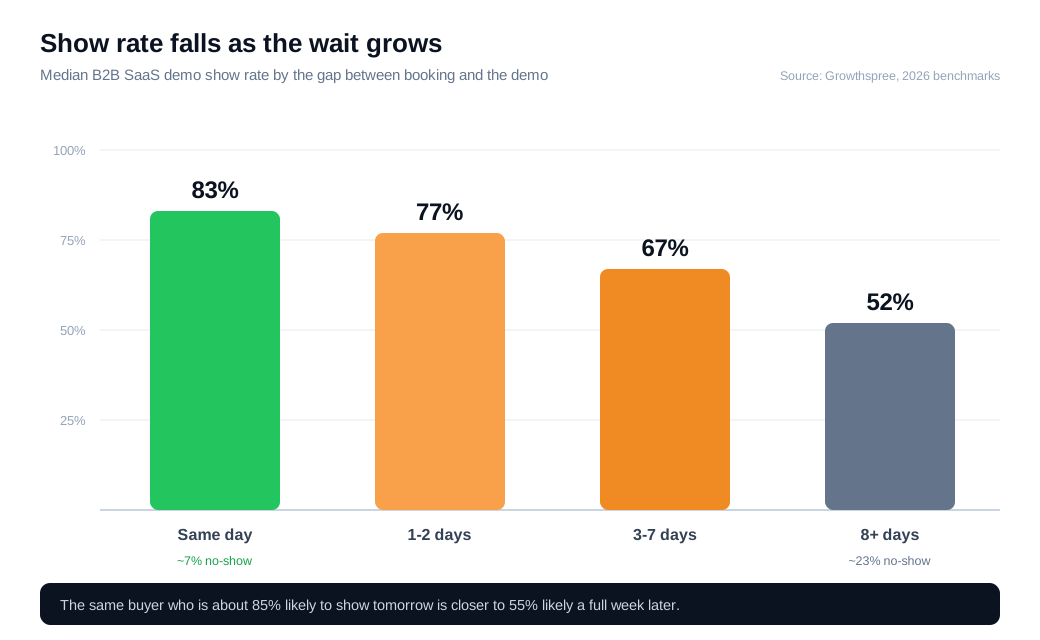
The speed-to-lead research explains why. The classic MIT and InsideSales.com Lead Response Management study, which examined more than 15,000 leads, found that contacting a lead within five minutes made a rep 21 times likelier to qualify it than waiting 30, one of many lead response studies pointing the same way. The clock that governs first contact also governs whether a booked demo survives to the calendar, because the interest that made someone request a demo does not hold at full strength for a week.
There is a cleaner fix than reminding people about a distant appointment, which is to shrink the appointment itself. Chili Piper's 2025 benchmark found that letting a qualified visitor book instantly after a form fill, rather than waiting for a rep to follow up, lifted form-to-meeting conversion from 30% to 66.7%. Some visitors do not need a future slot at all. When a high-intent visitor is already on your pricing page, starting the conversation on the spot with live video chat removes the wait entirely, and routing that request to an available rep in seconds through tight lead routing and notifications is what keeps the raised hand from going cold.
Here is a worked example. Say your team books 100 demos a month with an average five-day gap, which puts show rate near 67%, so 67 demos actually happen. Cut the average gap to same-day or next-day booking and show rate climbs to about 83%, or 83 demos. That is 16 extra demos a month from the same pipeline. At a 30% demo-to-close rate, those 16 demos are roughly 5 additional customers, won by changing nothing except how fast people get in.
What reminders reduce demo no-shows?
Well-timed reminders reduce no-shows, and the deepest body of research on the question, decades of healthcare studies, puts the effect at roughly a third. A booked demo is a promise, and a short nudge at the right moment is often all it takes to keep it.
The medical literature is worth borrowing from because it is large and controlled. A systematic review in The American Journal of Medicine found appointment reminder systems consistently cut no-show rates, and a randomized trial in a pediatric clinic saw no-shows fall from 38.1% without reminders to 23.5% with a simple text message. Those are clinic visits, not sales demos, so read the transfer as directional rather than exact. The mechanism is identical: people forget, and a reminder that reaches them fixes it.
The cadence that works for demos is short and layered, and it matches what Chili Piper and other scheduling tools recommend:
- At booking: a confirmation with the date, time, join link, a one-line agenda, and an easy reschedule option.
- 24 hours before: the most important touch. A reminder that reconfirms the time and restates, in one line, what the prospect will get out of the call. This is the moment they can flag a conflict instead of silently ghosting.
- 1 hour before: a short, personal note from the rep who will run the demo, ideally asking for a quick reply to confirm.
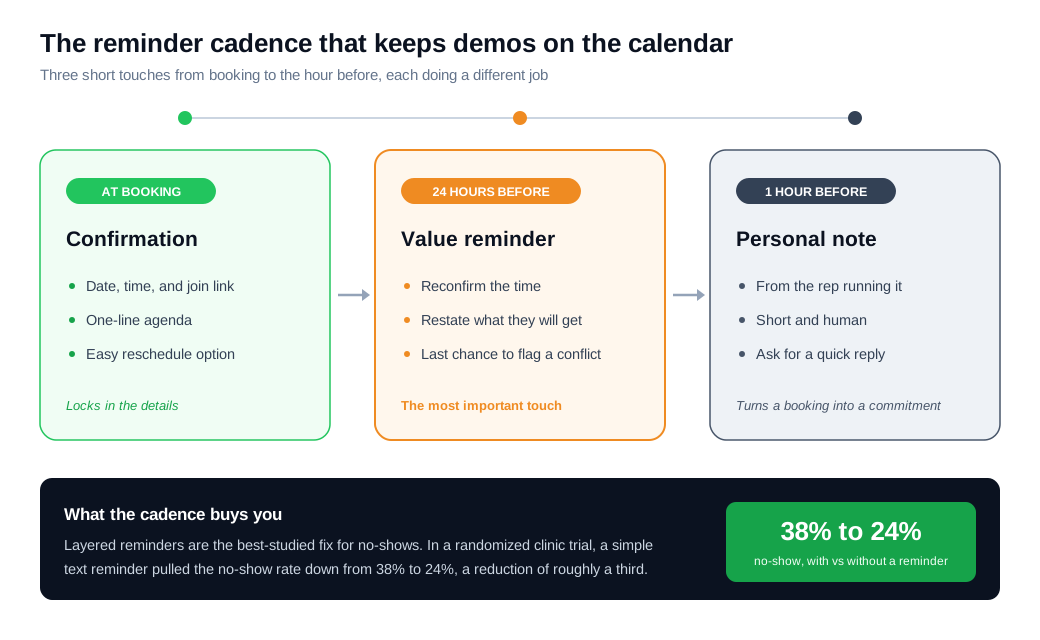
Two design choices raise the effect. Ask for a reply. A prospect who types "yes, see you at 2" has made a small commitment and is far likelier to show than one who received a silent email. And keep the value in front of them. The 24-hour reminder is a chance to re-sell the meeting rather than repeat logistics, so tie it to the specific problem they came in with. After hours, an AI chat assistant can answer the last-minute question that might otherwise turn into a quiet cancellation.
How does qualification change your no-show rate?
Qualification changes who books in the first place, so a little friction and a little value at the point of booking raise show rate by filtering out the merely curious. A frictionless "book a demo" button maximizes bookings and minimizes attendance, because it captures intent you have not yet earned.
The fix does not require a longer form. One or two questions that make the prospect articulate why they want the demo will screen out tire-kickers and prime the ones who stay. Asking for a company name, a rough team size, or the problem they are trying to solve turns a reflex click into a small decision, and a prospect who has named their own pain is invested in seeing whether you solve it.
Value works the same way. When the confirmation and the reminders speak to the specific challenge the prospect described, the demo starts to feel like an appointment about their problem rather than a generic pitch. A proactive nudge that offers a walkthrough at the moment a visitor lingers on pricing, then confirms what they want to see, does more for show rate than any number of reminders sent to a lead who booked on impulse. You will book slightly fewer demos this way, run more of the ones you book, and close more of those.
How do you re-book demo no-shows?
You re-book no-shows by reaching out within minutes, assuming good faith, and offering two specific times with a single click, and a disciplined team wins back roughly a third of them. A no-show still counts as a live lead whose meeting simply failed, and the meeting is the only thing you have to fix.
Speed matters here as much as it does on the first booking. Growthspree's recovery data found that about 30% to 35% of no-shows re-book within 48 hours when the follow-up is fast, so a team that recovers a third of its no-shows is materially more productive than one with the same show rate that writes them off. Reach out while the missed meeting is still fresh, ideally within 15 minutes.
Tone decides whether they answer. Assume the timing slipped, not that they blew you off. A message like "Looks like today did not work, totally understand, here are two times that might be easier" outperforms anything that reads as a scolding. Walnut's no-show playbook and others land on the same pattern: make rescheduling frictionless, offer concrete slots rather than a vague "let me know," and remove every extra step between the reply and a new booking.
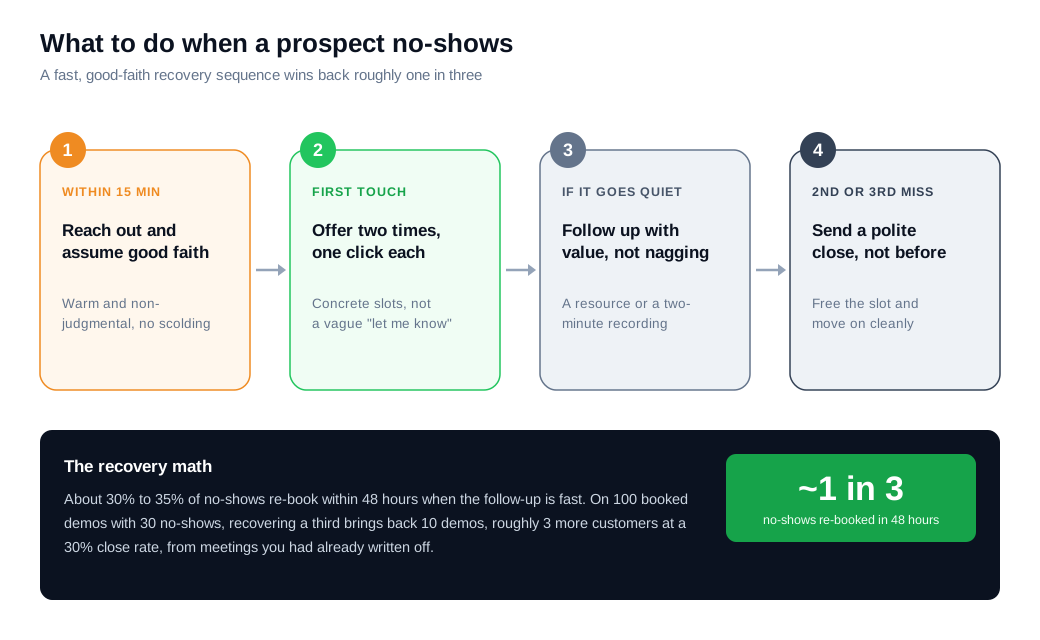
Build it as a short sequence, not a single email. The first touch, within the hour, offers two new times. If that goes quiet, the next touches add value instead of nagging, a relevant resource or a two-minute recording of the thing they wanted to see, so re-engaging feels worth their time. Save the polite breakup note for the second or third miss, not the first. Throughout, track three numbers: your no-show rate, your recovery rate, and the eventual close rate on recovered prospects. Those tell you whether the effort is paying off and where to tune it.
Here is a worked example. Take the same 100 booked demos a month. At a 30% no-show rate, 30 slip. A fast, good-faith recovery sequence that re-books 33% of them brings back 10 demos. At a 30% close rate, that is 3 more customers a month from meetings you had already written off, for the cost of a follow-up sequence you set up once.
Key takeaways
- A normal B2B demo no-show rate runs 20% to 40%. Median show rates sit at 55% to 65% per Growthspree, so treat under 20% no-shows as healthy and over 35% as a broken booking or reminder process.
- Intent cools by the day, so book fast. Same-day demos show up at 78% to 88% while demos booked eight or more days out fall to 45% to 58%, a swing worth more than any other single tactic.
- Instant booking beats a callback. Chili Piper found instant scheduling lifted form-to-meeting conversion from 30% to 66.7%, and starting a live conversation on the spot removes the wait altogether.
- Layer three reminders and ask for a reply. A confirmation at booking, a value-led reminder 24 hours out, and a personal note an hour before match the cadence that cut clinic no-shows from 38% to 24% in a controlled trial.
- Qualify a little to book better demos. One or two questions at booking screen out the merely curious and prime the buyers who stay, trading a few bookings for a higher show rate.
- Re-book fast and assume good faith. Roughly a third of no-shows return within 48 hours when you reach out within minutes, offer two one-click times, and save the breakup note for later.
TAGS

Written by
Daniel SemeckyCo-founder & CEO
Daniel is the co-founder and CEO of Glimpze. He spends his days talking to revenue teams about how to catch high-intent visitors before they bounce, and writes about inbound sales, lead conversion, and building a motion where marketing and sales actually share a number.


