
On this page
- What is sales and marketing alignment?
- Why do sales and marketing fall out of alignment?
- What does sales and marketing alignment actually look like?
- What shared metrics and SLAs keep the two teams aligned?
- How do you fix the lead handoff problem?
- How do you align sales and marketing for good?
- Key takeaways
- Sources
A record month for the marketing team can look like a disaster to the sales team. Marketing ships 500 new leads and celebrates the number in the Monday standup. Sales works the list, finds most of them are students, tire-kickers, or people who downloaded an ebook and forgot they existed, and quietly stops calling. Two weeks later marketing asks why so little pipeline closed, and sales says the leads were junk. Both teams are looking at the same 500 records and telling opposite stories.
That gap is expensive. Forrester, through its SiriusDecisions research, has found that organizations with tightly aligned sales, marketing, and product functions grow revenue about 19 percent faster and are about 15 percent more profitable than their peers. LinkedIn and Forrester have separately put the cost of misalignment across businesses in the range of a trillion dollars a year. The prize is real, and so is the waste.
This guide defines sales and marketing alignment, explains why teams drift apart, describes what alignment looks like in practice, covers the shared metrics and SLAs that hold it together, shows how to fix the handoff, and lays out how to keep the two teams aligned for good.
What is sales and marketing alignment?
Sales and marketing alignment is a shared system of goals, definitions, metrics, and communication that lets the two teams operate as one revenue engine instead of two departments that pass work over a wall. Marketing agrees on who a good lead is and how many are needed. Sales agrees on how fast and how hard it will work each one. Both are measured against the same pipeline and revenue numbers.
The word "shared" carries the weight. Alignment comes down to agreeing on a small number of specifics: the ideal customer profile, the definition of a qualified lead, the handoff rules, and the metrics that decide whether a month went well. When those are written down and both teams sign off, most of the day-to-day friction disappears.
Some people call the combined function "smarketing," a term HubSpot popularized. The label matters less than the structure underneath it. Aligned teams share a funnel, a definition of each stage, and a scoreboard. Misaligned teams share a Slack channel and a grudge.
Why do sales and marketing fall out of alignment?
Sales and marketing fall out of alignment because they are measured on different things, funded from one contested budget, and staffed by people who work in different rhythms. The friction is structural, so it keeps coming back unless the structure changes.
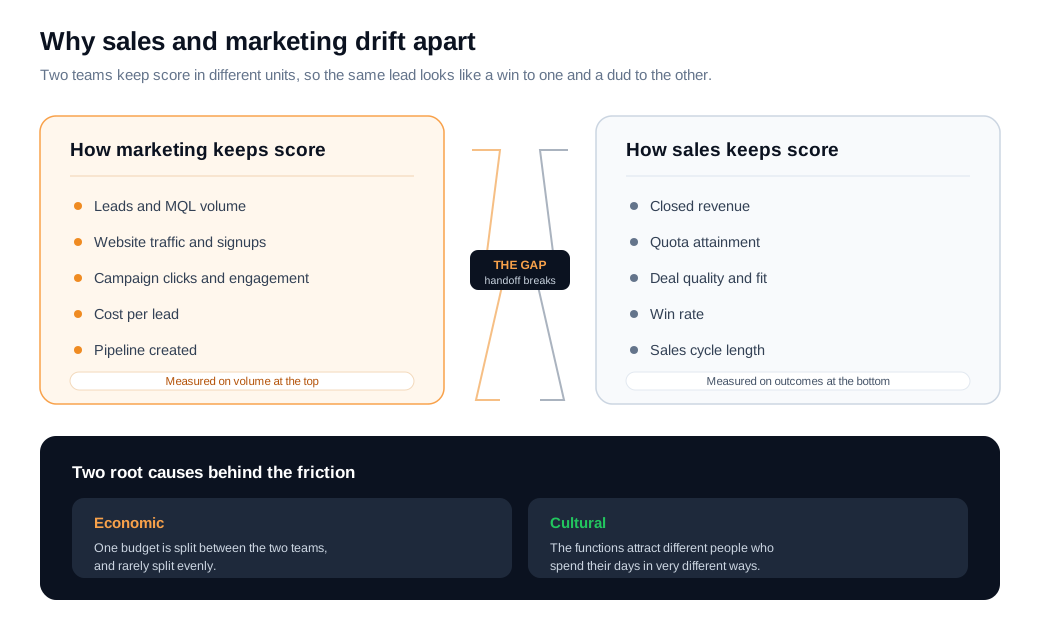
In their 2006 Harvard Business Review article "Ending the War Between Sales and Marketing," Philip Kotler, Neil Rackham, and Suj Krishnaswamy trace the conflict to two root causes. The first is economic: a single budget gets divided between the two functions, and neither side thinks the split is fair. Marketing wants more money for demand generation and brand. Sales wants more headcount and better leads. The second is cultural: the two functions attract different kinds of people. Marketers tend to be analytical and plan on a quarterly horizon. Salespeople are relationship-driven and live in a daily cycle of quota.
On top of those roots sits the metrics problem. Marketing is measured on lead volume, traffic, and cost per lead at the top of the funnel. Sales is measured on closed revenue, quota, and win rate at the bottom. A lead that marketing scores as a win can look like noise to the rep who has to call it. LinkedIn's research with Forrester reports that most sales and marketing professionals say their teams do not measure success with the same metrics, the disagreement dressed up as a dashboard.
A perception gap keeps the problem hidden. Forrester's 2024 alignment survey found that while many frontline professionals feel their sales and marketing leaders are not aligned, most C-level executives believe their teams already are. When leaders think the problem is solved and the people doing the work know better, nobody fixes it.
What does sales and marketing alignment actually look like?
Alignment looks like both teams working from one funnel, one definition of a qualified lead, and one shared view of the pipeline, with regular contact between them. You can usually spot it in a few concrete places.
Kotler and Rackham describe a spectrum of four relationship stages that helps locate where a company sits. In the undefined stage, the teams operate independently and only talk when there is a fight. In the defined stage, they have rules and a shared vocabulary, so at least they argue about the same things. In the aligned stage, they plan together and share a lead definition and process. In the integrated stage, the boundary blurs, they share metrics and budgets, and revenue is a joint result. Many companies live in "defined" and think they are "aligned."
In practice, an aligned setup has four visible traits:
- One ideal customer profile. Both teams agree, in writing, on the accounts and buyers worth pursuing, so marketing targets them and sales prioritizes them.
- One lead definition. There is a shared, specific bar for what counts as a marketing-qualified lead and a sales-qualified lead, rather than a vague "good fit."
- One pipeline view. Both teams look at the same CRM data and the same dashboard, so marketing sees what happened to the leads it sent and sales sees where its pipeline came from.
- Regular contact. A short weekly or biweekly meeting reviews the numbers, the handoff, and any leads that fell through, so problems get caught in days rather than quarters.
The clearest tell is what happens to a lead after marketing declares it ready. In an aligned team, it lands with a specific rep, gets worked on a known schedule, and its outcome is logged where marketing can see it. In a misaligned team, it drops into a shared queue and disappears.
What shared metrics and SLAs keep the two teams aligned?
The metrics and agreements that hold alignment together are a small set of shared numbers plus a written service-level agreement, or SLA, that spells out what each team owes the other. This is where good intentions become accountable.
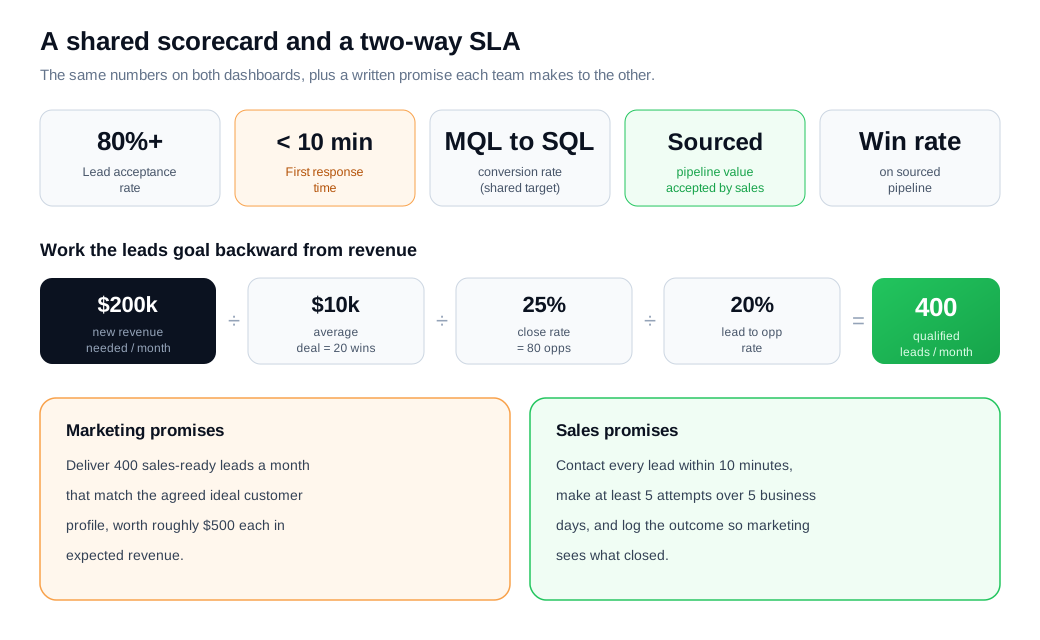
Start with the shared scoreboard. A handful of metrics matter more than the rest because both teams can see themselves in each one:
- Lead acceptance rate, the share of marketing-qualified leads that sales agrees to work. A healthy target is 80 percent or higher. A low rate is the earliest sign the lead definition is broken.
- First-response time, how long it takes a rep to reach a new lead. Aim for minutes, not hours.
- MQL-to-SQL conversion rate, the share of marketing-qualified leads that become genuine sales opportunities. Commonly cited industry benchmarks put the average around 13 percent, so a shared target above that is a real signal of quality.
- Marketing-sourced pipeline and revenue, counted in dollars that sales accepts and works, rather than raw lead counts.
- Win rate on sourced pipeline, which closes the loop between lead quality and outcomes.
The SLA turns those numbers into promises. HubSpot's version is a clean template: marketing commits to delivering a specific quantity and quality of leads, and sales commits to how quickly and how persistently it will work each one. Writing both halves is what makes it fair, because each team is now on the hook to the other.
Here is a worked example using HubSpot's method of working the leads goal backward from revenue. Suppose the business needs 200,000 dollars in new revenue a month, the average deal is worth 10,000 dollars, sales closes 25 percent of opportunities, and 20 percent of qualified leads become opportunities. To hit 200,000 dollars you need 20 new deals. At a 25 percent close rate, that requires 80 opportunities. At a 20 percent lead-to-opportunity rate, that requires 400 qualified leads a month. Divide the revenue goal by the leads and each qualified lead is worth about 500 dollars in expected revenue, which is a number both teams can respect. Marketing's side of the SLA becomes "deliver 400 leads that fit the ideal customer profile." Sales's side becomes "contact each within 10 minutes, make at least five attempts over five business days, and log the outcome."
The value of the calculation is the shared foundation it creates. Both teams now derive their targets from the same revenue goal, so the argument shifts from "your leads are bad" to "we are 40 leads short of the number we both agreed on."
How do you fix the lead handoff problem?
You fix the handoff by making it fast, specific, and closed-loop: route each qualified lead to a named rep in seconds, respond within minutes, and send the outcome back to marketing. Most pipeline leaks at this step, well below the top of the funnel.
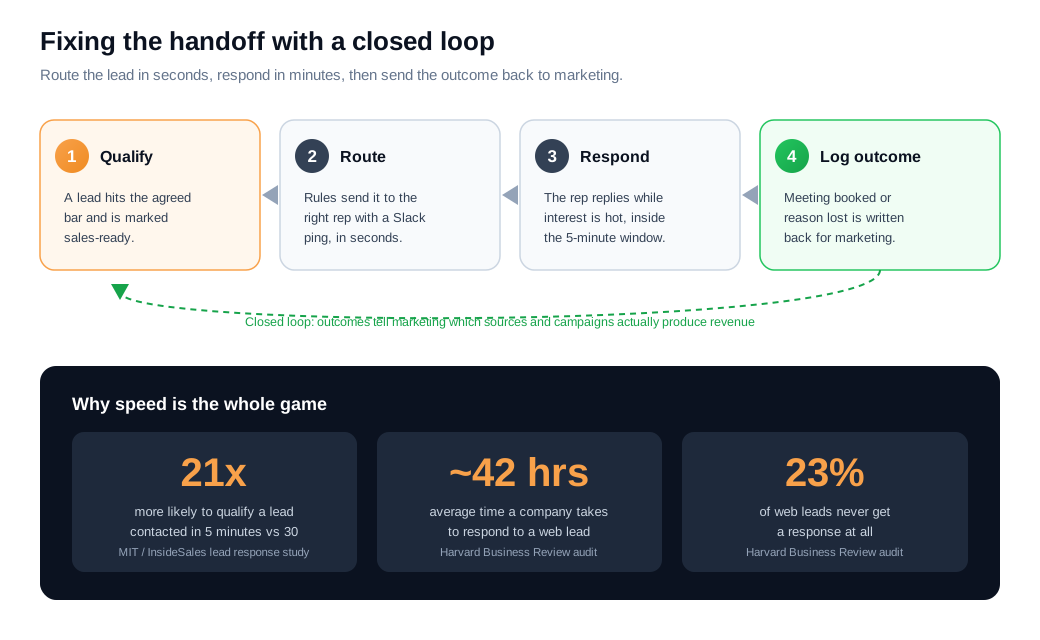
Speed is the largest lever, and the research is blunt. The Lead Response Management study led by Dr. James Oldroyd at MIT with InsideSales.com found that a lead contacted within five minutes rather than 30 was about 21 times more likely to be qualified. A Harvard Business Review audit of 2,241 companies found the average firm took around 42 hours to respond to a web lead, and 23 percent never responded at all.
Closing that gap takes three things:
- Instant routing. When a lead qualifies, a rule should assign it to the right rep by territory, product, or account, without a manager sorting a queue by hand. A lead routing and notifications setup that pings the assigned rep in Slack the moment a lead qualifies removes the minutes that kill conversion.
- A real response, fast. For high-intent moments, the strongest handoff is a live conversation while the buyer is still on the page. Tools such as live chat let a qualified visitor reach a rep in the moment, and an AI chat assistant can qualify and cover off-hours, then hand a hot lead to a human. This is the core of an inbound sales motion: catch interest at its peak instead of calling back two days later.
- A closed loop back to marketing. Every worked lead should end with a logged outcome, whether a meeting booked or a reason lost, written where marketing can see it. That feedback is how marketing learns which sources and campaigns actually produce revenue, so the next batch of leads is better than the last.
A handoff that is fast but has no feedback improves this month and nothing after it. A slow one loses the leads before any feedback matters. You need both.
How do you align sales and marketing for good?
You align sales and marketing for good by putting shared incentives, shared rituals, and shared ownership above the individual teams, so alignment survives a bad quarter or a change of managers. One-off offsites do not hold. Structure does.
Five moves make it durable:
- Tie both teams to one revenue number. When marketing's bonus depends partly on sourced pipeline that closes, and sales's targets are built from the same funnel math, the incentive to blame the other side drops. Shared goals are the foundation everything else rests on.
- Write the definitions and the SLA down, then revisit them. The ideal customer profile, the lead definitions, and the SLA should be documented and reviewed on a set cadence, because the market and the product change and a stale definition quietly rots.
- Meet on a rhythm. A short standing meeting, weekly or biweekly, where both teams review the shared metrics and walk through leads that fell through, keeps small problems small. This is the regular contact that Kotler and Rackham found separates aligned teams from merely defined ones.
- Give the funnel one owner. Many companies now put revenue operations, or a single leader over both functions, in charge of the shared data, definitions, and reporting. A neutral owner of the funnel stops the two teams from keeping separate scorecards.
- Use one source of truth. When both teams look at the same CRM and the same dashboard, the debate moves from whose numbers are right to what the numbers say. Shared data ends most of the argument on its own.
Alignment rarely fails for lack of good ideas at an offsite. It fails because nothing in the daily structure holds the two teams to the agreement once the offsite ends. Build the structure, and alignment stops being a project and becomes the default.
Key takeaways
- Alignment is shared, not friendly. Sales and marketing alignment means one ideal customer profile, one lead definition, one pipeline view, and one revenue goal that both teams own.
- The friction is structural. Different metrics, one contested budget, and different working rhythms pull the teams apart, so lasting fixes change the structure rather than the mood.
- A shared scoreboard settles most disputes. Track lead acceptance rate, first-response time, MQL-to-SQL conversion, sourced pipeline, and win rate, and both teams start arguing about the same numbers.
- An SLA turns goals into promises. Work the leads goal backward from revenue so marketing owns a lead quantity and quality and sales owns response speed and persistence.
- The handoff is where pipeline leaks. Route qualified leads in seconds, respond in minutes, and log every outcome, because a lead reached in five minutes is far more likely to qualify than one reached in 30.
- Structure keeps it aligned. Shared incentives, a standing meeting, a single funnel owner, and one source of truth outlast any single offsite.

Written by
Daniel SemeckyCo-founder & CEO
Daniel is the co-founder and CEO of Glimpze. He spends his days talking to revenue teams about how to catch high-intent visitors before they bounce, and writes about inbound sales, lead conversion, and building a motion where marketing and sales actually share a number.


