
On this page
A visitor lands on your pricing page from a comparison search, opens the plan toggle, reads it twice, and lingers over the enterprise tier. That is the strongest buying signal your website will produce all week. Then the page sits there, silent, offering a form that promises a reply within one business day.
A conversational marketing playbook is what fills that silence. It is a small, reusable flow that watches for a signal like the one above, opens a relevant message, asks a question or two, and hands a qualified buyer to a rep while the interest is still warm. Run a handful of good ones and your site starts converting attention you already paid for. Run them carelessly and you get a chat bubble that nobody staffs and everyone learns to close.
This guide covers what a chat playbook is, what belongs inside one, what triggers it, which plays convert the most, how to build and test one, how to measure it, and the mistakes that quietly waste the channel.
What is a chat playbook?
A chat playbook, the working unit of a conversational marketing playbook, is a preset conversation flow that fires on a defined trigger, opens with a targeted message, qualifies the visitor, and routes or books the ones worth a rep's time. Think of it as an if-this-then-that rule for a live conversation: when a certain visitor reaches a certain page and does a certain thing, show this message and run this flow.
The term comes from the conversational platforms that popularized the format, where a "playbook" is a single, self-contained conversation with one job. One playbook greets a first-time blog reader. Another qualifies a returning pricing-page visitor. A third re-engages a trial user who went quiet. Each has its own trigger, its own script, and its own definition of success.
A playbook and a chatbot are not the same layer. The chatbot, or the assistant, is the engine that carries the conversation. The playbook is the specific target, message, and goal you point that engine at. You can run the same AI chat assistant across ten playbooks, and each one behaves differently because the targeting and the script differ. The message can also run over live chat with a human, over an assistant, or as a proactive nudge that hands off to a rep the moment things get serious.
The reason to write playbooks down, rather than bolt a generic greeter onto every page, is that a documented play can be measured, compared, and improved. A widget that says "Hi, how can I help?" on all traffic cannot.
What should a playbook include?
A complete playbook has seven parts: a goal, an audience and targeting rule, a trigger, an opener, one to three qualifying questions, a routing rule, and a fallback for when no one is available. Skip any of them and the play tends to leak leads at exactly that step.
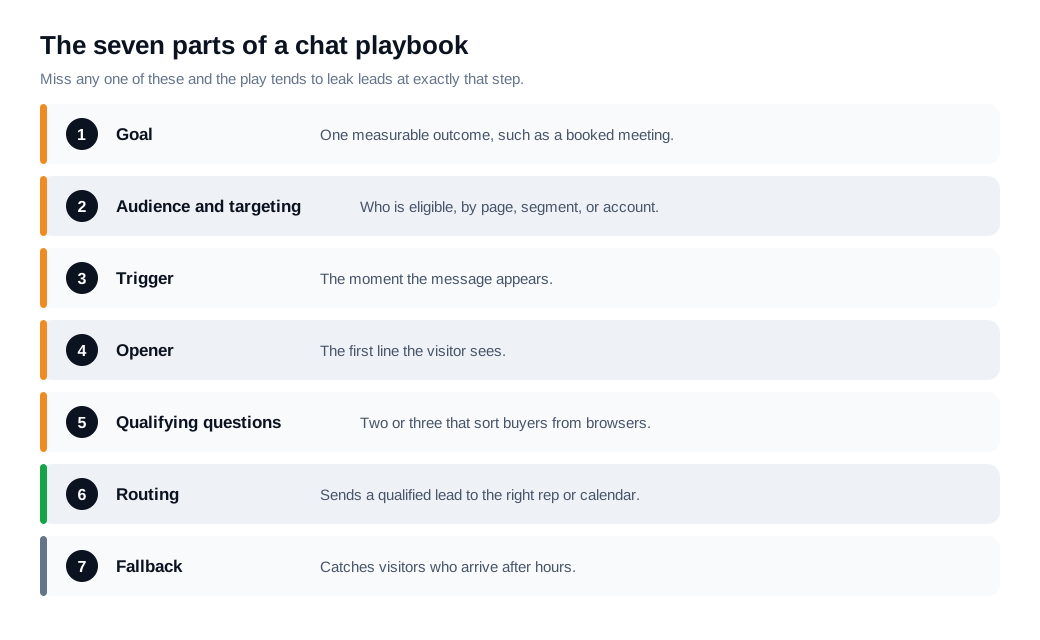
The goal is one measurable outcome, such as a booked meeting or a qualified conversation, and it keeps the play honest. The audience and targeting rule decides who is even eligible, by page, segment, or account. The trigger decides the moment the message appears. The opener is the first line the visitor sees, and it either earns a reply or gets ignored. The qualifying questions, kept to two or three, separate a buyer from a browser without feeling like a form. The routing rule sends a qualified person to the right rep or calendar. The fallback catches everyone who arrives when the team is offline, usually with an assistant or a short capture flow that sets expectations honestly.
You do not need every part perfect before launch. You need each one decided, so the play has a shape you can test instead of a vague hope that conversations will happen.
What triggers a playbook?
A playbook is triggered by a combination of signals: the page the visitor is on, what they do on that page, and, when you have the data, who they are. A trigger is the rule that decides the exact moment a message appears, and getting it right is the difference between a helpful prompt and an annoying one.
The behavioral signals are the workhorses. Dwell time fires a message after a visitor stays on a page for a set number of seconds. Scroll depth fires when they reach a specific section, like the plan comparison. Exit intent fires when the cursor moves toward the close button. Page or URL targeting limits a play to pricing, the demo request, or a single campaign landing page. A returning-visitor rule treats a second or third visit as higher intent than a first. Some setups also read high-intent language, so a question that mentions pricing, security, or a timeline escalates faster. Conversational platforms expose a deep set of these controls; Drift's own documentation lists six condition categories and more than 25 targeting conditions for shaping when a message fires.
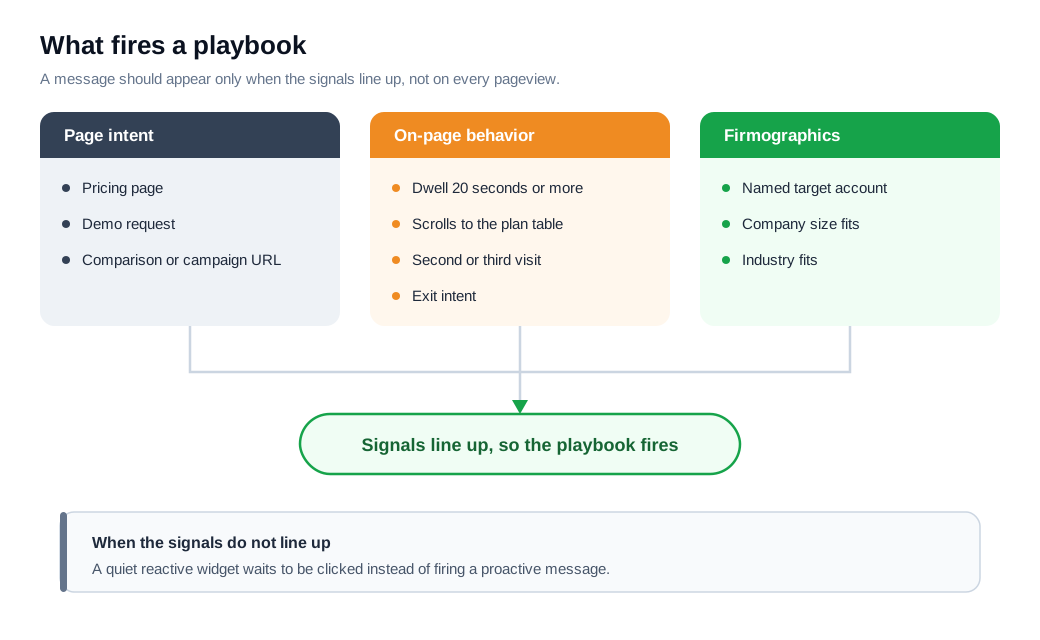
The discipline is in restraint. A prompt that fires on every page at three seconds trains people to dismiss the bubble on sight. Better triggers wait for signals to line up: a high-intent page, a behavior that shows real interest, and, if you have visitor enrichment, a firmographic fit like company size or a named target account. When those agree, a proactive message reads as timely. When they do not, a quiet reactive widget that waits to be clicked is the safer default. The guide to proactive outreach nudges covers how to set these thresholds without over-firing.
What playbooks drive the most conversions?
The playbooks that convert the most are the high-intent, decision-stage plays: the pricing-page play, the "skip the form" play on a demo request, and the returning target-account play. Salesloft, which now owns Drift, reports that in 2023 high-intent playbooks booked twice the meetings and sourced three times the opportunities of all other playbooks combined. Intent, not cleverness, is what moves the number.
Four plays earn their keep in most B2B programs. The pricing-page play fires when a visitor dwells on pricing or opens the plan comparison, then offers to answer a quick question and book time. The skip-the-form play replaces a static demo form with a short chat that qualifies and drops the visitor straight onto a rep's calendar, removing the wait a form creates. The returning target-account play greets a known or enriched account by name and routes it to the owning rep, which is the core of conversational account-based marketing. The welcome or concierge play sits on the homepage and content pages, sets a helpful tone, and points people to the right next step, though it qualifies far fewer buyers than the decision-stage plays.
A worked example shows why intent beats volume. Suppose a blog welcome play runs on 5,000 monthly content visitors. It engages 6 percent, or 300 conversations, but content readers rarely buy today, so 8 percent qualify (24) and 20 percent of those book, giving about 5 meetings. Now suppose a pricing-page play runs on just 900 visitors who dwell 20 seconds or open the plan toggle. It engages 20 percent (180 conversations), 45 percent qualify (81), and 25 percent book, giving about 20 meetings. The pricing play books roughly four times the meetings from one-fifth of the traffic, which is the pattern the Salesloft data describes.
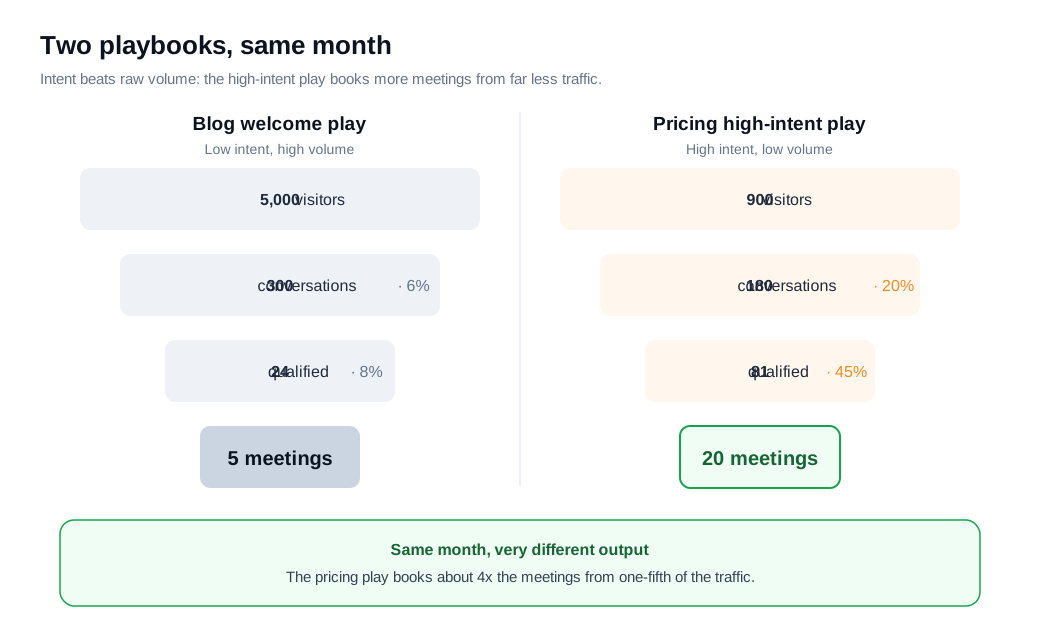
The lesson is not to drop the welcome play. It is to spend your best copy, your fastest routing, and your human coverage on the plays where good-fit buyers actually decide. A guide to welcome messages and flows helps with the top-of-funnel plays, but the decision-stage plays deserve a rep on standby.
How do you build and test a playbook?
You build a playbook by starting from a single goal on a single page, writing the trigger, opener, questions, and routing to serve that goal, then A/B testing one element at a time against a control. Building the whole program at once is how teams end up with a dozen half-tuned plays and no idea which one works.
Start narrow. Pick one high-intent page, write one goal (a booked meeting is a good first target), and set a trigger that reflects real interest rather than a pageview. Draft an opener that leads with a specific benefit or question instead of "How can I help?" Add two or three qualifying questions phrased like a helpful person, not a form. Wire the routing so a qualified lead reaches the right rep instantly through routing and notifications, because a play that qualifies a buyer and then leaves them waiting undoes its own work.
Then test. Change one variable, hold everything else steady, and split traffic between the new version and the control. The most valuable test is usually the opener: a direct question like "Comparing plans? I can help you pick one" against a menu like "See pricing," "Book a demo," or "Talk to sales." The better option depends on your audience, so you measure rather than guess. Run each test until it has enough conversations to trust, keep the winner as the new control, and move to the next variable, whether that is the trigger threshold, the number of questions, or the routing path. One clean test at a time keeps the result readable.
How do you measure whether a playbook is working?
Measure a playbook on the metrics between a conversation and revenue: engagement rate, qualified conversations, meetings booked, pipeline influenced, and win rate. Total chats started tells you the trigger is firing, and almost nothing else.
Read the numbers as a ladder. Engagement rate, the share of prompts that get a reply, tells you whether the opener and targeting are relevant. Qualified conversations tell you whether the questions are doing their job. Meetings booked and pipeline influenced are the numbers a revenue team cares about, and they require your chat tool to be connected to the CRM so a conversation can be traced to a deal. Speed sits underneath all of it. The MIT and InsideSales.com Lead Response Management study of more than 15,000 leads found that contacting a lead within five minutes rather than thirty made it about 21 times more likely to qualify, yet Drift's State of Conversational Marketing research found only 7 percent of companies respond within five minutes, and a Harvard Business Review audit of 2,241 firms put the average web-lead response at roughly 42 hours, with 23 percent never responding at all. A playbook exists to close that gap, so a play that fails to shorten time-to-response will show up in the reporting.
The direction of the channel supports leaning on an assistant for the first touch. Gartner has reported that 85 percent of customer service leaders planned to explore or pilot a customer-facing conversational generative AI tool in 2025, and predicts that by 2028 at least 70 percent of customers will use a conversational AI interface to begin a service interaction.
What mistakes should you avoid?
The most common mistakes are running a widget nobody staffs, reusing one opener on every page, asking for an email before you have helped, and counting chats instead of pipeline. Each is easy to make and expensive to leave in place.
An unstaffed play is the worst of them, because a prompt that promises a fast reply and then goes silent breaks a promise you made on the page. Cover your peak traffic with real people, let an assistant or an honest offline form handle the rest, and be clear about your hours. Reusing one generic opener wastes the targeting that makes playbooks work, so a blog reader and a pricing-page visitor should never see the same line. Demanding personal details up front pushes people to abandon the chat, so lead with value, qualify in the middle, and collect contact information only once the person has a reason to share it. And reporting success by chat volume hides whether the channel earns its place, which is why the metric that matters is meetings booked and pipeline influenced. Teams building this into a broader inbound sales motion tend to keep the channel honest precisely because they measure it against pipeline from the start.
Key takeaways
- A playbook is the working unit of conversational marketing. It is a reusable flow with one trigger, one script, and one goal, and a program is several of them, each doing a specific job.
- A complete play has seven parts. Goal, audience and targeting, trigger, opener, qualifying questions, routing, and fallback, and a leak at any step costs leads.
- Trigger on combined signals, not pageviews. Line up the page, the on-page behavior, and firmographic fit so a proactive message lands as timely rather than intrusive.
- High-intent plays convert the most. Pricing, skip-the-form, and returning-account plays booked twice the meetings and three times the opportunities of other plays, so spend your best effort there.
- Build narrow, then test one variable at a time. Start with a single page and goal, and A/B test the opener first, keeping the winner as your new control.
- Measure the ladder to revenue. Track engagement, qualified conversations, meetings, and pipeline influenced, and remember that a lead reached in five minutes is far likelier to qualify.

Written by
Daniel SemeckyCo-founder & CEO
Daniel is the co-founder and CEO of Glimpze. He spends his days talking to revenue teams about how to catch high-intent visitors before they bounce, and writes about inbound sales, lead conversion, and building a motion where marketing and sales actually share a number.


