
On this page
- What is a self-serve demo?
- What is a sales-led demo?
- How do buyer preferences differ between the two?
- Which one converts better?
- When should you lead with a self-serve demo?
- When should you lead with a sales-led demo?
- How do you offer both without making buyers choose?
- How do you measure a self-serve demo against a sales-led demo?
- Key takeaways
- Sources
A prospect opens your product page on a Tuesday night. She can click through a working version of the software right there, or she can fill out a form and wait for a rep to walk her through it on Thursday. Two paths, same product, and the one you make easy shapes who buys.
Teams keep framing self-serve and sales-led demos as rivals, when most buyers touch both inside a single purchase. A self-serve demo lets a curious researcher see the product with no form and no calendar. A sales-led demo puts a person in the room to read the buyer, tailor the pitch, and answer the objection a recording never saw coming.
This post defines each format, shows how buyer preference actually splits, covers which one converts better, when to lead with each, how to run both without forcing a choice, and how to measure the two on their own terms.
What is a self-serve demo?
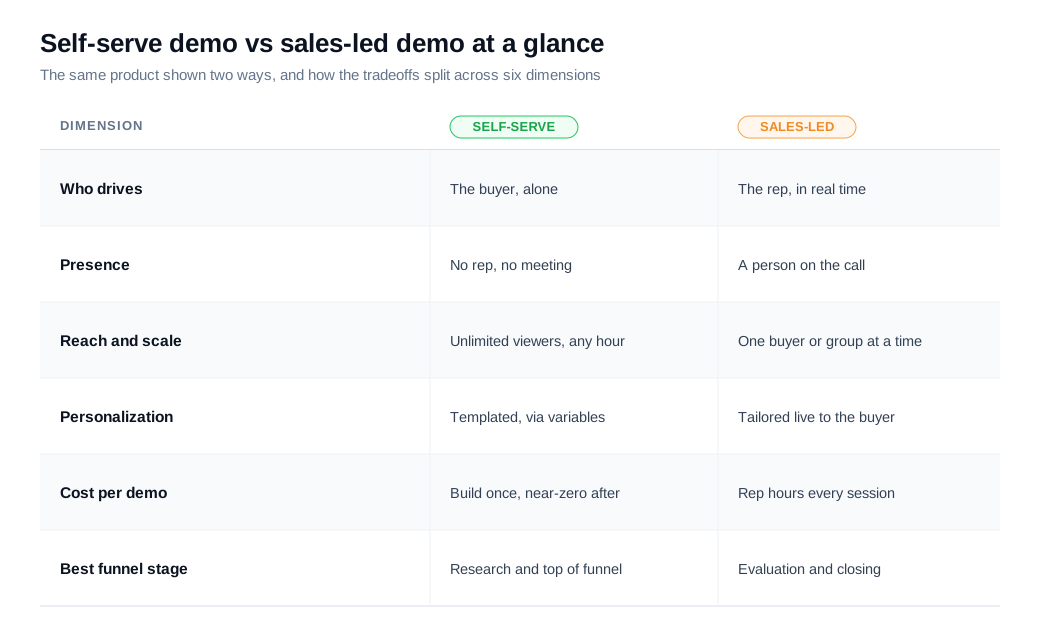
A self-serve demo is an interactive, buyer-driven product experience that a prospect explores on their own, with no rep on the call and no meeting on the calendar. Instead of watching someone share a screen, the buyer clicks real buttons, moves through real screens, and stops when they have seen what they came for.
The format spans a range. At one end sits a guided, click-through demo embedded on a website, the kind Supademo describes as a way for buyers to understand the product before they talk to anyone. Further along sits a sandbox or free trial where the buyer runs their own workflow, and newer still is an AI demo agent that answers questions as the buyer clicks. What they share is that the buyer drives. They skip ahead to the part they care about, replay a step, and leave when they are done.
Buyers move through a good one. Navattic's State of the Interactive Product Demo 2025, built on more than 28,000 demos, found the top quartile held a 50.1% engagement rate and a 28.9% completion rate, meaning half of the people who opened those demos progressed past the first step and nearly a third finished the whole path. A self-serve demo is how you show up in the research window, before a hand ever goes up.
What is a sales-led demo?
A sales-led demo is a live session where a rep walks one prospect or buying group through the product in real time, tailoring the walkthrough and fielding questions as they surface. It is scheduled, high-touch, and low-volume: one rep, one buyer or committee, thirty minutes on the calendar.
The rep does what a recording cannot. They read a buyer hesitating on price, lean into the feature that got a nod, reorder the pitch on the fly, and handle the objection that surfaces in minute nine. That live tailoring is where the format earns its cost. Gartner's research on personalization suggests demos built around a prospect's specific challenges lift conversion by up to 40%, and a live rep is where that tailoring is easiest to deliver.
The close-rate numbers reflect the high-touch nature of the format. Optifai's benchmark of 939 B2B companies puts the average demo-to-close rate at 25%, with SaaS at 30%, figures that largely describe rep-run demos given to booked prospects. A sales-led demo happens once, for the people who showed up, and it cannot run while your team sleeps. What it buys is trust and judgment at the point a deal is actually decided.
How do buyer preferences differ between the two?
Buyers overwhelmingly want to start on their own and increasingly resent a mandatory sales call, yet the same buyers make better decisions when a rep is involved later, which is the tension every demo strategy has to manage. The preference is not subtle, and the outcome data cuts the other way.
Start with the preference. Gartner's 2026 sales survey of 646 B2B buyers found that 67% prefer a rep-free experience for at least part of their journey, up from 61% in the comparable 2025 survey, and 45% said they used AI tools during a recent purchase. A self-serve demo meets that preference head-on instead of fighting it with a gated form.
Now the twist. Gartner has documented a buyer's paradox: the same self-service that buyers ask for tends to produce more purchase regret, while buyers who use supplier-provided digital tools alongside a rep are 1.8 times more likely to complete a high-quality deal. The pattern holds downstream too. A separate 2026 Gartner survey found 69% of B2B buyers still turn to a sales rep to validate AI-generated research before they trust it. Buyers want the freedom of self-serve early and the reassurance of a human before they sign.
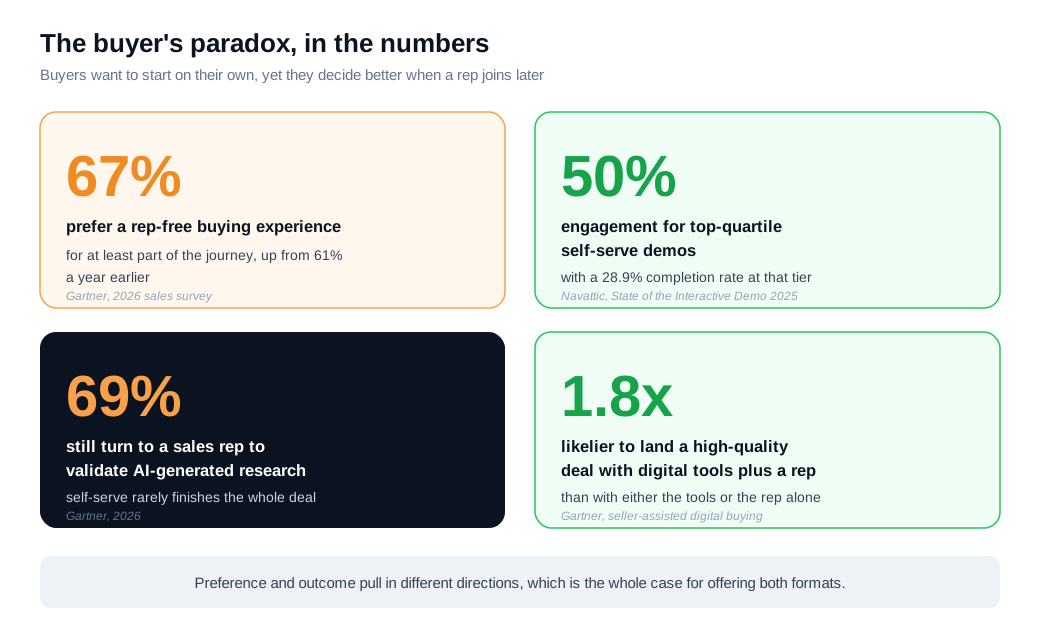
The read for a demo strategy is direct. Give the early researcher a self-serve path so you do not lose the majority who refuse to book a call to see the product, then make a rep easy to reach at the moment the decision gets real, because that is where the regret and the deal quality both live.
Which one converts better?
On raw close rate a sales-led demo usually wins, while a self-serve demo converts far more of the top of the funnel for a fraction of the cost, so the better format depends on which conversion you are counting. No single number settles it, because the two are measured at different points in the buying journey.
Close rate favors the live session. The Optifai benchmark's 30% SaaS demo-to-close rate reflects rep-run demos given to qualified, booked prospects who already raised a hand. Those are late-funnel conversions, counted at the finish line.
Self-serve demos work higher up, where a live call never reaches. In an analysis of anonymized funnels, Storylane found that prospects who engaged with an interactive demo reached a 10.1% deal conversion rate, roughly 3.2 times the 3.1% average in the sample, and that personalized demos converted 37% higher than generic ones. Read those numbers with the same care you would read any vendor benchmark, because a buyer who chooses to click a self-serve demo is already signaling intent, so some of that lift belongs to the buyer rather than to the format. The consistent pattern across the data is that sales-led wins on close rate and self-serve wins on reach, and both effects are real.
When should you lead with a self-serve demo?
Lead with a self-serve demo when you need to reach many buyers early in their research, when the product is easy to grasp at a glance, or when your price point cannot support a rep on every deal. Most of a modern B2B purchase happens before anyone raises a hand, and a self-serve demo is how you show up in that window.
The format fits a handful of specific jobs. It carries the top of the funnel, where a demo on your pricing or product page lets a researcher see the product without a form. It handles high-volume and SMB motions, where booking a live demo for every lead would swamp the team. It works across time zones and after hours, when no rep is online. And it travels, because a self-serve demo can be forwarded to the other people on the buying committee who never joined a call, which is where a lot of deals are actually settled.
Consistency is the quiet advantage. Every viewer of a self-serve demo sees your sharpest version, with the best framing and no rep having an off day. You can personalize at scale by swapping in a prospect's name, logo, or industry through variables, so one base demo renders as a tailored version per account without rebuilding anything. When buyers tell Gartner in growing numbers that they prefer a rep-free start, an ungated self-serve demo is the most direct way to give it to them.
When should you lead with a sales-led demo?
Lead with a sales-led demo when intent is high, the deal is complex or high-value, or the buyer arrives with questions and objections a self-serve tour cannot anticipate. The moment a prospect wants a real answer to a specific worry, a person beats a playback.
Complexity is the clearest case. Enterprise deals with long cycles and several stakeholders need the tailoring and trust that only a live session builds, which is why higher-value segments still lean on rep-run demos even as self-serve spreads. Demo-to-close rates tend to slide as deal size grows, so the enterprise segment is exactly where a rep's judgment earns its hour. Discovery and the closing conversation both depend on reading reactions in real time and adjusting on the spot.
High intent is the second case, and speed is why. A visitor clicking through your self-serve demo on the pricing page right now is a raised hand, and a live conversation started while the tab is still open converts better than a callback three days later. This is where a tool like live video chat earns its place, because the buyer is already interested and on the site, and a rep who joins in the moment can turn a self-guided look into a real evaluation before the buyer clicks away.
How do you offer both without making buyers choose?
You offer both by letting a self-serve demo educate and qualify the whole top of the funnel, then routing the buyers who show real intent into a sales-led conversation at the moment their interest peaks. In this design the self-serve demo does the reach and the live call does the closing, so the two reinforce each other instead of competing. This is the hybrid that McKinsey and others now call product-led sales.
A practical flow looks like this. A researcher finds a self-serve demo on your site and clicks through it without talking to anyone, exactly the rep-free start most buyers want. Their behavior, finishing the demo, revisiting the pricing page, hitting a plan limit, becomes a product-qualified signal. When that signal fires, you offer a live conversation right there and route the request to an available rep in seconds rather than a shared inbox nobody watches.
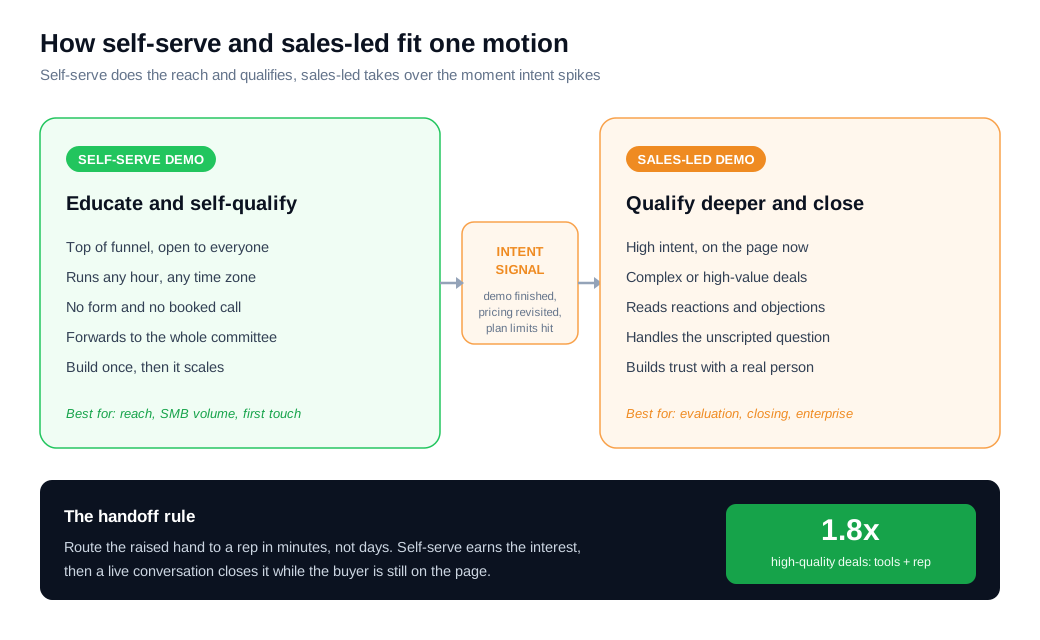
Two pieces make the handoff work. The first is fast routing, so the raised hand reaches a human while intent is still hot, which is the whole point of tight lead routing and notifications. The second is a well-timed nudge, a proactive message that appears when a visitor lingers on pricing and offers a live walkthrough, so you catch the interested buyer without making them hunt for a Contact Sales link. For teams turning site traffic into pipeline, this self-serve-to-live handoff is the spine of an inbound sales motion, and an AI chat assistant can cover the hours when no rep is online and qualify visitors before a person joins.
How do you measure a self-serve demo against a sales-led demo?
Measure them on separate scales, because a self-serve demo and a sales-led demo sit at different points in the funnel and a single blended number hides which one is actually working. One counts an early signal, the other counts a finished deal.
For self-serve demos, track engagement rate (the share who progress past the first step), completion rate (the share who finish the path), and view-to-action (the share who take a next step such as a trial, a booking, or a form fill). For sales-led demos, track show rate (booked demos that actually happen) and demo-to-close (customers divided by demos delivered). Comparing a self-serve view-to-action directly against a live close rate is a category error, because one is a much earlier measurement than the other.
Here is a worked example. Your product page draws 2,000 visitors a month. You embed an ungated self-serve demo, 25% click into it, about 500 buyers, and at the top-quartile 28.9% completion roughly 145 finish the whole tour. Say 12% of those finishers raise a hand for a live walkthrough, about 17 booked sales-led demos, which your reps close at the SaaS-typical 30%, or 5 new customers. Separately, your outbound team books 40 cold sales-led demos in the same month and also closes 30%, or 12 customers. On close rate the sales-led path looks far stronger, 30% against the self-serve demo's roughly 1% view-to-customer rate. But the self-serve layer educated 500 people for the cost of building the demo once, fed your reps 17 warm demos that tend to close higher than cold ones, and did it all while the team slept. Judge by close rate and the sales-led demo wins. Judge by pipeline created per rep-hour and the self-serve demo is doing work the calendar never could.
Whichever rate you optimize, segment the result by whether the buyer saw a self-serve demo first, because the self-serve-then-live path usually closes at a different rate than a cold sales-led demo, and that difference is the case for running both.
Key takeaways
- Self-serve wins on reach, sales-led wins on close rate. Optifai puts SaaS demo-to-close near 30% for rep-run demos, while self-serve demos convert far more of the funnel for the cost of building them once.
- The buyer's paradox is the whole story. Gartner found 67% of B2B buyers prefer a rep-free experience, yet buyers who pair digital tools with a rep are 1.8 times likelier to land a high-quality deal and 69% still validate their research with a human.
- Lead with self-serve up top. A self-serve demo carries the research window, SMB volume, after-hours traffic, and the committee members who never join a call, and it gives buyers the rep-free start they now expect.
- Lead with sales-led on complexity and intent. Enterprise deals and high-intent visitors need the tailoring, trust, and real-time judgment that only a live session delivers.
- Offer both and obsess over the handoff. Let a self-serve demo qualify the top of the funnel, then route the raised hand to a rep in minutes so self-serve never dead-ends in a contact form.
- Measure the two separately. Track engagement, completion, and view-to-action for self-serve, show rate and demo-to-close for sales-led, and compare the self-serve-then-live path against a cold demo before you call a winner.
TAGS

Written by
Daniel SemeckyCo-founder & CEO
Daniel is the co-founder and CEO of Glimpze. He spends his days talking to revenue teams about how to catch high-intent visitors before they bounce, and writes about inbound sales, lead conversion, and building a motion where marketing and sales actually share a number.


