
On this page
Two reps get the same lead. The first asks what problem the buyer wants to solve, then maps a product to it. The second asks about the buyer's business before saying a word about what they sell. Both want to help, and both can win.
They are running different playbooks, and the names for those playbooks, solution selling and consultative selling, get thrown around as if they are interchangeable. They overlap heavily. They are also distinct, and the distinction matters most when the deal is large and several people have to agree before anyone signs.
This guide covers how solution selling works, how consultative selling differs, whether the classic form of solution selling is dead, which approach fits complex B2B deals, when to use each, and how to blend them into one motion.
What is the difference between solution selling and consultative selling?
The core difference is scope. Solution selling starts from a defined problem and maps your product to it. Consultative selling starts from the buyer's whole situation and treats the recommendation, which can include "do nothing yet," as the output of a diagnosis rather than the goal of the call.
Put another way, solution selling is anchored to your catalog. The rep's job is to connect a customer pain to something in the product line and show why that thing removes the pain. Consultative selling is anchored to the buyer. The rep acts as an advisor first, and the sale is a byproduct of good advice. Many practitioners describe solution selling as a subset of the broader consultative approach, which is why the two blur together in practice.
The clearest way to hold both in your head is side by side.
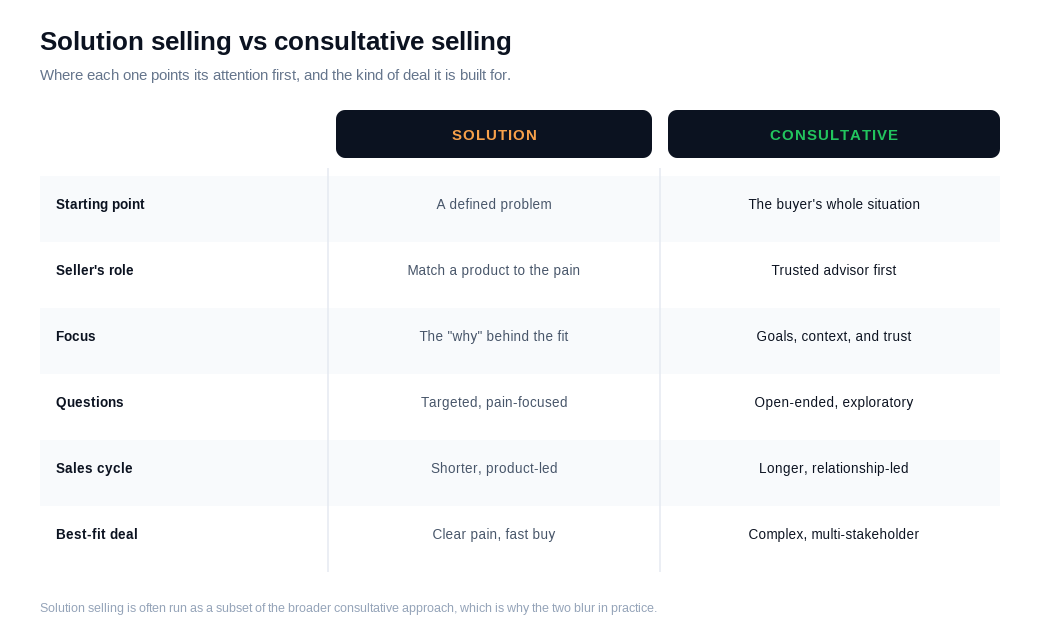
Neither is a script. Both reward preparation and real curiosity. The difference is where you point that curiosity first: at the problem, or at the person and the business around it.
How does solution selling work?
Solution selling works by uncovering a customer's specific pain, then positioning your product as the fix for that pain instead of leading with a feature list. The seller sells the "why" behind a purchase, not the "what" of a spec sheet.
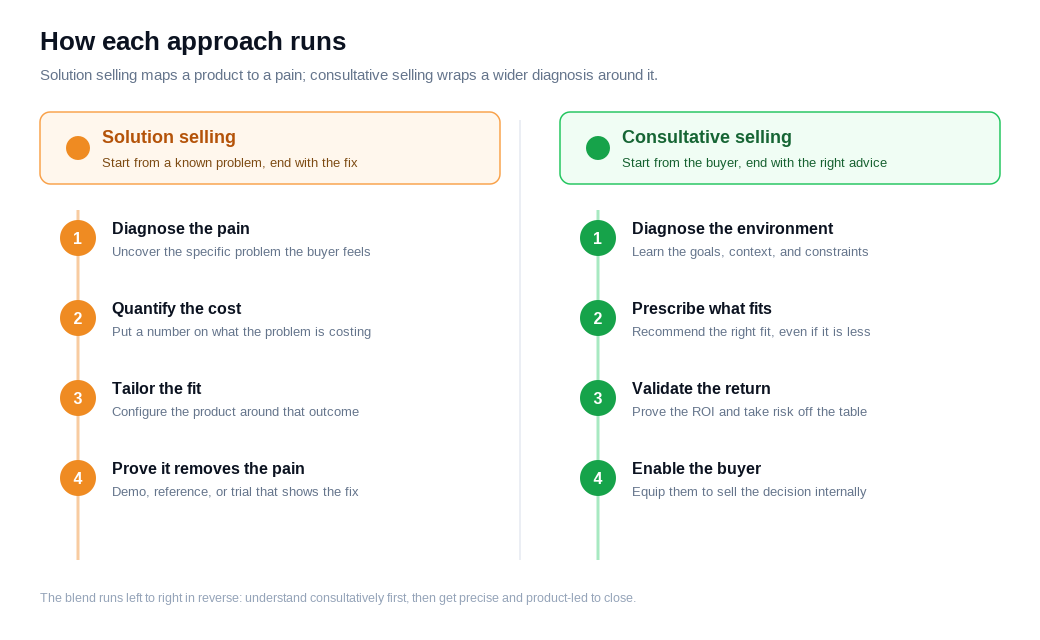
The method was coined in the late 1970s by Michael Bosworth and spread through the 1980s and 1990s as products got more complex and buyers needed help connecting features to outcomes. A typical solution-selling sequence runs in four moves: diagnose the pain, quantify what it costs the buyer, tailor a configuration that removes it, and prove the fix with a demo, a reference, or a trial. Salesforce frames it as identifying and solving business challenges rather than pushing products, and that reframing is the whole point.
A concrete version helps. A buyer says their team keeps missing renewal dates. A feature-led pitch lists calendar integrations and reminder settings. A solution-led pitch first works out that missed renewals cost this buyer roughly $40,000 in lapsed contracts last year, then ties one workflow to erasing that number. The product is identical in both pitches. The framing is what moves the deal.
Done well, solution selling keeps the conversation on the buyer's outcome. Done badly, it becomes feature-matching with extra steps, where the rep hears one keyword, reaches for the nearest product, and stops listening.
How does consultative selling differ?
Consultative selling differs by widening the lens from a single stated problem to the buyer's entire context, and by building trust before building a case for the product. It rests on a simple premise: people extend more credibility to an advisor than to a salesperson.
In practice that means more research and more listening up front. The consultative rep studies the account, runs a discovery conversation built on open-ended questions, and works to understand goals, constraints, and how the buyer defines success before proposing anything. Zendesk describes the approach as leading with the customer's needs rather than the product, and Revenue.io frames the whole method around the trust an advisor earns and a salesperson has to work for.
A useful way to see the consultative arc is as four activities: diagnosis (understand the environment), prescription (recommend what actually fits, even if it is less than the buyer expected to spend), validation (prove the return and remove risk), and enablement (equip the buyer to sell the decision internally). That last step, enablement, is where consultative selling pulls away from solution selling, because it accepts that the rep is often absent when the real decision gets made.
The questions give the game away. A solution-focused rep asks what problem the buyer is trying to fix. A consultative rep asks that too, then keeps going: what happens if you do nothing, who else feels this pain, and how will you know it worked. The answers reshape the recommendation, and they sometimes reveal that the stated problem is a symptom of a bigger one the buyer had not named.
Is solution selling dead?
Solution selling is alive and well, but the narrow version of it, where a rep extracts a stated need and matches a product to it, has lost ground. That was the argument CEB made in the widely read 2012 Harvard Business Review article, "The End of Solution Sales."
The authors, Brent Adamson, Matthew Dixon, and Nicholas Toman, made a specific claim: buyers used to need reps to define solutions, but sophisticated procurement teams and easy access to information mean many buyers can now define solutions on their own. Their prescription, which became the Challenger Sale, was for reps to teach buyers something new about their own business and challenge how they had framed the problem. The piece drew heavy criticism from people who felt it caricatured what good solution selling always did, and that debate is worth reading on its own.
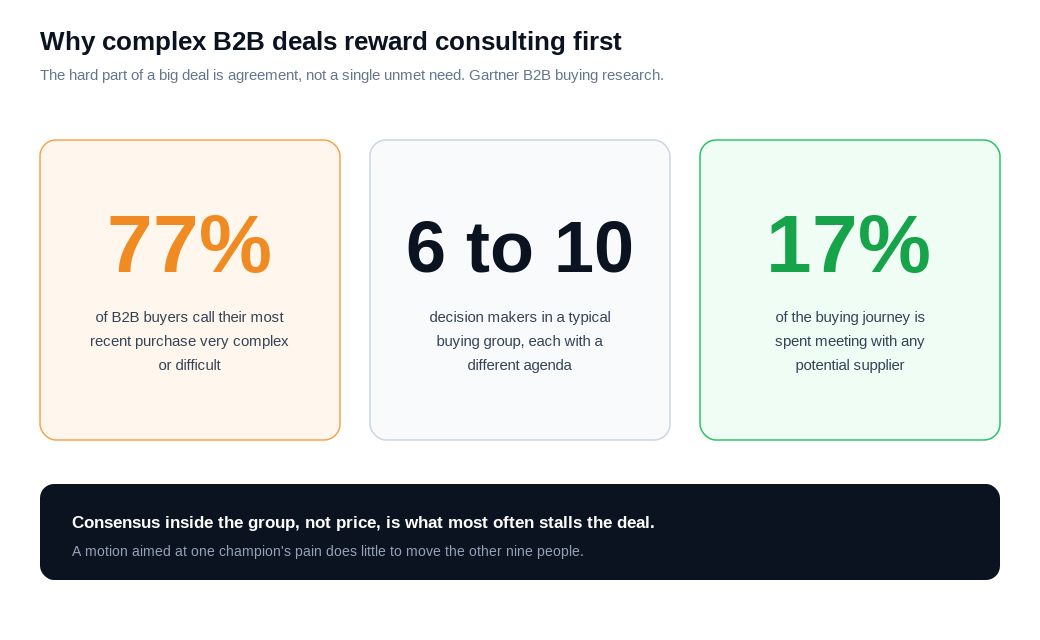
Two things are true at once. Buyers do arrive further along than they used to. Gartner's B2B buying research finds that buyers spend only about 17% of the entire journey meeting with any potential supplier, spread across every vendor they consider. And yet the discipline of diagnosing pain has not gone anywhere. What changed is that a rep who only surfaces a stated need, and adds no perspective the buyer could not get from a search engine, has very little to offer.
Which approach fits complex B2B deals?
Consultative selling fits complex B2B deals better, because the hard part of those deals is rarely a single unmet need. The hard part is getting a group of people with different priorities to agree.
The data is blunt about how hard that has become. Gartner reports that 77% of B2B buyers describe their most recent purchase as very complex or difficult, and that a typical buying group now runs to six to ten decision makers, each arriving with their own information and their own agenda. Consensus inside that group, rather than price, is the most common thing that stalls a deal. A solution-selling motion aimed at one champion's pain does little to move the other nine people.
Here is what that looks like with numbers.
A team is buying a $60,000-per-year analytics platform. The buying group is eight people: a VP of operations who champions it, a data lead, two analysts, someone from finance, an IT security reviewer, legal, and the CFO who signs. A pure solution-selling rep nails the data lead's pain, dashboards that take three days to build, and sends a strong proposal. The deal then sits for four months, because finance cannot see the return and security has unanswered questions. A consultative rep spends the first two calls mapping who has to say yes and what each person cares about, then builds a one-page business case finance can forward, hands security a pre-filled questionnaire, and gives the champion the language to defend the decision. Same product, same price, and the second deal closes in nine weeks because the rep sold to the group instead of to one person.
None of this means solution selling has no place in a complex deal. The product-mapping simply happens after the consultative work of understanding the group, rather than in place of it.
When should you use each approach?
Use solution selling when the buyer already knows their problem and the purchase is fast and product-led; use consultative selling when the problem is fuzzy, the stakes are high, and several people have to be convinced. The deciding factors are how well-defined the pain is, how big the deal is, and how many people touch the decision.
Short, transactional purchases in a category the buyer already understands reward a crisp solution-selling motion. The buyer has diagnosed themselves, and a fast, precise match is exactly what they want. Piling on discovery questions there just slows things down.
High-value, multi-stakeholder, ambiguous purchases reward the consultative arc, because the buyer needs help framing the problem and building internal agreement more than they need another feature demo. The bigger the check and the longer the list of approvers, the more the consultative work pays for itself.
Plenty of deals sit in the middle, where the buyer half-knows the problem. There the move is to open with a few consultative questions to confirm the diagnosis, then switch quickly to a solution-led demo once the pain is clear. Reading which mode a given deal needs is most of the skill.
Inbound shifts the timing more than the choice. When a high-intent visitor lands on your pricing page, they have often already self-diagnosed, so a quick, solution-oriented conversation converts better than a long discovery script. Catching that moment is the whole idea behind live chat on a high-intent page, and it is why fast, in-context conversations sit at the center of a modern inbound sales motion. The larger and more complex the deal, the more that first quick exchange is only the opening of a longer consultative relationship.
How do you blend both approaches?
You blend them by wrapping a consultative frame around a solution-selling core: diagnose the whole situation first, then get specific and technical about the product that removes the pain. The sequence is what makes it work.
Early in the deal, lean consultative. Research the account, run real discovery, map the buying group, and where you have genuine expertise, challenge how the buyer has framed the problem. Once you understand the situation and the people, shift toward solution selling: configure a precise fit, quantify the return, and prove it with references and a trial. Most modern methodologies, from Challenger to MEDDIC, are hybrids that formalize this exact hand-off between understanding and prescribing.
The channel you use shapes how well the blend holds up. Consultative selling depends on catching the buyer while their attention is on the problem, and a form that promises a reply within a day is the wrong tool for that. A brief, well-timed nudge or a live conversation at the moment of peak intent, the kind covered in a proactive outreach playbook, gives the consultative work somewhere to happen before the window closes. Start by understanding, finish by prescribing, and let the size and complexity of the deal decide how much of each the buyer actually needs.
Key takeaways
- Scope is the real difference. Solution selling maps a product to a stated pain; consultative selling diagnoses the whole situation and treats the recommendation as advice.
- Solution selling still works, in its place. The narrow "hear a need, match a product" version lost ground after 2012, but disciplined pain diagnosis remains essential.
- Complex B2B deals favor the consultative approach, because 77% of buyers call these purchases difficult and six to ten people have to agree.
- Match the method to the deal. Fast, self-diagnosed purchases reward solution selling; high-stakes, multi-stakeholder deals reward consulting first.
- Blend by sequence. Open consultative to understand the buyer and the group, then get precise and product-led to close.
- Timing beats technique. Catch the buyer while their attention is on the problem, or the best method in the world arrives too late.
TAGS

Written by
Daniel SemeckyCo-founder & CEO
Daniel is the co-founder and CEO of Glimpze. He spends his days talking to revenue teams about how to catch high-intent visitors before they bounce, and writes about inbound sales, lead conversion, and building a motion where marketing and sales actually share a number.


