
On this page
Every sales rep works the same constraint: a finite number of hours and a queue that is always longer than the day. Two hundred names might sit in that queue on a Monday morning, and only a handful will ever become revenue. The rep who treats all two hundred as equal is quietly choosing to give the same effort to a curious blog reader and a buyer who requested a demo an hour ago.
That choice is expensive. Warm and cold leads convert at rates that differ by roughly an order of magnitude, so the order in which you work them changes your numbers more than almost any subject line or script. Getting prioritization right is the difference between a pipeline that compounds and one that leaks.
This guide covers what actually separates a warm lead from a cold one, how to score and rank them, what outreach fits each temperature, how to warm cold leads up over time, and when a cold lead still deserves your attention.
Warm leads vs cold leads: what's the difference?
A warm lead has already engaged with your business and shown some intent, while a cold lead has no relationship with you and little or no awareness that you exist. That one distinction, engagement, drives almost everything else about how you should treat them.
Cold leads are prospects who fit your ideal customer profile but have not raised their hand. They might match your target industry, company size, and role, yet they have never visited a meaningful page, opened an email, or asked a question. They may genuinely need what you sell and still have no idea who you are. Per EverQuote's breakdown, a cold lead is someone who has had no prior interaction with your brand.
Warm leads have taken an action that signals interest: visiting several pages, downloading a guide, subscribing to a newsletter, replying to a message, or attending a webinar. They know your name and they are weighing whether you can solve their problem.
Most teams add a third tier on top. A hot lead is a warm lead who has started buying behavior: requesting a demo, asking about pricing, or bringing a decision-maker into the conversation. It helps to picture the three as one spectrum of intent rather than three sealed boxes.
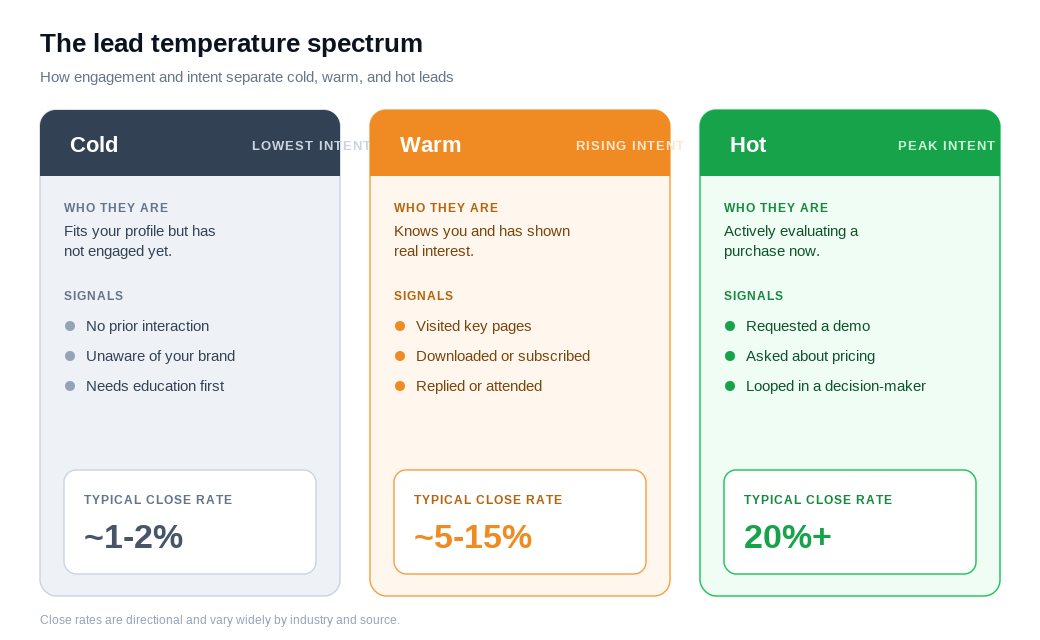
The gap in outcomes is large. One widely cited figure puts the close rate for search-driven warm leads near 14.6% against roughly 1.7% for cold outbound leads, a comparison repeated across sales resources like LiveAgent. Warmer leads also move faster: analyses of B2B pipelines commonly find warm-sourced deals closing in 30 to 60 days versus 90 to 180 days for cold. Treat the exact percentages as directional, since they swing hard by industry, but the shape holds everywhere: engagement predicts conversion.
How do you score and prioritize warm and cold leads?
You prioritize leads by scoring them on two dimensions, fit and behavior, then working the highest scores first. Fit is who they are: job title, industry, company size. Behavior is what they have done: pages viewed, emails opened, demos requested. A composite of the two predicts conversion better than either one alone.
The common structure is a 0 to 100 model. You assign points for fit signals and behavior signals, then set thresholds that map to a specific action.
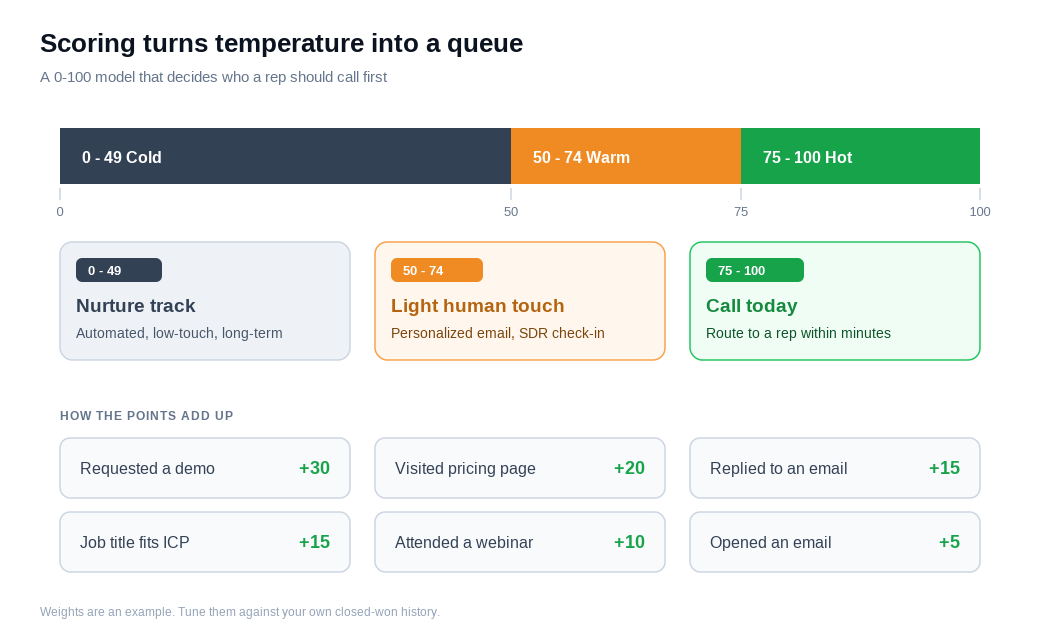
A workable starting model: give a demo request 30 points, a pricing-page visit 20, an email reply 15, a matching job title 15, a webinar attendance 10, and an email open 5. Then draw two lines. Below 50 is cold and goes to nurture. From 50 to 74 is warm and gets a light human touch. From 75 up is hot and a rep calls the same day.
This ties directly to the marketing-to-sales handoff. A marketing qualified lead (MQL) has engaged enough to be worth nurturing; a sales qualified lead (SQL) has shown buying signals a rep should act on. HubSpot notes that the shift from MQL to SQL happens when a prospect asks about pricing, timelines, or implementation. Only a minority of MQLs, often cited around 13%, ever cross into SQL, which is exactly why scoring earns its keep: it stops reps from burning hours on leads that are not ready.
Here is the prioritization math on a month of 1,000 leads. Say 700 score as cold, 250 as warm, and 50 as hot. If cold convert at 1.5%, warm at 8%, and hot at 22%, that works out to about 10, 20, and 11 customers, or 41 in total. Now suppose one rep has time for 150 real conversations that month. Spend all 150 on the 300 warm and hot leads and you touch nearly every high-probability buyer. Spread the same 150 evenly across all 1,000 and most of the effort lands on the 700 that were never close. Same traffic, same headcount, very different revenue, decided entirely by order of operations.
What outreach works for warm vs cold leads?
Match the outreach to the temperature: cold leads need education and permission, warm leads need relevance and help, and hot leads need speed. A cold script wastes a hot lead's intent, and a hot pitch gets a cold lead to ignore you.
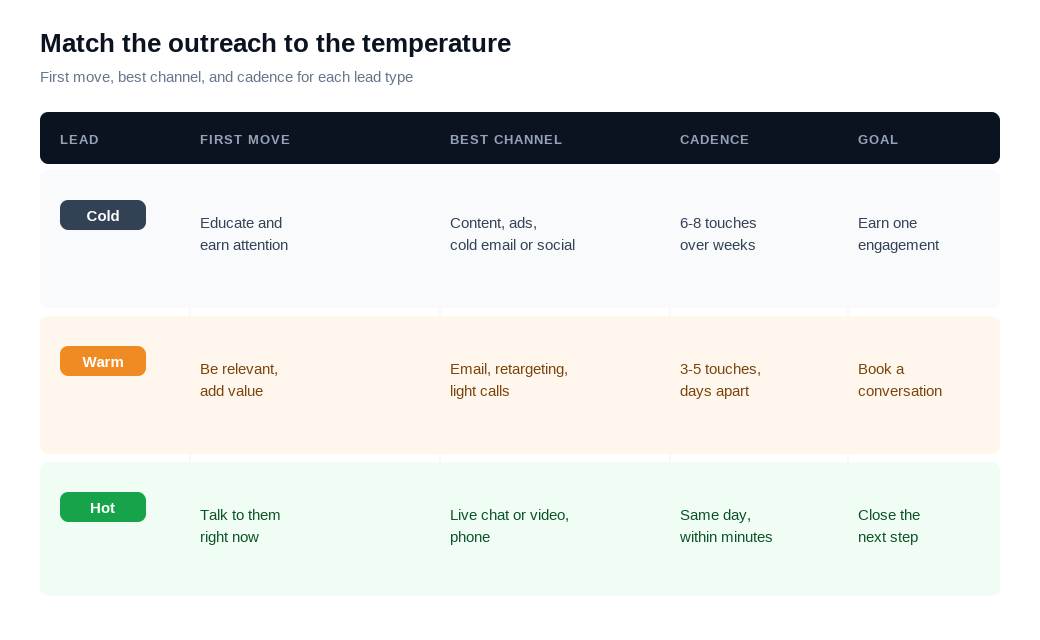
For cold leads, the goal of the first touch is a single engagement rather than a sale. That means value-led content, retargeting ads, and short, specific cold emails or social messages that earn attention. Volume and patience matter here. Cold email reply rates have fallen to around 3 to 5% on average, with well-targeted campaigns reaching 8 to 15% (per Martal's 2026 benchmarks), and most replies only come after several follow-ups. So a cold sequence is built to run four to eight touches over weeks, each one adding a fresh reason to pay attention.
Run the math and the case for patience gets concrete. Send 1,000 cold emails at a 4% reply rate and you get 40 replies. If a quarter of those turn into a real conversation, that is 10 conversations from 1,000 sends. The same effort aimed at 250 warm leads, where reply rates commonly run 10 to 30%, produces far more conversations from a fraction of the volume. That is the whole argument for prioritization in one calculation.
For warm leads, drop the pitch and be useful. They already know you, so reference what they engaged with, answer the question they seem to be asking, and offer a next step that fits their stage: a relevant case study, a short call, an invitation to a live session. Three to five well-timed, personalized touches usually beat a long automated drip.
For hot leads, the only tactic that matters is speed. When someone is on your pricing page or has just asked for a demo, a same-day email is already slow. The strongest response is a real conversation while intent is still peaking, which is why a fast inbound sales motion routes hot leads to a person immediately instead of dropping them into a queue.
How do you convert cold leads into warm ones?
You convert cold leads into warm ones by earning repeated, low-pressure engagement over time, until they know you and trust you enough to raise their hand. This is lead nurturing, and it runs mostly on consistency and relevance rather than persuasion.
The mechanics are straightforward. Deliver useful content on the channels your prospects already use, personalize it to their role and problem, and keep showing up without asking for the sale on every touch. It commonly takes six to eight touches to turn genuine cold outreach into a lead worth passing to sales, so a real nurture program is measured in weeks and months, not days.
The payoff is well documented. Companies that nurture well generate 50% more sales-ready leads at 33% lower cost, according to Forrester research cited by HubSpot, and nurtured leads tend to make larger purchases than leads that were rushed. The purpose of nurturing is to move a cold contact up the temperature scale so that by the time a rep engages, the lead is already warm.
Watch closely for the moment a nurtured cold lead heats up. A prospect who suddenly visits your pricing page three times, forwards an email internally, or replies with a real question has just crossed a line. That behavior should trip your scoring model and pull them out of the slow nurture track into fast, human follow-up. Catching that transition quickly is where a lot of pipeline is won or lost.
Are warm leads always better than cold leads?
No. Warm leads convert more efficiently, but a pipeline built only on inbound warmth will cap your growth and hand your best accounts to whoever is willing to reach out first. Cold leads are how you reach buyers who are not searching yet, including the large enterprise accounts that rarely fill out a form.
Warm leads carry a hidden ceiling: you mostly get the demand that already exists. If you sell into a new category, or you want a specific list of named accounts, waiting for those buyers to warm up on their own is not a plan. Cold outreach lets you choose your targets and create demand rather than only capturing it.
The practical answer is to run both and let them feed each other. Cold outreach and content create the awareness that produces tomorrow's warm leads; warm inbound lowers your blended cost and proves which messages resonate. Prioritization governs sequence and effort, so warm and hot leads get worked first and fastest while cold leads run on a longer, cheaper, mostly automated track in the background.
How do you keep warm leads from going cold?
You keep warm leads warm by shortening the time between the moment they show intent and the moment they reach a person. Intent is perishable. A lead who is hot on Tuesday afternoon is often just a name in a CRM by Thursday, and the usual culprit is a slow, form-and-wait follow-up process.
The evidence on response time is stark. Harvard Business Review's study "The Short Life of Online Sales Leads" found that firms contacting a prospect within an hour were nearly seven times more likely to have a meaningful conversation with a decision-maker than those that waited even 60 minutes. The Lead Response Management study found the odds of qualifying a lead drop sharply once you pass the first five minutes.
Two things protect warm leads in practice. First, route them fast. When a lead crosses your hot threshold, it should reach an available rep in seconds instead of waiting for the assigned owner to come out of a meeting, and a clear lead routing and notification setup handles that automatically. Second, give high-intent visitors a way to talk to you the moment they want to, rather than a form that books a callback for next week. Letting a buyer on your pricing page start a live chat or video conversation with a rep, right on the page, captures intent at its peak. That is the gap a real-time tool like Glimpze is built to close: warm leads convert far better than cold ones, and the fastest way to waste a warm lead is to make it wait.
Key takeaways
- Engagement is the dividing line. A warm lead has interacted with you and shown intent; a cold lead has no relationship and little awareness. Treat the two as a spectrum from cold to warm to hot.
- Score on fit and behavior, then work the top first. A simple 0 to 100 model with clear thresholds turns a messy queue into a ranked list, so reps spend limited hours where deals actually close.
- Match outreach to temperature. Cold leads need education and many touches, warm leads need relevance and help, and hot leads need a same-day human response.
- Nurture cold leads with consistency. Six to eight useful, personalized touches move cold contacts up the scale, and strong nurturing yields 50% more sales-ready leads at 33% lower cost.
- Keep working cold outreach. Warm leads convert better, yet cold prospecting reaches buyers who are not searching yet and creates the demand that becomes tomorrow's warm leads.
- Speed keeps warm leads warm. The fastest way to lose a warm lead is to make it wait, so route hot leads instantly and offer a live path to a person at peak intent.
TAGS

Written by
Daniel SemeckyCo-founder & CEO
Daniel is the co-founder and CEO of Glimpze. He spends his days talking to revenue teams about how to catch high-intent visitors before they bounce, and writes about inbound sales, lead conversion, and building a motion where marketing and sales actually share a number.


