
On this page
A prospect fills out a form on your pricing page at 2:14 p.m. Two things can happen next. A rep calls back in four minutes while the tab is still open, or the lead drops into a queue until tomorrow morning and gets a voicemail. Same product, same rep, same script. The outcome usually is not the same.
That live back-and-forth is a sales call, and it is where most of the real selling happens. Emails set it up and proposals follow it, but the conversation is where a prospect decides whether you actually understand their problem. This guide breaks down what a sales call is, the main types, how to structure one, how discovery, demo, and closing calls differ, whether to run them over video or phone, and the best practices that hold up across hundreds of thousands of recorded calls.
What is a sales call?
A sales call is a focused, real-time conversation between a salesperson and a prospect or customer with the goal of moving a deal toward a purchase. It can happen over the phone, on a video call, or in person, and it can run two minutes or an hour depending on where the buyer sits in their journey.
The word "call" is doing a lot of work. Not every sales call is a phone call anymore. A screen-shared product walkthrough, a Zoom-style video meeting, and a scheduled discovery conversation are all sales calls in the sense that matters: a live, two-way exchange aimed at advancing a specific opportunity.
What separates a sales call from a casual chat is intent and structure. Every sales call has a job tied to a stage in the pipeline, a rough plan for how it should go, and a next step it is supposed to produce. A call that ends with no agreed action is usually a call that failed, even if everyone was friendly. Sales calls happen on both sides of the fence: outbound, where the rep starts the conversation cold, and inbound, where the buyer raised their hand first and the rep responds fast.
What are the types of sales calls?
The main types of sales calls are cold calls, warm calls, discovery calls, demo calls, closing calls, and follow-up calls, and each one has a distinct job in the pipeline. Confusing them is a common way to lose deals, because a rep who tries to close on a discovery call or pitch features on a cold call is using the wrong tool for the moment.
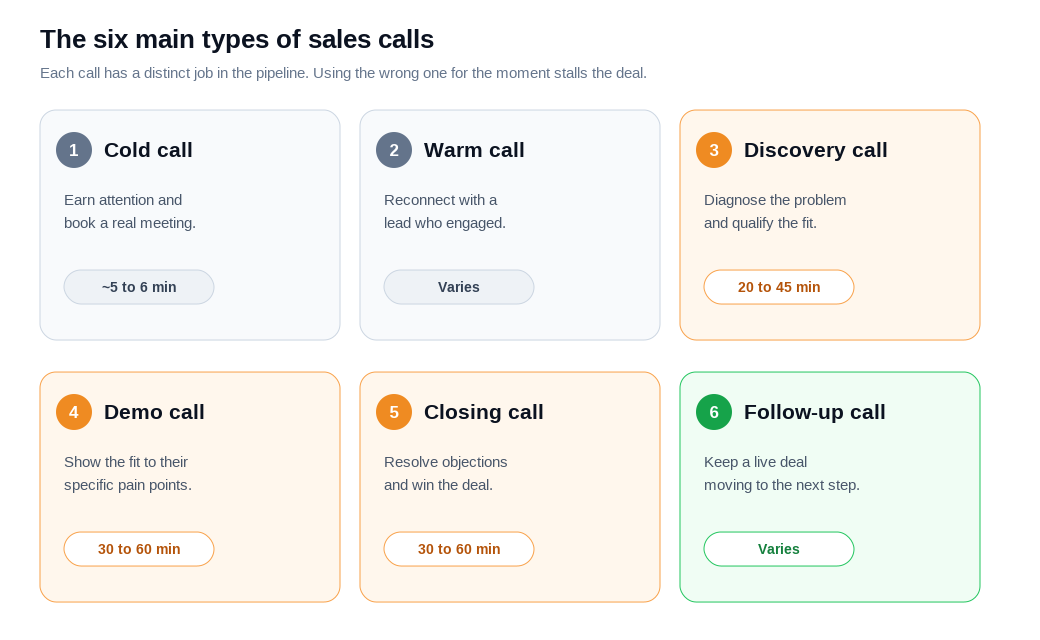
Here is what each one is for.
- Cold call. An outbound call to someone with no prior relationship to you. The goal is to earn a few minutes of attention and book a real meeting, so selling hard here usually backfires. Gong's analysis of cold calls found the successful ones average about 5 minutes and 50 seconds, while the ones that go nowhere average around 3 minutes and 14 seconds, so earning enough interest to keep talking is the whole game.
- Warm call. A call to someone who has already engaged, by downloading a resource, replying to an email, or coming through a referral. You have context a cold call lacks, so you can skip the cold open and get to relevance faster.
- Discovery call. A scheduled conversation with an interested prospect focused on understanding their situation, problems, and priorities, and qualifying whether there is a fit. This is diagnosis before any pitch, and the short version is that you are there to ask, not tell.
- Demo call. A walkthrough of your product tailored to the pain points surfaced during discovery. The job is to show how the product solves their specific problem, using their language and their numbers, rather than touring every feature.
- Closing call. The conversation where you resolve final objections, align on terms and pricing, and ask for the business. By this point the buyer already believes in the product, so the work is clearing the path to yes.
- Follow-up call. Any call that keeps a live deal moving between the milestones above, from checking in after a demo to chasing a signature. Most deals need several, and this is where a lot of pipeline quietly dies.
Real pipelines mix these. A single deal might run a cold call, a discovery call, a demo, two follow-ups, and a closing call before it signs.
How do you structure a sales call?
Structure a sales call in six steps: open and build rapport, set the agenda, ask questions and diagnose, present a tailored solution, handle objections, and confirm a specific next step. The exact weighting shifts by call type, but the sequence holds for almost every live sales conversation.
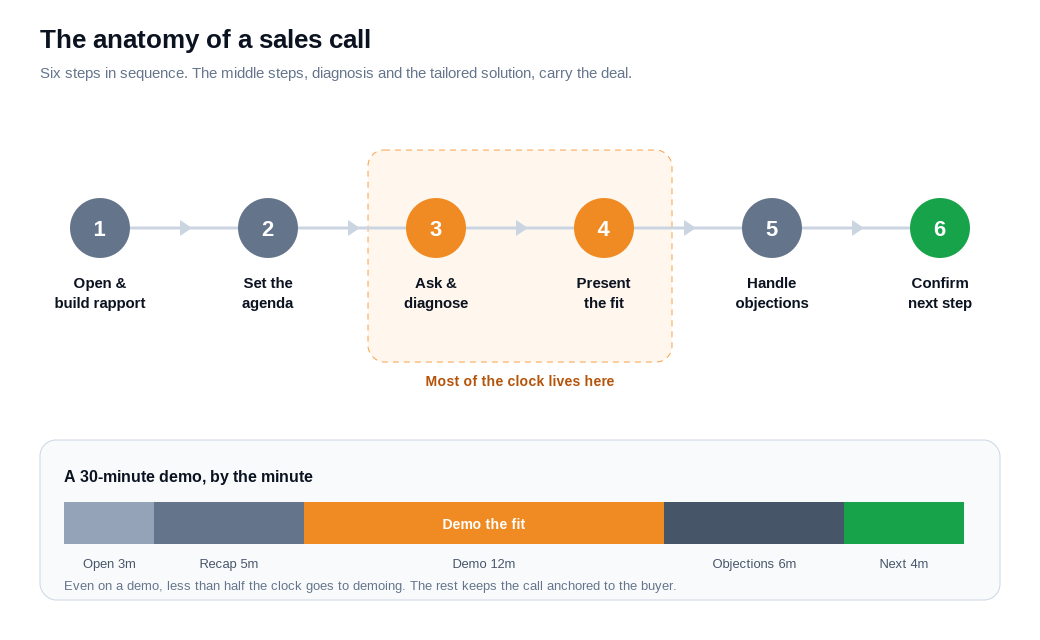
The open is short. Confirm you have the time you booked, thank them for it, and read the room before diving in. The agenda step is where you say out loud what the call will cover and how it will end, usually by deciding on a next step together. Naming the exit up front lowers the pressure and gets you honest answers.
The middle two steps carry the deal. Diagnosis is questions, not statements: what does their process look like today, where does it break, what is that costing them. Only after you understand the problem do you present, and the presentation should tie directly to what they just told you. Objections come next, and they are a buying signal more often than a rejection. The call ends by locking a next step on the calendar, not with a vague "I'll follow up."
A worked example makes the weighting concrete. On a 30-minute demo call, a good split is roughly 3 minutes to open and set the agenda, 5 minutes to re-confirm the problems from discovery, 12 minutes to demo the two or three workflows that map to those problems, 6 minutes to handle questions and objections, and 4 minutes to agree the next step. Notice that even on a demo, less than half the clock goes to actually demoing. The rest keeps the conversation anchored to the buyer.
How do discovery, demo, and closing calls differ?
Discovery, demo, and closing calls differ in their goal, their timing in the pipeline, and who does most of the talking. Discovery is about learning, the demo is about showing, and the close is about deciding, so treating them as interchangeable is a fast way to stall a deal.
| | Discovery call | Demo call | Closing call | |---|---|---|---| | Goal | Diagnose the problem and qualify fit | Show how the product solves that problem | Resolve objections and win the commitment | | Timing | Early, right after interest | Middle, after discovery | Late, once value is proven | | Who talks more | The buyer | Balanced, leaning seller | Balanced, leaning buyer | | Key question | "Walk me through how this works today." | "Here is how that specific problem gets solved." | "What do we need to do to move forward?" | | Typical length | 20 to 45 minutes | 30 to 60 minutes | 30 to 60 minutes |
The most common mistake is collapsing discovery into the demo. A rep skips the diagnosis, jumps to a generic product tour, and then wonders why the buyer went quiet. Without discovery, the demo has no target, so it becomes a feature list, and feature lists do not close deals. The reverse mistake shows up at the end: reps who keep re-selling a buyer who is already convinced, instead of asking for the decision and handling the real objection, which is usually procurement, timing, or an internal stakeholder who has not seen the product yet.
Should you run sales calls over video or phone?
Run high-stakes, later-stage calls over video and keep quick, early-stage calls on the phone. Both channels win, and the right choice depends on the deal stage and what the buyer prefers, so the useful question is which one fits this specific call.
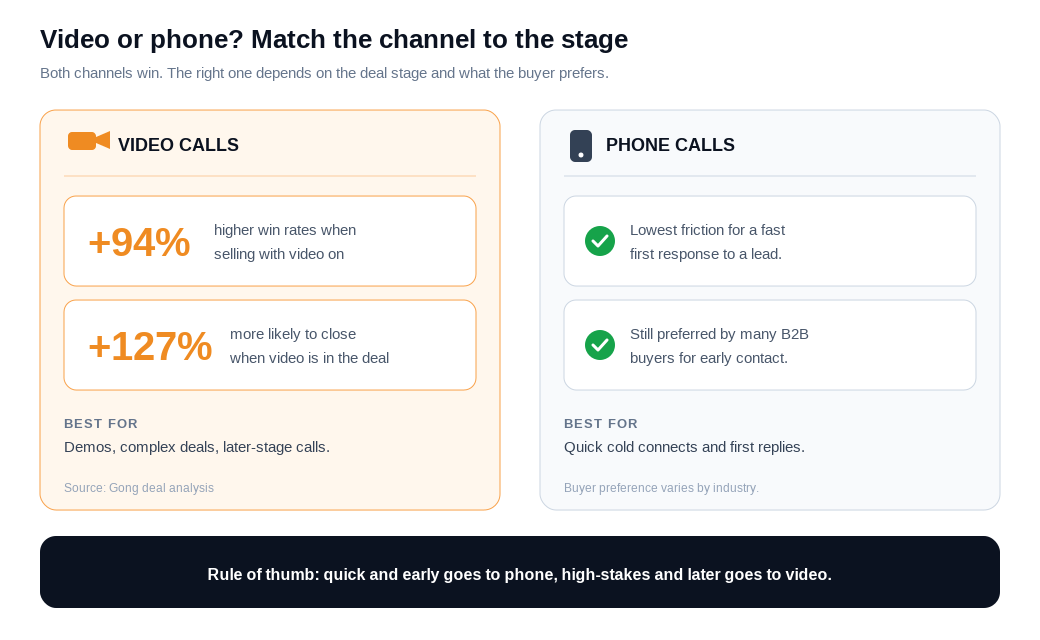
The video case is strong for demos and complex deals. Gong's analysis of recorded deals found win rates were about 94 percent higher when reps sold with video on, and that deals were roughly 127 percent more likely to close when video appeared at any point in the sales process. The reasons are intuitive: you can read faces, share a screen, and build the kind of rapport that audio alone struggles to create. Vidyard's virtual selling research points the same direction, with video meetings closing at a higher rate than audio-only calls even as many reps still default to the phone out of habit.
The phone case is not dead. For a fast first response to an inbound lead or a two-minute cold connect, a phone call is lower friction and often what the buyer expects. Plenty of B2B buyers still prefer a phone conversation for early contact, and forcing a webcam on someone who just wanted a quick answer adds friction you do not need.
The practical answer for inbound teams is to meet the buyer where their interest is highest. When a high-intent visitor is on your pricing page right now, being able to move straight into a live video call or screen share from the site, rather than scheduling for next week, captures the moment while it is live. For an inbound sales motion, that speed matters more than the channel debate, because the deal you win is usually the one you reach first.
What are sales call best practices?
The best practices for sales calls are consistent across the data: listen more than you talk, prepare before you dial, ask before you pitch, follow up relentlessly, and time your outreach. None of these is exotic, and most reps still get them wrong.
Listen more than you talk. Gong's research across large volumes of recorded calls puts the winning talk-to-listen ratio near 43 percent talking to 57 percent listening, while the average rep talks closer to 60 percent of the time. The gap widens on lost deals, where low performers talk more and let their monologues run long. Top reps keep their longest uninterrupted stretch under roughly 76 seconds. Cold calls are the exception that proves the rule: on a successful cold call the ratio flips toward the rep at about 55 to 45, because early on you have to earn attention before you can ask for it.
Prepare before you dial. Know the account, the person, and why they are on the call before you open your mouth. Buyer time is scarce. Gartner's research on the B2B buying journey found that buyers spend only about 17 percent of the entire purchase process meeting with potential suppliers, and that sliver is split across every vendor they are considering. Wasting it on questions you could have answered with two minutes of research is expensive.
Follow up relentlessly. Most deals are not won on the first call. Industry follow-up data consistently shows the majority of sales require five or more touches, and that many reps give up after one. Here is what that costs, worked out. Say your team fields 150 inbound demo requests a month and, like many teams, roughly half never get a second touch after the first missed connection. If 75 requests go cold and even one in ten would have booked on a second or third attempt, that is 7 to 8 meetings a month left on the table. Over a year that is close to 90 meetings. At a 25 percent close rate and a 6,000 dollar average deal, that is roughly 135,000 dollars in pipeline that existed and was never worked.
Speed is part of follow-up too. The Lead Response Management study run through MIT and InsideSales found that contacting a web lead within five minutes made reps far more likely to qualify it than waiting even thirty minutes, and the advantage decays sharply by the hour. A fast routing and notification setup that pings the right rep the moment a lead comes in is one way to protect that window, because the response you send in five minutes is worth more than the perfect one you send tomorrow.
Time your outreach. When you call matters at the margins. Analyses of cold call connect rates tend to land on mid-week and mid-morning or late afternoon as the strongest windows, with Tuesday often topping the list and Friday afternoons the weakest, all in the prospect's local time. This is a tiebreaker, not a strategy, but it is free.
One more that gets skipped: pick a framework per call type and stick to it. A team that runs the same discovery structure on every call will beat a team that switches methodology every quarter, because consistency is what makes calls coachable.
How long should a sales call be?
The right length depends on the call type, and the range is wide. Cold calls that convert tend to run about 5 to 6 minutes, discovery calls land around 20 to 45 minutes, and demos and closing calls run 30 to 60 minutes, stretching longer for enterprise deals with multiple stakeholders.
Length is a symptom, not a goal. A discovery call that runs long because the buyer is engaged and describing real problems is healthy. A demo that runs long because the rep is touring every feature is not. The useful metric hiding inside call length is engagement: are they talking, asking questions, and pushing back, or waiting for you to finish. On the calls that close, the buyer is doing a lot of the talking, which is why longer discovery calls often correlate with wins and longer seller monologues correlate with losses.
Key takeaways
- A sales call is a live conversation with a job. It moves one deal toward a purchase, has a structure, and should end with an agreed next step, whether it runs over phone, video, or in person.
- Match the call type to the stage. Cold and warm calls open the door, discovery diagnoses, the demo shows the fit, the close asks for the business, and follow-ups keep it all moving. Using the wrong one stalls the deal.
- Structure every call in six steps. Open, set the agenda, diagnose with questions, present to what you heard, handle objections, and confirm a next step, with the middle steps getting most of the clock.
- Listen more than you talk. The winning talk-to-listen ratio sits near 43 to 57, the average rep talks too much, and long monologues track with lost deals. Cold calls are the exception, closer to 55 to 45.
- Video wins the high-stakes calls, phone wins the quick ones. Selling with video correlated with roughly 94 percent higher win rates in Gong's data, while phone stays the low-friction choice for fast first contact.
- Follow up and follow up fast. Most deals need five or more touches, many reps quit after one, and responding within five minutes beats a slower, more polished reply.
TAGS

Written by
Daniel SemeckyCo-founder & CEO
Daniel is the co-founder and CEO of Glimpze. He spends his days talking to revenue teams about how to catch high-intent visitors before they bounce, and writes about inbound sales, lead conversion, and building a motion where marketing and sales actually share a number.


