
On this page
- What is AI lead qualification?
- How does AI qualify leads?
- What data does AI lead qualification use?
- How accurate is AI lead qualification, and where is the bias risk?
- AI vs human qualification: which is better?
- How do you deploy AI lead qualification safely?
- So, can you trust AI lead qualification?
- Key takeaways
- Sources
A B2B site collects 800 inbound leads in a month. Some are students doing homework, some are competitors poking around, and a handful are ready-to-buy accounts with real budget and a deadline. The four reps working that list cannot tell which is which from a name and an email address, so they work it top to bottom and spend most of their week on people who were never going to buy.
AI lead qualification is the attempt to fix that sorting problem with software. A model reads everything you know about a lead, estimates how likely it is to convert, and pushes the strongest ones to a rep first. The promise is speed and consistency at a scale no human team can match. The fair question, and the one this post is really about, is whether you can trust the score it hands you.
This guide covers how AI qualifies leads, what data it runs on, how accurate it actually is and where bias creeps in, how it stacks up against a human rep, and how to deploy it without breaking a privacy rule or a good lead.
What is AI lead qualification?
AI lead qualification is the use of machine learning to score and rank inbound leads by how likely they are to become customers, so sales works the best ones first instead of guessing.
It helps to separate it from what came before. Rules-based lead scoring, the old approach, has a marketer assign points by hand: plus ten for a director job title, plus five for a pricing-page visit, minus twenty for a free email domain. Those weights are guesses. Predictive scoring, the AI version, learns the weights from your own conversion history by finding which attributes actually correlated with closed deals in the past.
There are two flavors you will run into. The first is background scoring, where a model silently ranks every lead in your CRM. The second is conversational qualification, where an AI chat assistant greets a visitor, asks a few qualifying questions in the moment, and grades the answers against your criteria. Both get sold under the same label, and many teams run both at once.
How does AI qualify leads?
AI qualifies a lead by collecting data about it, comparing that data to patterns from your past deals, producing a probability score, and then ranking or routing the lead based on that score.
The background version runs through five repeatable steps:
- Ingest. Pull the lead's data from your CRM, marketing automation platform, website analytics, and email tools into one profile.
- Enrich. Fill the gaps with third-party data, so a bare email turns into a company, headcount, industry, and role.
- Score. Run the enriched profile through a model trained on your historical conversions to get a probability, often expressed as a 0 to 100 grade.
- Rank and route. Sort leads by score, apply a threshold, and send the ones above the line to the right rep.
- Learn. Feed the real outcome, closed or lost, back into the model so the next batch of scores gets sharper.
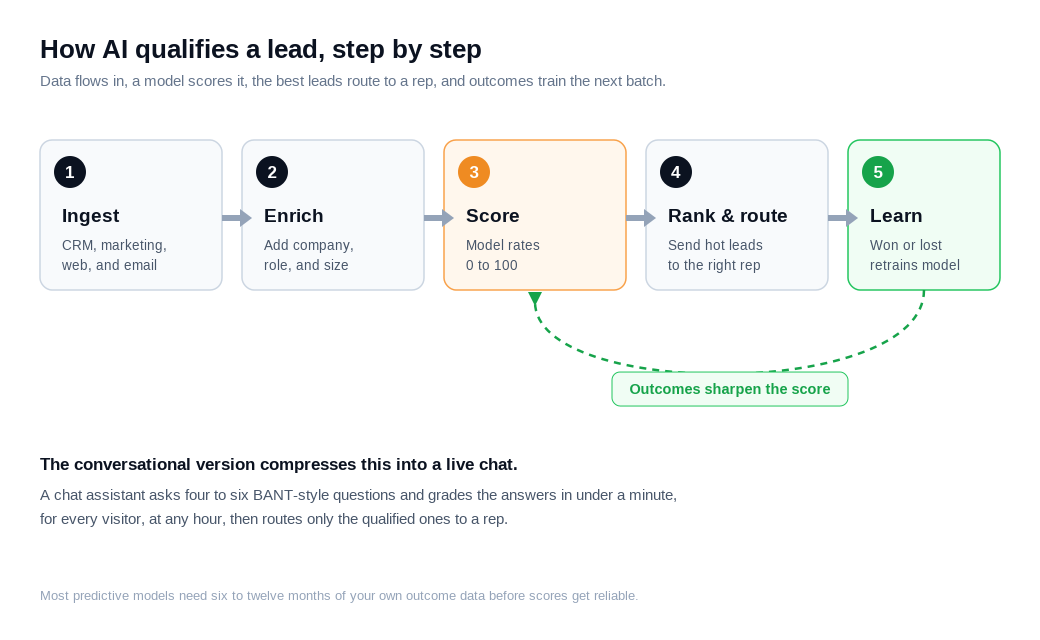
The conversational version compresses that into a live chat. According to Salesforce, teams run a chat version of their intake script, usually BANT or MEDDIC, asking four to six qualifying questions, checking the answers against preset thresholds, and passing only the qualified leads to a rep or a calendar. A conversation that would take a rep thirty minutes on a call gets handled in under a minute, at any hour, for every visitor who shows up rather than the few a rep can reach.
One caveat on the learning step. Most predictive models need six to twelve months of your own outcome data before their scores get reliably accurate, per Clay's overview of AI lead qualification. Before that, the model is borrowing patterns from generic data and its confidence is thinner than the score suggests.
What data does AI lead qualification use?
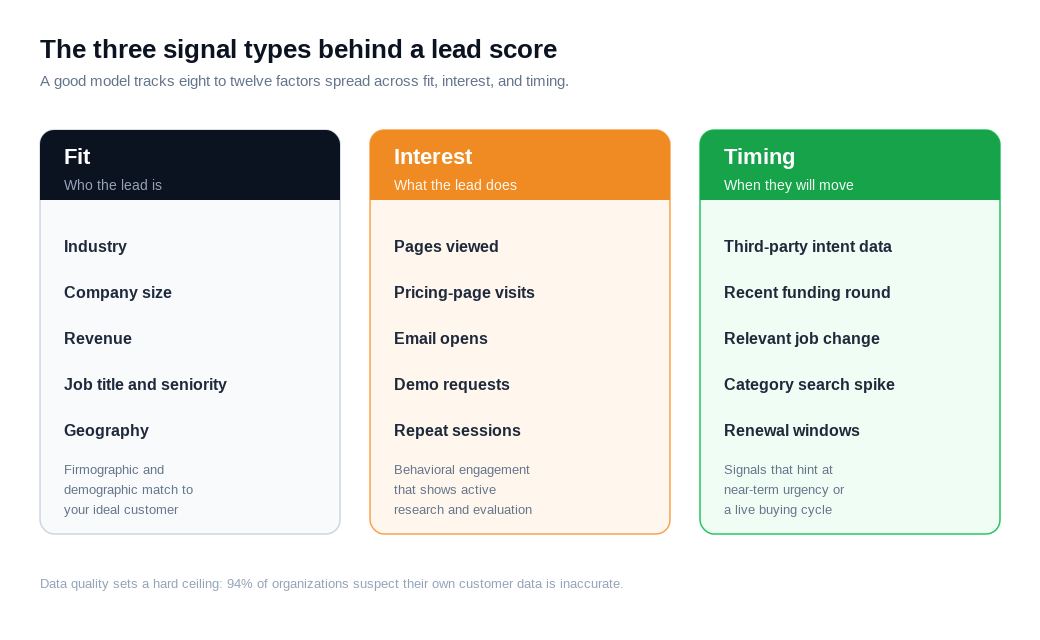
AI lead qualification runs on three families of signal, fit, interest, and timing, pulled from your CRM, your website, your marketing tools, and third-party enrichment providers.
A good scoring model usually tracks eight to twelve factors spread across those three buckets:
- Fit covers who the lead is: industry, company size, revenue, job title, seniority, and geography. This is the firmographic and demographic match against your ideal customer profile.
- Interest covers what the lead does: pages viewed, pricing-page visits, email opens, content downloads, demo requests, and repeat sessions. This is behavioral engagement that shows active research.
- Timing covers when the lead is likely to move: third-party intent data, a recent funding round, a relevant job change, or a spike in category search. These hint at near-term urgency.
The data comes from a stack you probably already own: the CRM for history, the marketing platform for engagement, website analytics for behavior, and enrichment APIs to fill in firmographics. The quality of that stack sets a hard ceiling on the model.
That ceiling is lower than most teams assume. Experian research, cited in analyses of lead-scoring data quality, found that 94% of organizations suspect their own customer data is inaccurate, with duplicate rates reaching 10% in systems without proper governance, according to a breakdown of predictive-scoring failure modes on HackrLife. A model trained on dirty data inherits those errors and then applies them consistently to every new lead, which is a polite way of saying it gets the same things wrong thousands of times a day.
How accurate is AI lead qualification, and where is the bias risk?
On clean historical data an AI model can score leads with impressive accuracy, but that lab number overstates real-world performance, and the largest risk is that the model learns your team's old habits instead of genuine buying intent.
Start with the optimistic case. A 2025 study in Frontiers in Artificial Intelligence tested fifteen classifiers on a B2B lead dataset and found that a Gradient Boosting model reached 98.4% accuracy, an AUC of 0.989, and recall of 0.959, per the published results. Ensemble methods like gradient boosting beat simpler approaches across the board. Numbers like that are real, and they are why the category works at all.
The catch is that a curated historical dataset is a friendlier place than your live pipeline. A more honest working target for production is a 70% or better rate from marketing-qualified lead to sales opportunity on the leads you actually act on, a benchmark drawn from monday.com's guide to AI-driven qualification.
Here is a worked example that keeps the accuracy claim grounded. Say 1,000 leads arrive in a month and the model flags the top 20%, so 200 leads, as high fit. If precision on that slice is 70%, then 140 of those 200 are worth a call and 60 are false positives your reps waste time on. Meanwhile the model deprioritizes 800 leads, and if 5% of those, so 40 leads, would have converted, they are false negatives you may never call. A 98% headline accuracy tells you nothing about those 40 missed deals, which is why you measure precision on the slice you act on.
Then there is bias, the quieter problem. A systematic review of 44 lead-scoring studies published in Information Technology and Management found that most predictive models lack the frameworks needed to detect bias in the first place, as summarized in the same HackrLife analysis. The specific trap is selection bias. If you train a model only on the leads your reps chose to pursue, it learns which traits predicted sales attention rather than which traits predicted real value. A lead that looks like the accounts your team already likes scores high, and a good lead outside that pattern gets buried. Because buried leads never get called, they never convert, which then confirms the model's original guess. The loop tightens around your existing habits and calls it intelligence.
AI vs human qualification: which is better?
AI wins on speed, coverage, and consistency, and humans win on judgment, nuance, and reading intent that never shows up in the data, so the strongest teams use both rather than picking one.
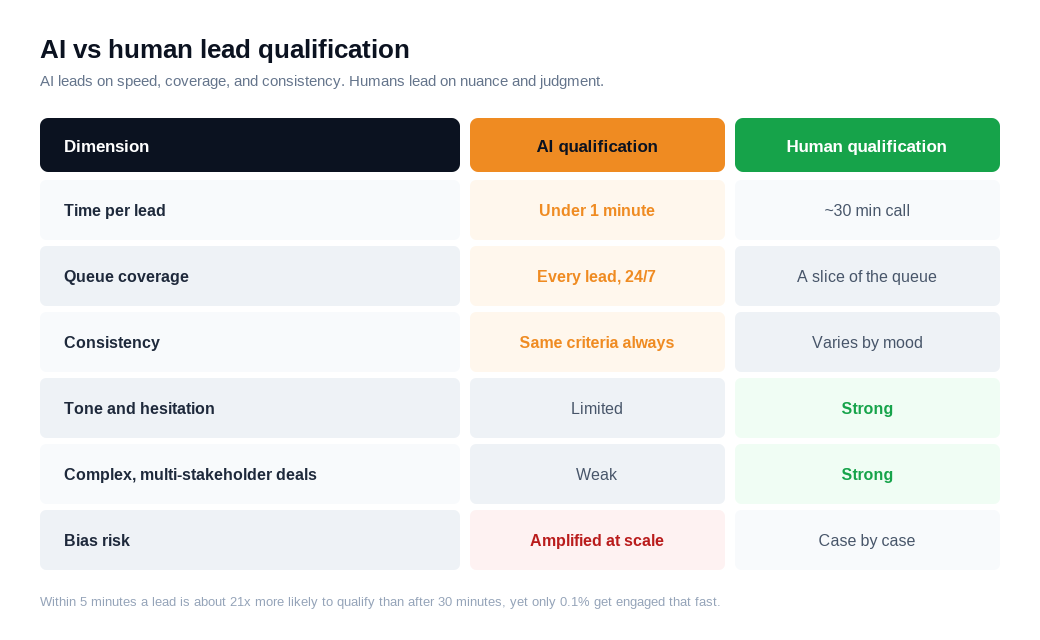
Speed is the clearest gap. A rep spends real time on each qualification, and can only reach a slice of the queue in a busy week. A model scores every lead in under a second and a chat assistant qualifies each visitor in under a minute. That matters because of a well-documented decay curve. Research led by Dr. James Oldroyd, based on more than 15,000 leads and published through InsideSales, found that contacting a lead within five minutes makes you about 21 times more likely to qualify it than waiting 30 minutes, and that qualification odds fall roughly 10% for each minute of delay in that first window, as compiled in a 2026 review of lead-response statistics. Despite that, only about 0.1% of inbound leads get engaged inside five minutes. AI closes that gap because it does not sleep, take lunch, or work a queue in order.
Consistency is the second gap. A model applies the same criteria to lead number one and lead number 900. A tired rep at 4 p.m. on Friday does not, and tends to favor familiar logos and gut feel.
Humans hold the ground that matters most on real deals. A person catches hesitation in a reply, hears sarcasm, notices that the actual decision-maker is someone the form never mentioned, and handles a committee of four stakeholders with competing agendas. The score tells a rep who to call first. A rep decides what the call actually means.
The practical read is a division of labor. Let the model triage and rank the whole queue, then route the high-intent leads to a person fast over live chat or a call, which is the core of an inbound sales motion built on speed. With 800 leads and four reps who can each run maybe 40 quality touches a week, the AI's job is to make sure the roughly 150 leads worth a same-day human conversation actually get one.
How do you deploy AI lead qualification safely?
Deploy it as an assistant that ranks and routes, keep a human in the loop on decisions that affect a person, and treat the data and the privacy rules as seriously as the model itself.
A short set of guardrails covers most of the risk:
- Keep a human in the loop. Under GDPR Article 22, a decision based solely on automated processing that has a significant effect on a person carries strict conditions. The EU Court of Justice SCHUFA ruling showed that an influential automated score can count as the decision even when a human nominally signs off, per Baker McKenzie's summary of profiling rules. Most B2B lead prioritization sits below that legal threshold, but the direction of travel is clear: let the score inform a person, not replace one.
- Get the legal basis and the transparency right. If your scoring touches personal data, and it does, you owe a lawful basis and a clear account of how the profiling works. The EU AI Act adds documentation and human-oversight expectations, with a major compliance deadline on August 2, 2026, according to GDPR Local's AI Act summary.
- Audit the model for bias. Look at how scores distribute across segments and watch for proxies, where company size or geography stands in for something you never meant to score on. If the model only ever rates accounts that look like last year's customers, you have found the selection-bias loop.
- Fix the data before you trust the score. Deduplicate, enforce governance, and verify enrichment. A model on dirty data is confident and wrong.
- Measure the right number. Track precision on the leads you act on and the rate from qualified lead to opportunity, not the headline accuracy figure that looks great and predicts nothing.
- Route the output fast. A score is worthless if the lead sits in a queue. A tight routing and notifications setup gets the hot lead to the right rep in seconds, and grounding the assistant in your real product docs keeps it from inventing answers.
So, can you trust AI lead qualification?
You can trust AI lead qualification to rank and route leads at a speed and scale no human team matches. You should not hand it the final say on who deserves a person's time with no oversight.
The trustworthy version is a prioritization layer, checked by a human, fed clean data, audited for the biases it inherits, and judged on the deals it actually helps close. The untrustworthy version is a black-box grade that quietly decides who gets ignored, trained on the habits it was supposed to improve. The difference comes down to the workflow you wrap around it, far more than the algorithm.
Key takeaways
- AI lead qualification scores and ranks leads by conversion likelihood, using machine learning that learns weights from your own history instead of the hand-set point rules of older scoring.
- The score runs on three signal types, fit, interest, and timing, and its accuracy is capped by data quality, which is why 94% of organizations suspecting their own data matters so much.
- Lab accuracy oversells real performance, so a 98% study result should not be confused with a production target closer to a 70% qualified-lead-to-opportunity rate on the leads you act on.
- Selection bias is the main trap, because a model trained only on leads reps chose to pursue learns what earned attention rather than what predicted value, then buries good leads outside the pattern.
- AI beats humans on speed, coverage, and consistency, and humans beat AI on nuance and judgment, so the durable setup routes AI-triaged high-intent leads to a person fast.
- Safe deployment is a workflow, not a setting, meaning a human in the loop, a lawful basis and transparency, bias audits, clean data, and measurement on real outcomes.
TAGS

Written by
Nilas MylerCo-founder & CTO, Glimpze
Nilas is the co-founder and CTO of Glimpze, an inbound sales tool that turns high-intent website visitors into live conversations. A former SEO consultant for some of the largest companies in Denmark, he writes about speed-to-lead, inbound sales, and conversion rate optimization — the technical and operational mechanics of turning traffic into pipeline.


