
On this page
- What is an instant demo?
- What is the difference between an instant demo and a scheduled demo?
- Why does speed-to-demo matter?
- What are the types of instant demos?
- How do you offer an instant demo on your website?
- Do instant demos replace live sales reps?
- How do you measure whether an instant demo is working?
- Key takeaways
- Sources
A buyer lands on your pricing page at 9:40 on a Tuesday, ready to see the product. The only path forward is a form and a promise that someone will be in touch. By the time a rep replies, the buyer has read three competitor pages and lost the thread of why they cared.
That gap between wanting a demo and getting one has quietly become the most expensive step in a lot of sales funnels. An instant demo removes it. The buyer sees the product now, on their terms, while the intent that brought them is still warm.
This post covers what an instant demo actually is, how it differs from a scheduled one, why speed-to-demo moves conversion, the main types you can offer, how to set one up on your site, whether it replaces live reps, and how to tell if it is working.
What is an instant demo?
An instant demo is any product demonstration a buyer can start immediately, without booking a slot or waiting for a reply. The defining trait is time-to-first-look measured in seconds or minutes rather than days.
That immediacy can take several forms. It might be a clickable walkthrough embedded on a feature page, a short video the buyer plays on demand, an AI assistant that answers questions and navigates the product live, or a real rep who joins a video call the moment the buyer raises a hand. What ties them together is that the buyer controls the timing and never has to enter a scheduling queue.
The idea grew out of a simple mismatch. Buyers now do most of their research before they ever want to talk to sales, and they expect the same self-directed speed from a demo that they get from every other part of the web. Gartner's 2026 sales survey found that 67% of B2B buyers say they prefer a rep-free experience, up from 61% a year earlier, based on a survey of 646 buyers conducted from August through September 2025. The traditional "request a demo, wait for a rep" flow was built for a buyer who no longer exists in the majority.
An instant demo answers a specific question at a specific moment: can I see how this works, right now, without a meeting? For a growing share of buyers, a yes to that question is table stakes.
What is the difference between an instant demo and a scheduled demo?
The core difference is timing and control: an instant demo starts on the buyer's click, while a scheduled demo starts on a rep's calendar. Everything else, from show rates to the kind of deal each fits, follows from that one variable.
A scheduled demo introduces a delay between interest and action, and delay is where deals leak. A buyer who was motivated on Tuesday gets a Thursday slot, then a Monday reschedule, and the momentum is gone. An instant demo collapses that delay to zero, which is why it maps so cleanly to how self-directed buyers already behave.
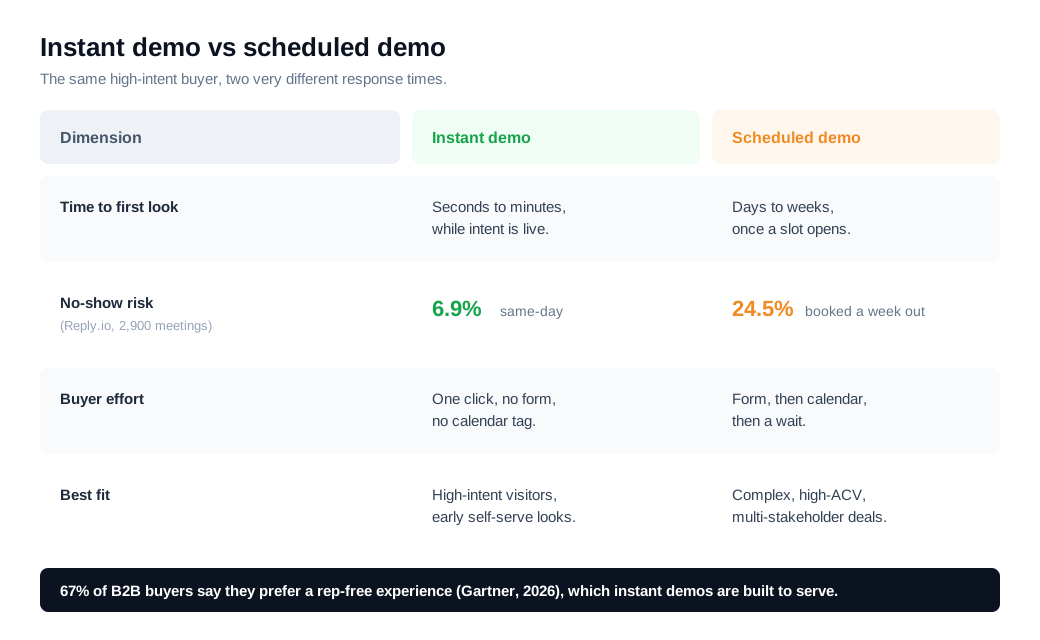
The no-show math makes the difference concrete. Reply.io analyzed roughly 2,900 booked meetings and found that a demo scheduled for the same day it was booked had a no-show rate of 6.9%, while a demo booked more than a week out no-showed 24.5% of the time. The further the demo drifts from the moment of intent, the more of your pipeline evaporates before anyone shows up.
None of this means scheduled demos are obsolete. A complex, high-ACV deal with a buying committee often needs a tailored live session, and forcing that into a two-minute instant format would shortchange it. The useful way to think about it is coverage: instant demos catch the high-intent visitor who wants a look today, and scheduled demos serve the deeper evaluation that follows. Most teams that adopt instant demos keep scheduled ones for later stages rather than replacing them outright.
Why does speed-to-demo matter?
Speed-to-demo matters because buyer intent decays fast, and the elapsed time between a buyer signaling interest and seeing the product is one of the variables most tied to whether they convert. Every hour of delay lets competing context, second thoughts, and rival tabs crowd in.
The response-time research that sales teams have quoted for a decade applies directly here. The Lead Response Management study led by Dr. James Oldroyd at MIT found that contacting a lead within five minutes rather than thirty made a firm about 21 times likelier to qualify it. Harvard Business Review's audit of 2,241 companies, "The Short Life of Online Sales Leads," found the average first response to an inbound lead took 42 hours, and that firms answering within an hour were nearly seven times likelier to have a meaningful conversation with a decision-maker than those that waited even sixty minutes longer. A demo is the highest-intent request a visitor can make, so the same physics hit even harder.
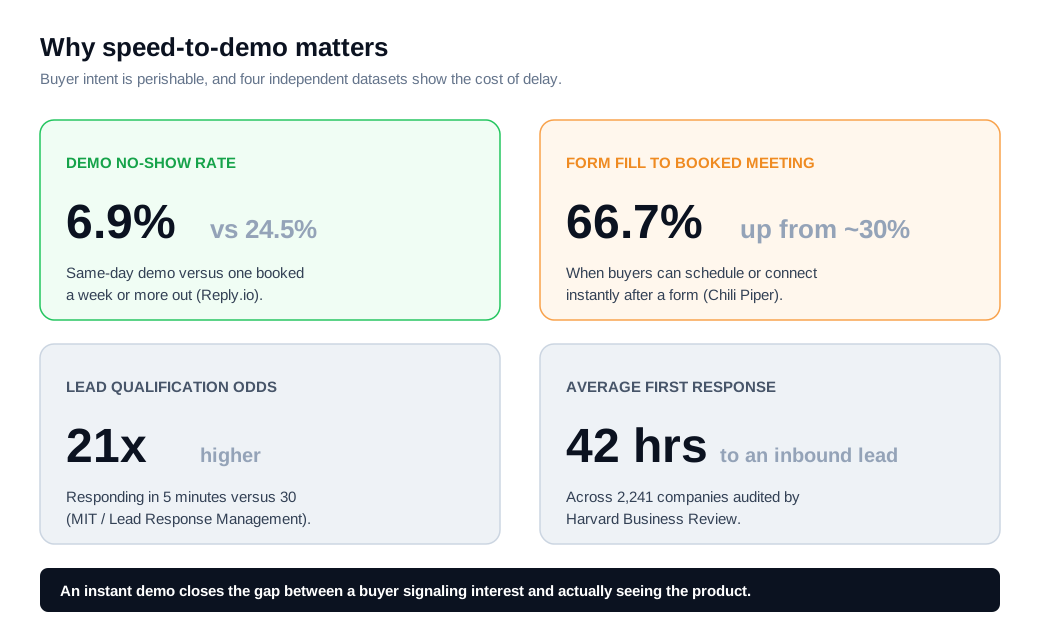
There is direct demo-stage evidence too. Chili Piper's benchmark analysis found that letting a prospect book a meeting immediately after a form fill roughly doubled inbound conversion, from about 30% to 66.7% from form fill to booked meeting, and that routing them to a live rep on the spot pushed it to 69.2%. The friction you remove between "I want a demo" and "I have a demo" shows up as pipeline.
Consider the arithmetic. Say 1,000 visitors a month reach a demo-intent page and 3% request a demo, which is 30 requests. If those go into a queue that produces a 24.5% no-show rate, about 23 demos actually happen. Offer the same 30 buyers an instant option with a same-day-equivalent 6.9% no-show, and roughly 28 demos happen. That is five extra live conversations a month from the same traffic, before you count the buyers who would never have filled out a form at all but will click a self-serve tour.
What are the types of instant demos?
There are four common types of instant demo, and they sit on a spectrum from fully self-serve to a live human within seconds. Most teams end up offering two or three of them for different intent levels.
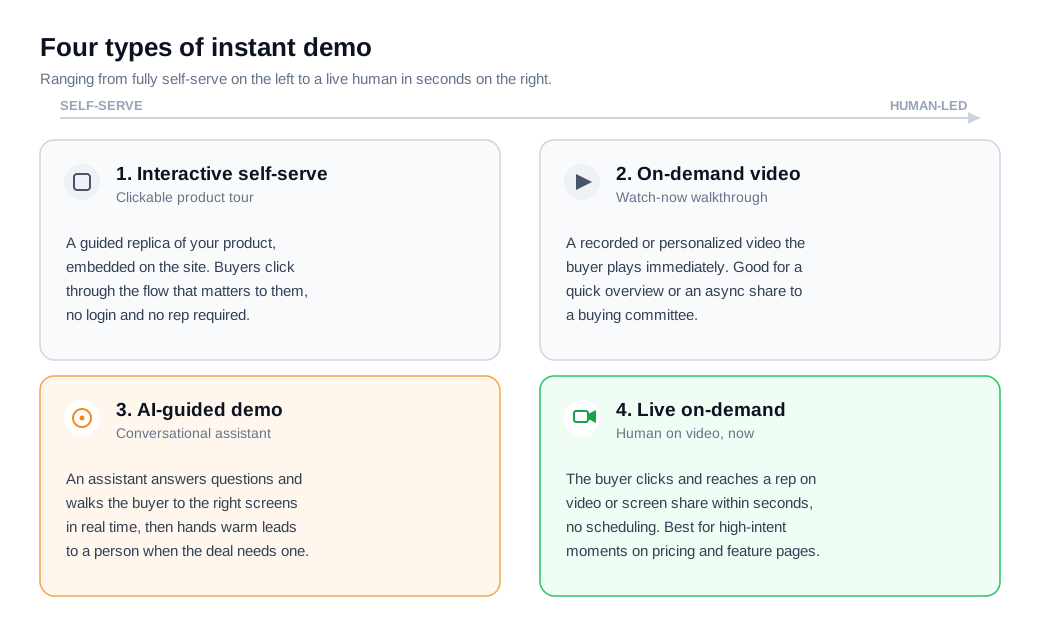
Interactive self-serve demos are guided, clickable replicas of your product embedded on your site. The buyer explores the flow that matters to them with no login and no rep. These are the format most people mean by "interactive demo," and the benchmark data is encouraging: Navattic's State of the Interactive Product Demo report found that the top quartile of interactive demos held a 50.1% engagement rate and a 28.9% completion rate, with website embeds making up the majority of use cases. Survey respondents attributed 10% to 20% of inbound lead volume to their demos.
On-demand video demos are recorded or lightly personalized walkthroughs a buyer plays right away. They work well as a quick overview or as an async artifact a champion can forward to a buying committee without scheduling anything.
AI-guided demos use a conversational assistant to answer questions and walk the buyer to the relevant screens in real time, then hand off warm leads to a human when the deal needs one. An AI chat assistant can qualify and orient a visitor at 2 a.m. when no rep is online, which extends instant coverage to every timezone.
Live on-demand demos put a real person on the buyer's screen within seconds. The buyer clicks, and a rep joins over live video and screen share with no calendar step in between. This is the format that most resembles a classic demo, compressed into the moment of peak interest. It fits high-intent pages best, where a visitor comparing plans is signaling they are close to a decision. Lighter-touch live chat sits alongside it for buyers who want a fast answer before committing to a call.
The point of the spectrum is that different buyers want different depths at different moments. A tire-kicker wants a self-serve click-through. A buyer with budget and a deadline wants a person, now.
How do you offer an instant demo on your website?
You offer an instant demo by placing a low-friction entry point where buyer intent peaks, then removing every step between the click and the product. The mechanics matter less than the discipline of cutting delay.
Start with placement. The demo trigger belongs on your pricing page, your key feature pages, and your comparison pages, because those are where visitors declare intent. A single "book a demo" button buried in the nav wastes the signal. Put the instant option in the buyer's path at the moment they are leaning in.
Next, cut the form. A long qualification form is a scheduled demo in disguise, since it filters and delays before anyone sees anything. For a self-serve tour, ask for nothing up front and capture an email at a natural stopping point inside the experience. For a live option, let the buyer start the conversation first and gather context during it.
For live on-demand demos, coverage and routing decide whether the promise holds. If a visitor clicks and no one answers, you have taught them that "instant" was marketing. Route the request to the right rep by page, territory, or account, and fire an alert the second it lands. Glimpze handles this with a live visitor feed and Slack alerts through its lead routing and notifications, so a rep can join before the buyer clicks away. Setting clear coverage windows, and falling back to an AI assistant or a same-day booking outside them, keeps the experience honest.
You can also make the offer proactive. Rather than waiting for a click, a subtle nudge when a visitor lingers on pricing can open the door, which is the idea behind proactive outreach prompts. The install itself is usually a single line of script, and tools in this category, including a free tier on the Glimpze pricing plan, let you test the motion before committing budget.
Finally, close the loop. An instant demo should still produce a record and a next step. Whoever ran it, human or AI, should log what the buyer explored and either book the deeper session or send a same-day recap while the interest is fresh.
Do instant demos replace live sales reps?
No, instant demos do not replace live reps for most deals; they change where the rep enters the conversation. The buyer does more of the early exploration alone, and the rep joins later, better informed, for the parts that need a human.
The same Gartner research that found 67% of buyers preferring a rep-free experience also found that buyers still turn to sellers to validate what they have learned and to navigate complex, risky decisions. Self-serve handles the "show me how it works" phase. A person handles negotiation, security review, custom scoping, and the reassurance a six-figure signature needs. Instant demos let reps skip the repetitive product tour and spend their time where judgment actually moves the deal.
For inbound sales teams, that shift is a gift rather than a threat. A rep who joins a live on-demand call is talking to someone who already clicked, already explored, and already qualified themselves by asking for a person. The conversation starts several steps ahead of a cold scheduled demo, which is a better use of an expensive hour on both sides.
How do you measure whether an instant demo is working?
You measure an instant demo by tracking engagement, its influence on pipeline, and the show rate of any live sessions it produces, rather than by counting plays. A demo that gets started and abandoned is a warning, not a win.
For self-serve formats, watch completion rate and step drop-off. Navattic's benchmarks give you a yardstick: a completion rate in the high 20s puts you in the top quartile, and demos in the 8-to-15-step range tend to perform best, so a long tour that no one finishes is a signal to trim. Tie demo engagement back to opportunities created, since the real question is whether it feeds pipeline, not whether it entertains.
For live on-demand demos, the no-show comparison becomes your scoreboard. If scheduled demos in your funnel run a 20% to 25% no-show rate and your instant option runs in the single digits, that gap is recovered pipeline you can quantify.
Here is a worked example. A team gets 2,000 demo-intent visitors a month and converts 3% to a demo request, or 60 requests. Under a scheduled-only model with a 24% no-show rate, about 46 demos happen, and at a 20% demo-to-close rate that is roughly 9 deals. Add an instant option that lifts the effective request rate to 5% (100 requests, because self-serve captures buyers who would never fill a form) and drops no-shows to 8%, and about 92 demos happen. Even holding close rate flat at 20%, that is about 18 deals from the same traffic. The lever here is removing the wait. A slicker demo script matters far less than speed.
Key takeaways
- An instant demo is defined by timing. The buyer starts it on their own click, with time-to-first-look measured in seconds or minutes, rather than waiting on a rep's calendar.
- Delay is where demos leak. Reply.io found a 6.9% no-show rate for same-day demos versus 24.5% for demos booked more than a week out, and speed-to-lead research shows qualification odds fall sharply with every extra hour.
- Buyers now expect self-direction. Gartner found 67% of B2B buyers prefer a rep-free experience, so a "request a demo and wait" flow is out of step with how most people buy.
- There are four types on one spectrum. Interactive self-serve tours, on-demand video, AI-guided demos, and live on-demand human sessions cover different intent levels from fully self-serve to a person in seconds.
- Placement and routing make it real. Put the entry point where intent peaks, cut the form, and route live requests to a rep instantly, or the "instant" promise breaks the first time no one answers.
- Reps still matter, later. Instant demos handle the product tour so a human can enter for negotiation, security, and scoping, meeting the buyer already qualified and several steps ahead.
TAGS

Written by
Daniel SemeckyCo-founder & CEO
Daniel is the co-founder and CEO of Glimpze. He spends his days talking to revenue teams about how to catch high-intent visitors before they bounce, and writes about inbound sales, lead conversion, and building a motion where marketing and sales actually share a number.


