
On this page
- What is lead scoring?
- How does lead scoring work?
- What is the difference between explicit (fit) and behavioral (intent) scoring?
- How do you build a lead scoring model?
- What are the common lead scoring mistakes?
- How does lead scoring connect to speed to lead?
- Does lead scoring still work in 2026?
- Key takeaways
- Sources
Two leads land in your CRM within the same hour. One is a VP of operations at a 200-person company who just sat on your pricing page for four minutes and booked a demo. The other is a personal Gmail address that grabbed a free ebook and never came back. A rep who treats both the same wastes the morning, and the VP cools off while she waits.
Lead scoring is how you tell those two apart before anyone picks up the phone. It turns a pile of undifferentiated form fills into a ranked list, so the rep works the VP first and the ebook grabber drops into an email nurture. The mechanics are plain arithmetic. The payoff is that your best leads stop waiting behind your worst ones.
This guide defines lead scoring, shows how it works, separates fit (explicit) from intent (behavioral) scoring, builds a model with a worked example, lists the mistakes that break most models, and asks whether any of it still holds up in 2026.
What is lead scoring?
Lead scoring is the practice of assigning a numeric value to each lead based on how likely they are to become a customer, so your team can rank and prioritize them instead of working the list in the order it arrived. Points go up for signals that predict a sale and down for signals that predict a dead end. When a lead crosses a threshold you set, it becomes a marketing qualified lead (MQL) and gets handed to sales.
The score usually sits on a 0 to 100 scale and updates in real time as the lead acts: opening emails, viewing pricing, requesting a demo. Two inputs feed it. One describes who the lead is, from firmographic and demographic data; the other describes what the lead does, from behavior on your site and in your emails. A good model blends both, because either one alone tells half the story.
The practice pays for itself when volume outruns capacity. Companies that use lead scoring report a 138 percent return on lead-generation spend against 78 percent for those that skip it, yet only about 44 percent of organizations run a scoring model at all, per Landbase's 2026 lead scoring statistics. When ten leads arrive a week, a rep can eyeball them. When hundreds arrive, triage breaks down and high-intent buyers slip through.
How does lead scoring work?
Lead scoring works by defining a set of attributes and actions, attaching a point value to each, summing those points for every lead, and then acting on the total once it clears a qualification threshold. The model runs continuously, so a lead's rank rises and falls as new data arrives.
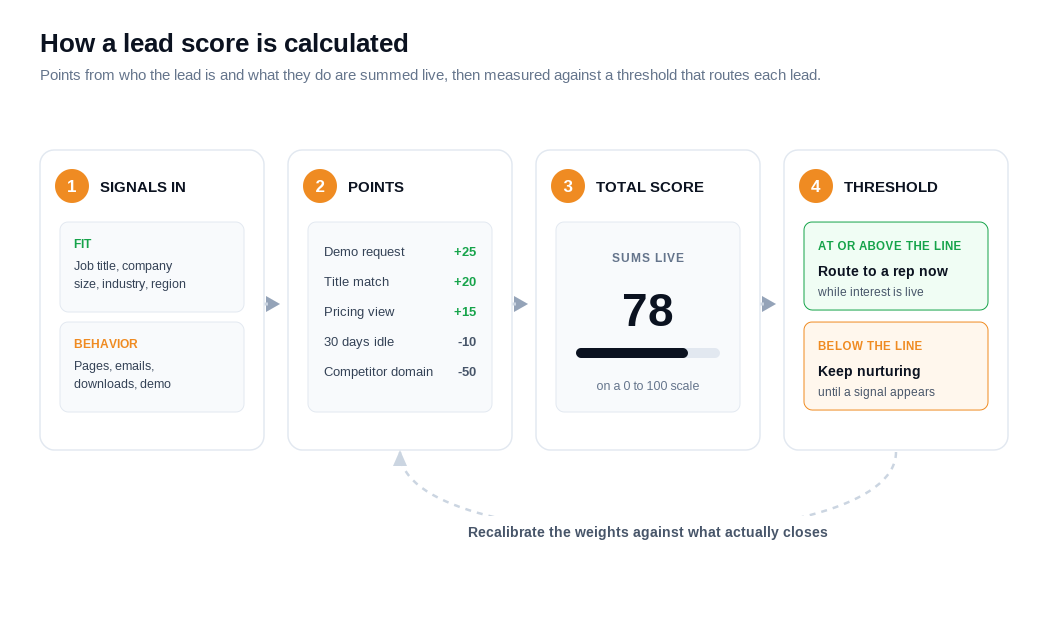
Start with the inputs. Marketing and sales agree on which traits and behaviors correlate with closed deals, then translate each into points. A director-level title might be worth 20 points, a pricing-page visit 15, a demo request 25. Negative signals subtract: a student job title, a competitor's email domain, or 30 days of silence pull the score back down. Your CRM or marketing automation platform tallies it automatically.
Then set the line. The MQL threshold is the score at which a lead is deemed ready for sales contact. Below it, the lead keeps nurturing. Above it, the lead routes to a rep, ideally within minutes while interest is still hot. The threshold is a business decision you calibrate against real conversion data, not a number you guess once and leave alone.
The last piece is the feedback loop. You compare the scores your leads carried against whether they actually converted, then adjust the weights and the threshold. A model that never gets recalibrated drifts away from reality, which is why the good ones are run as living systems rather than a one-time setup.
What is the difference between explicit (fit) and behavioral (intent) scoring?
Explicit scoring measures fit, meaning how well a lead matches your ideal customer profile, while behavioral scoring measures intent, meaning how actively that lead is engaging with you right now. Fit answers whether you should sell to this person, and intent answers whether they are ready to talk. You need both, and confusing them is the single most common way scoring models go wrong.
Explicit data is information the lead hands you directly, usually through a form: job title, company size, industry, revenue band, location, and tech stack. It is stable and it describes the account. A VP of engineering at a 500-person SaaS company is a strong fit whether she visited today or last month. This is the demographic and firmographic layer, and on its own it tells you whether a lead is worth pursuing at all.
Behavioral data is the digital footprint the lead leaves as they move: pages viewed, emails opened, content downloaded, webinars attended, demos requested. It is dynamic, and it describes timing. Behavioral scoring is where real buying intent shows up, since someone who reads three case studies and prices out a plan in one week is telling you something a job title never could, as Nutshell's guide to behavioral lead scoring lays out. A perfect-fit lead who does nothing is not a live opportunity yet.
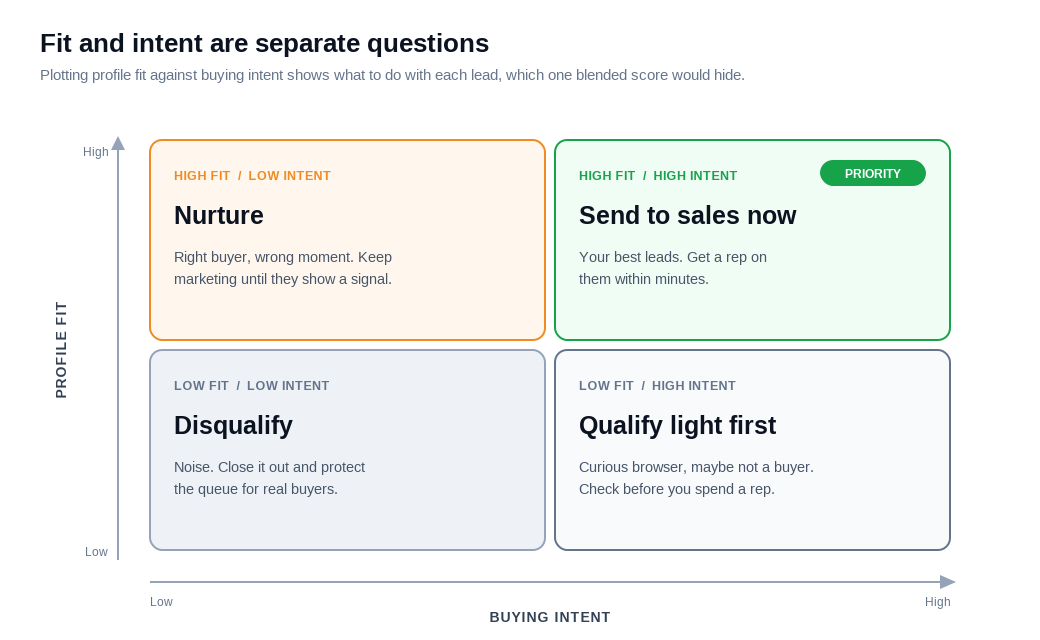
The clean way to hold both is a fit-and-intent matrix, a two-by-two grid. High fit plus high intent is the top-right corner, and those leads go to sales immediately. High fit plus low intent is the right profile at the wrong time, so those go to nurture until they show a signal. Low fit plus high intent is a curious browser who may not be a buyer, worth a light-touch qualifying check before you spend a rep on them. Low fit plus low intent is noise. Collapsing all of this into one number is the flaw the smartest teams design around, because one score doing two jobs hides which corner a lead sits in.
How do you build a lead scoring model?
You build a lead scoring model in six steps: align sales and marketing on definitions, define your ideal customer profile, assign point values to fit and behavior, add negative scoring and decay, set the MQL threshold against real conversion data, then test and refine on a schedule. The whole thing is a spreadsheet exercise before it is ever a software one.
First, align on what MQL and SQL actually mean, in writing. An MQL has enough fit and engagement to warrant sales attention. A sales qualified lead (SQL) is one a rep has spoken to and confirmed as a real opportunity. If the two teams do not agree on these definitions, no scoring model will fix the friction between them.
Second, define your ICP from your actual customers, not your aspirations. Look at your best accounts and pull the traits they share. Third, assign points. A workable default is a 100-point model split roughly between fit and behavior, weighted toward behavior because intent is the better predictor of timing.
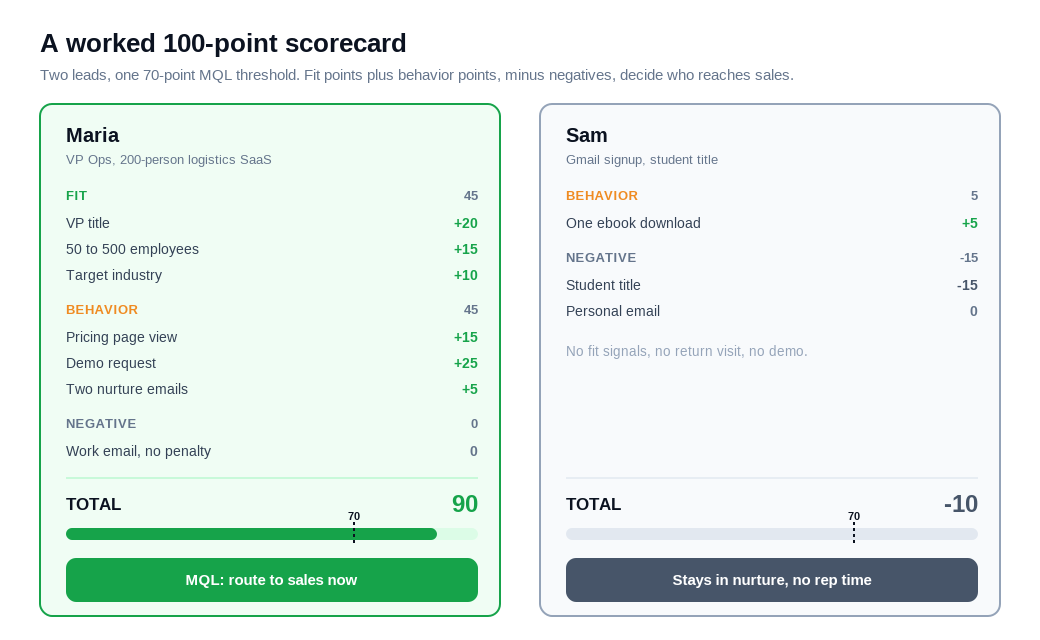
Here is a worked example. Take a B2B SaaS team with a 70-point MQL threshold. A lead, Maria, comes in as a VP of operations at a 200-person logistics software firm. Fit points: VP title +20, company in the 50 to 500 employee band +15, target industry +10, for 45 fit points. Behavior: viewed the pricing page +15, requested a demo +25, opened two nurture emails +5, for 45 behavioral points. She used a work email, so no negative applies. Her running total is 90. That clears 70, she becomes an MQL, and she routes to a rep the same minute. Now take Sam, who signed up with a Gmail address, holds a student title (-15), and downloaded one ebook (+5). Sam sits at -10 and never reaches sales, which is the correct outcome.
Fourth, add negative scoring and decay so scores cannot only climb. Subtract points for poor-fit titles, competitor domains, and unsubscribes, and let points fade when a lead goes quiet, for example -10 after 30 days of inactivity. Fifth, set the threshold using closed-won analysis: look at what scores your actual customers carried at the moment sales first engaged, and set the line just below that band. Start somewhere between 60 and 80 and adjust. Sixth, test against known-good and known-bad contacts, then watch the MQL-to-SQL rate. Across industries that rate averages around 13 percent, with B2B SaaS running higher when behavioral signals feed the model, according to Data-Mania's MQL-to-SQL benchmarks. If your rate sits far below your peer band, the threshold is too low and you are flooding sales with leads that are not ready.
What are the common lead scoring mistakes?
The most common lead scoring mistakes are scoring without negatives, letting scores never decay, conflating fit and intent into one number, scoring vanity actions, and treating the model as a set-and-forget project. Each one inflates scores and erodes the trust sales places in your MQLs.
No negative scoring is the quiet killer. Without deductions, every score only moves up, so poor-fit leads and long-dead ones slowly drift over the threshold and clog the queue, a pattern Reform's rundown of lead scoring mistakes puts near the top of the list. Make the negatives large enough to pull a lead out of MQL status. The same logic drives decay: a webinar attendee from six months ago with no activity since should not outrank a lead who requested a demo yesterday, yet without decay that is exactly what happens, and reps lose trust in the score the first time they call a hot lead who has gone cold.
Conflating fit and intent is the structural mistake. A single blended score can hide a low-fit browser behind a high number, or bury a perfect-fit account that is simply between buying cycles. Scoring vanity actions is a cousin of it: heavy points for opening an email or visiting the careers page reward activity that does not predict a purchase, so the score measures busyness in place of buying.
The last mistake is shipping the model and walking away. Buyer behavior shifts, your product moves upmarket, and the weights that fit last year stop correlating with revenue. Static models lose their edge quickly, and the strongest ones evolve with the business and its customers rather than sitting untouched for years. Plan the next revision before the first one goes live.
How does lead scoring connect to speed to lead?
Lead scoring and speed to lead are two halves of one job: scoring decides which leads deserve a fast human response, and speed to lead determines whether that response arrives while the lead is still warm. A brilliant score that routes a hot lead into a queue nobody watches wastes the insight entirely.
The urgency is real because most of the buying journey happens before a lead ever fills out a form. Gartner's research on the B2B buying journey found that buyers spend only 17 percent of their time meeting with potential suppliers, and about half of qualified leads are not ready to buy at the moment they first convert, as the lead nurturing statistics compiled by Salesgenie show. By the time someone scores as an MQL, they have often already decided you are a contender. The window to reach them is short.
That is why the strongest setups pair a high score with an instant path to a person. When a top-quadrant lead is live on your pricing page, a rep alerted through a routing and notifications workflow can start a conversation on the spot instead of emailing to schedule one. Some teams run live chat on high-intent pages so a rep can talk the moment a qualifying lead surfaces; others let an AI chat assistant field the first questions and hand off warm, which keeps the response instant after hours. For an inbound sales motion, scoring is the trigger and speed is the follow-through, and neither delivers on its own.
Does lead scoring still work in 2026?
Yes, lead scoring still works in 2026, though the bar has moved: rule-based point models remain the right starting point for most teams, while predictive and AI-driven scoring have shifted from a competitive edge to a baseline expectation at larger operations. The method still holds. The lazy version of it does not.
Manual point models still earn their place, especially below the data volume where a machine learning model has enough signal to train on. A clean set of explicit weights, honest negatives, and decay will outperform an under-trained predictive engine, and a human can read and defend it. Practitioners who complain scoring stopped working are usually running a static model they built once and never revisited, a point Simple Machines Marketing makes at length.
At the top end, the ground has genuinely shifted. AI use in lead scoring climbed from 23 percent of B2B teams in 2024 to 38 percent in 2025 and 61 percent by early 2026, with roughly three-quarters of B2B companies expected to run AI-driven scoring by the end of the year, per Landbase. The same research pegs rule-based accuracy at 15 to 25 percent and predictive models at 40 to 60 percent, which explains why enterprises treat AI scoring as table stakes rather than a differentiator. Predictive scoring trains on your historical wins and losses to weight signals automatically, and the signal set keeps widening to third-party intent data that flags accounts researching your category before they touch your domain.
The through-line has not changed. Rank leads by how well they fit and how much they want to talk, respond fast when both are high, and keep recalibrating against what actually closes. Whether the weights come from a spreadsheet or a model, that is the job.
Key takeaways
- Lead scoring ranks leads by likelihood to buy so your team works the best ones first. Points go up for buying signals and down for dead-end signals, and a lead becomes an MQL once it clears a threshold you set.
- Fit and intent are different questions, and you need both. Explicit (fit) scoring says whether to sell to someone; behavioral (intent) scoring says whether they are ready to talk, and intent usually decides timing.
- Build the model in six steps and treat it as living. Align on definitions, define the ICP from real customers, assign points weighted toward behavior, add negatives and decay, set the threshold from closed-won data, then test and refine.
- Negative scoring and decay are what keep a model honest. Without them every score only climbs, poor-fit and stale leads drift into the queue, and sales stops trusting your MQLs.
- A score is only as good as the response behind it. Pair a high score with an instant path to a rep, because most B2B buying happens before the form fill and the window is short.
- Lead scoring still works in 2026 if you keep it current. Rule-based models remain right for most teams, predictive and AI scoring are baseline at enterprise scale, and the job of ranking by fit and intent has not changed.
TAGS

Written by
Daniel SemeckyCo-founder & CEO
Daniel is the co-founder and CEO of Glimpze. He spends his days talking to revenue teams about how to catch high-intent visitors before they bounce, and writes about inbound sales, lead conversion, and building a motion where marketing and sales actually share a number.


