
On this page
A support inbox does not tell you who is furious. It shows you 600 tickets that all look the same in a list, sorted by time, each one a subject line and a name. The customer who wrote "third time asking, still broken, canceling today" gets the same row height as "quick question about billing," and both wait their turn.
Sentiment analysis is the layer that reads the tone inside those messages and puts a number on it, so the angry ticket climbs to the top instead of aging quietly at position 214. It is the difference between catching an upset customer on Tuesday and hearing about the cancellation on Friday.
Here is the path this guide takes: what sentiment analysis is, how it turns a message into a score, how it flags unhappy customers, how teams act on the signal, how accurate it really is, and where it still gets things wrong.
What is sentiment analysis in customer support?
Sentiment analysis in customer support is a technique that uses natural language processing to read the emotion in what a customer wrote or said, then labels each message as positive, negative, or neutral, usually with a score for how strong that feeling is. It reads the mood behind the words rather than the topic of the message.
The inputs come from everywhere a customer leaves a trace: support tickets, live chats, phone transcripts, surveys, reviews, and social posts. Software built on machine learning, natural language processing, and natural language understanding processes that text at a volume no team could read by hand, as Nextiva describes in its overview of customer sentiment analysis. The output is a reading of how the customer feels, attached to the interaction it came from.
The three-bucket label is the floor, not the ceiling. More capable systems detect specific emotions such as anger or relief, gauge urgency, and run at the aspect level, separating how a customer feels about shipping from how they feel about the product, per SentiSum's breakdown of customer sentiment analysis. That aspect view is what turns a vague "this customer is unhappy" into "this customer is happy with the product and angry about the refund process." The reading also runs in two modes: live, inside an AI chat assistant scoring a conversation as it unfolds, or in batch, sweeping a month of tickets to surface trends.
How does sentiment analysis work?
Sentiment analysis works by breaking a message into its words and structure, matching that against either a scored dictionary or a trained model, and combining the pieces into a single polarity score, usually on a scale from -1 for very negative to +1 for very positive. Two families of method do this, and they trade interpretability for accuracy in opposite directions.
Lexicon-based methods carry a dictionary where every word already has a polarity score, then average those scores across the sentence. The approach splits text into words, looks each one up, and computes the polarity of the whole passage from its parts, with scores landing between -1 and +1, as laid out in a PLOS One study on lexicon-based sentiment analysis. Tools like VADER and TextBlob work this way. They are fast and easy to explain, because you can point at the exact words that moved the score.
Machine learning methods learn sentiment from thousands of labeled examples instead of a fixed word list, which lets them read context that a dictionary cannot. That context is where the accuracy comes from.
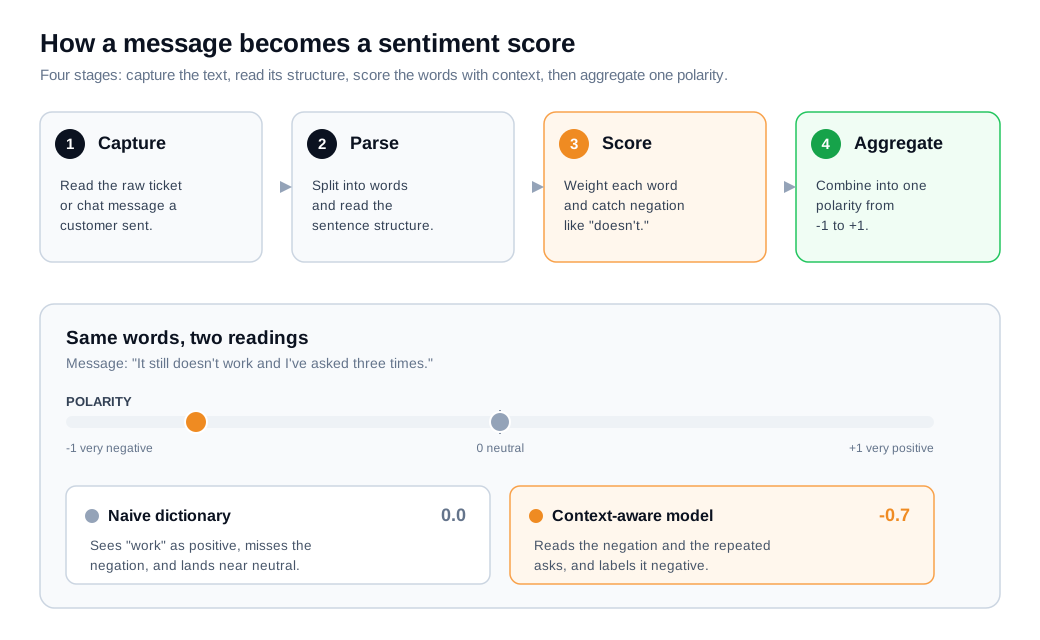
Here is a worked example. A customer writes "It still doesn't work and I've asked three times." A naive dictionary spots the word "work," which usually carries mild positive weight, misses that "doesn't" negates it, and lands near neutral. A context-aware model reads the negation and the frustration in "three times," scores the message near -0.7, and labels it negative with high confidence. The words are identical. The reading is not, and that gap is the whole reason teams reach for trained models on real support traffic.
The best systems stack layers on top of the raw score. They read sentiment (how negative), intent (what the person wants), and emotion (which specific feeling), then combine the three, so -0.7 becomes "frustrated, about a bug, wants a fix," which is what edesk describes as the multi-layer approach behind ticket triage.
How does sentiment analysis flag unhappy customers?
Sentiment analysis flags unhappy customers by scoring every incoming message in real time and raising any ticket whose sentiment falls below a set threshold, so the most negative conversations get surfaced instead of waiting their turn in a time-sorted queue. The threshold is a dial you set, and everything below it triggers an action.
Most tools express the score on a simple range, often 0 to 100, then let you decide what happens at the low end. Tickets that fall below a negative-sentiment threshold get automatically escalated, re-queued, routed to a senior agent, or handed a tighter service-level deadline, as edesk documents in its guide to sentiment-based prioritization. The queue stops being first-in-first-out and becomes angriest-first.
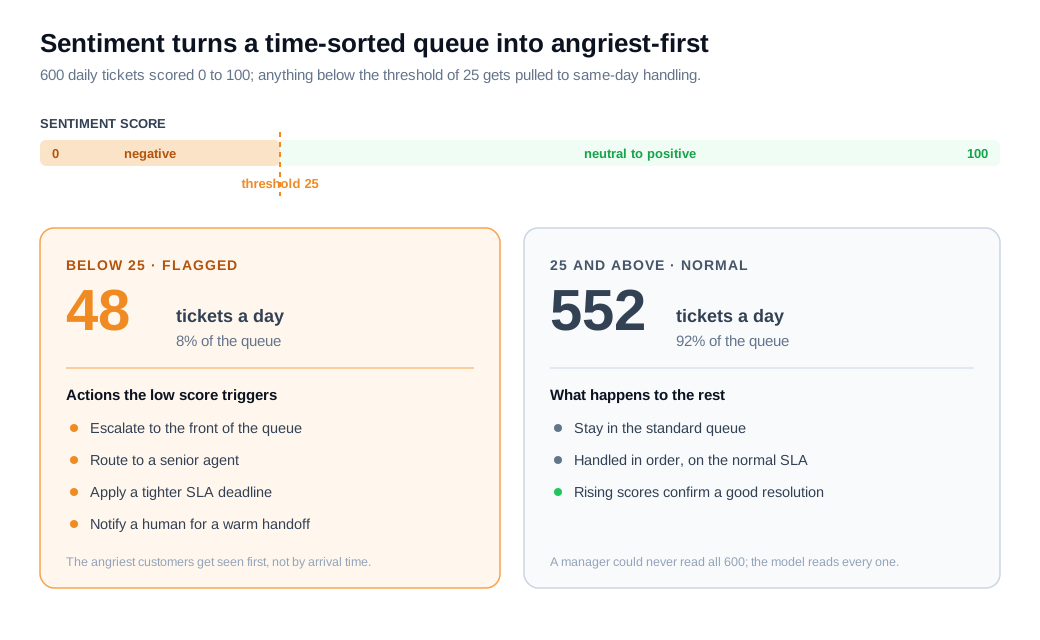
Put numbers on it. A B2B desk takes 600 tickets a day, and a real-time model scores each one from 0 to 100 as it arrives. Set the flag threshold at 25. If 8 percent of messages score below it, that is 48 tickets a day pulled forward for same-day attention. A manager scanning the inbox could never read all 600 to find those 48. The model reads all 600 and hands back the short list that reads angry.
The signal also works before a customer explodes. A study of support ticket escalation trained and evaluated on over 2.5 million tickets and 10,000 escalations found a considerable difference in sentiment between tickets that escalated and those that did not, as reported in the paper How Angry Are Your Customers? from an IBM research team. A sentiment score that slides downward across a thread is an early warning, which lets a team step in while the issue is still recoverable rather than after the customer has decided to leave.
How do teams act on sentiment signals?
Teams act on sentiment signals in three ways: routing individual negative conversations to the right person fast, tracking sentiment trends to find systemic problems, and using flagged interactions to coach agents. The score is only useful when it triggers one of these.
Routing is the immediate move. A sharply negative score can fire a routing and notifications rule that pings a senior rep in Slack or pulls the conversation into live chat with a human, carrying the sentiment reading along so the rep opens the thread already knowing the customer is hot. The handoff is warm, and the customer does not have to re-explain how frustrated they are.
Trend tracking is the slower, higher-leverage move. Aggregate sentiment over weeks, attach it to customer profiles that include segment, plan, and account value, and a drop stops being a vague worry and becomes "enterprise accounts with billing tickets turned negative this month." Enterpret's guidance on going beyond CSAT scores treats a sentiment shift as a tripwire that tells you which verbatims to read next, correlated with NPS and churn risk rather than read in isolation. That is how a single painful feature gets found and fixed instead of quietly driving cancellations.
Coaching closes the loop on the team side. Flagged interactions reveal the patterns that produce negative sentiment, such as long waits or repeated handoffs, and those transcripts become training material for the agents who need it.
Here is the payoff in numbers. edesk reports that adding sentiment triage helped support teams cut escalations by about 30 percent and reduce resolution times by 15 to 20 percent. On a 600-ticket desk that escalates 60 tickets a week, a 30 percent cut is 18 fewer escalations every week, which is real hours returned to the team. The stakes behind that work are steep: Zendesk's customer service research finds 63 percent of consumers willing to switch to a competitor after a single bad experience, and up to 80 percent of CX leaders planning to start tracking customer emotions. Grounding the assistant that does the reading in your real policies, following an AI assistant setup, keeps its responses tied to what your team can actually deliver.
How accurate is sentiment analysis?
Sentiment analysis is accurate enough to triage at scale but not accurate enough to trust blindly, with modern transformer models reaching roughly 85 to 90 percent on clean text while simpler lexicon methods sit lower and every method drops on messy real-world language. The gap between methods is large and well measured.
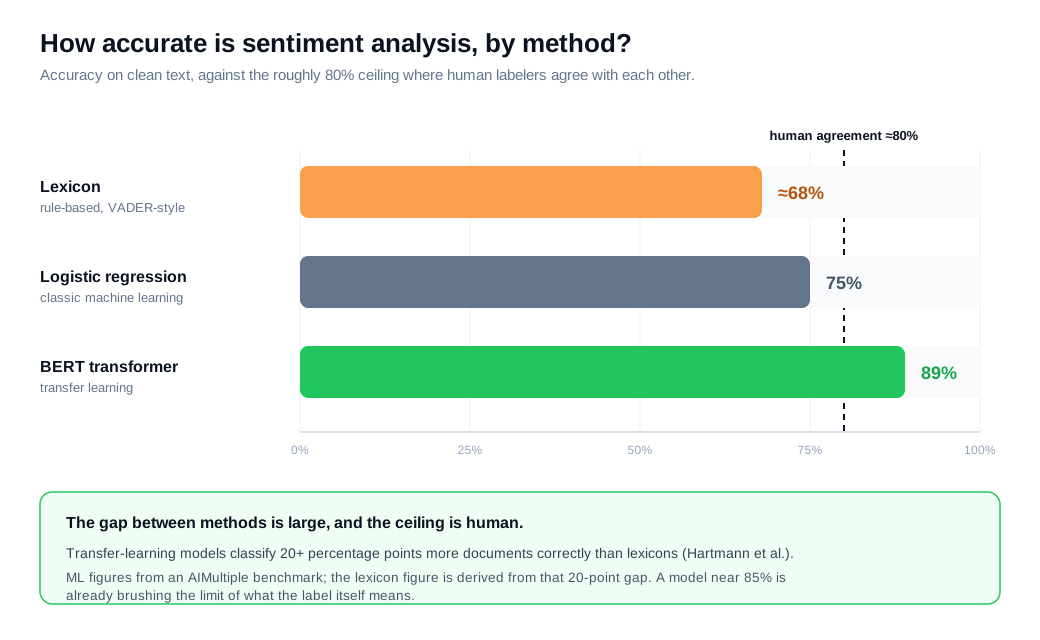
The academic reference here is strong. In More than a Feeling, published in the International Journal of Research in Marketing, Hartmann and colleagues found that transfer learning models classify, on average, more than 20 percentage points more documents correctly than the established lexicons that marketing research long relied on. A benchmark from AIMultiple puts concrete numbers on the same pattern, with a BERT model reaching about 89 percent accuracy against roughly 75 percent for logistic regression on the same task.
The ceiling matters as much as the score. Humans labeling sentiment agree with each other only about 80 percent of the time, because nuance, sarcasm, and mixed emotions are genuinely hard to call, which Edge Delta notes in its guide to sentiment analysis accuracy. A model that matches human labels 85 percent of the time is already brushing against the limit of what the label itself means, so chasing 99 percent is chasing a number the underlying task cannot support.
Work the math on a real desk. A team processes 1,000 tickets a day through a model that is 88 percent accurate, which means about 120 readings a day are wrong. The way to live with that error is to auto-act only on high-confidence, strongly negative scores and route the borderline ones to a person, so the model catches most of the real anger while a human absorbs the ambiguous cases. Accuracy is a reason to design the workflow carefully, not a reason to skip the tool.
What are the limits of sentiment analysis?
The hardest limits are sarcasm, negation, and mixed sentiment, because each one can flip the true feeling in a way that word-level scoring misses. These are not edge cases in support. They are the native dialect of a frustrated customer.
Negation shows up constantly in real feedback, in phrases like "not helpful," "doesn't work," and "never again." The trouble is scope: the negation word's effect can stretch across the rest of the sentence, so a model that only checks the next word gets the reading wrong, as Toptal explains among its sentiment accuracy traps. Miss the negation and the angriest message reads as neutral.
Sarcasm is worse, because it inverts the signal outright. "Great, another outage, love it" reads positive on the surface while meaning the opposite, and a classifier leaning on cheerful words turns that furious message into a false positive, which Enterpret covers in its guide to handling sarcasm and negation. Mixed sentiment adds a third trap: "I love the product but checkout is painful" carries two feelings in one line, and only aspect-level analysis separates them.
The practical response is to keep humans on the cases where a wrong reading is expensive, fine-tune the model on your own tickets so it learns your customers' phrasing, and treat every score as a prioritization aid rather than a verdict. Used that way, sentiment analysis surfaces the conversations worth a human's attention, and a person still makes the call on the ones that matter most.
Key takeaways
- Sentiment analysis reads mood, not topic, labeling each ticket, chat, or review as positive, negative, or neutral with a strength score, and the better systems add emotion, urgency, and aspect-level detail.
- The score comes from a dictionary or a trained model, landing between -1 and +1, where lexicon tools like VADER are easy to explain and machine learning models read context such as negation far better.
- Flagging works by threshold, scoring every message in real time and pulling anything below a set line to the front of the queue, so 48 angry tickets out of 600 get surfaced instead of buried.
- The signal drives three actions, routing hot conversations to a person, tracking trends to find systemic problems, and turning flagged chats into agent coaching, with reported escalation cuts around 30 percent.
- Accuracy tops out near human agreement, with transformer models around 85 to 90 percent on clean text, more than 20 points above lexicons, but capped by the roughly 80 percent rate at which humans agree with each other.
- Sarcasm and negation are the real limits, so keep a person on the expensive and low-confidence cases, fine-tune on your own tickets, and treat the score as a triage aid rather than a final answer.
TAGS

Written by
Nilas MylerCo-founder & CTO, Glimpze
Nilas is the co-founder and CTO of Glimpze, an inbound sales tool that turns high-intent website visitors into live conversations. A former SEO consultant for some of the largest companies in Denmark, he writes about speed-to-lead, inbound sales, and conversion rate optimization — the technical and operational mechanics of turning traffic into pipeline.


