
On this page
- What makes live chat effective?
- What is a good live chat response time?
- Should you use proactive or reactive chat?
- How should you staff and cover live chat?
- How do you measure live chat success?
- How do you write live chat messages that convert?
- What are the most common live chat mistakes?
- Key takeaways
- Sources
A visitor opens the chat widget on your pricing page and types one line: "Does the Pro plan include SSO?" The clock starts.
If a rep answers in twenty seconds with a real answer and a question of their own, that person is in a conversation. If the widget shows "typical reply time: a few hours," the tab is already closed.
Live chat lives or dies on small decisions like that one. Who answers, how fast, what they say first, which pages the widget watches, and whether anyone measures the result. Get those right and chat becomes one of the highest-converting channels on your site. Get them wrong and you run a support queue with a friendlier font.
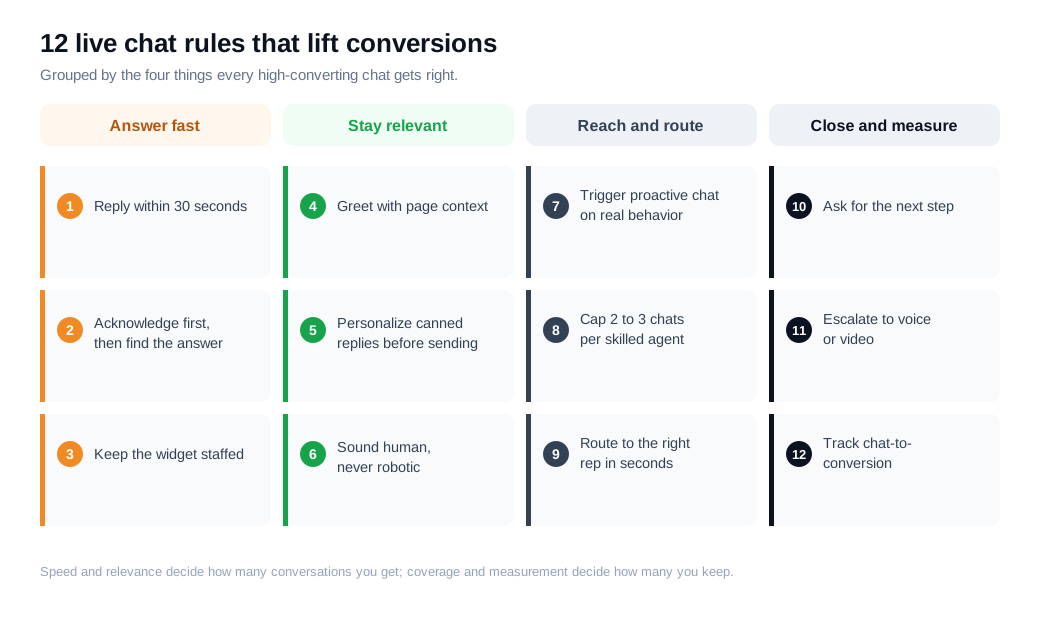
This guide covers what actually makes live chat effective, a realistic response-time target, when to use proactive versus reactive chat, how to staff and cover the channel, and how to measure whether any of it works. Twelve rules run through all five, and they are summarized below.
What makes live chat effective?
Effective live chat combines speed, context, and a clear next step, so a visitor gets a useful answer in seconds and a reason to keep going. The channel wins on timing. A person is already on the page, already curious, and one question away from a decision.
The satisfaction data explains why buyers reach for it. In eDigital's benchmark survey of 2,000 consumers, live chat scored the highest satisfaction of any support channel at 73%, ahead of email at 61% and phone at 44%.
The conversion figure cited most often, attributed to Forrester, is that visitors who engage in a live chat are 2.8 times more likely to convert than visitors who never open it. Some of that gap is selection, since people who start a chat were often warmer to begin with, so treat the multiple as directional rather than a guarantee.
Three levers separate a chat that converts from one that just answers tickets:
- Speed, because attention decays by the second.
- Relevance, since a message tied to the page a visitor is reading lands harder than a generic hello. Research summarized by chat vendors credits personalized messaging with lifting conversions by around 51%, a SmarterHQ figure worth reading as a direction of travel.
- Intent, because a good chat asks for the next step instead of ending politely.
A tool like live chat only earns its keep when the person running it treats each conversation as a chance to move a deal, not a chore to clear.
What is a good live chat response time?
A good live chat first response lands in under 30 seconds, and 60 seconds is the outer limit before you start losing people. Teams that answer inside 30 seconds report the highest customer satisfaction, and satisfaction falls off sharply once replies drift past two minutes.
Separate two clocks that often get confused. First response time is how long a visitor waits for any human reply after they send a message. Resolution time is how long the whole conversation takes.
First response time is the one that decides whether a visitor stays, so it deserves the tighter target. Even a short acknowledgment ("Hi, let me check that for you") stops the countdown and holds attention while you find the real answer.
The benchmarks are humbling. Reported averages for live chat first response sit around 1 minute 35 seconds across industries, with SaaS near 1 minute 22 seconds and small teams of one to nine people answering in about 31 seconds.
Customer expectations run ahead of that: roughly 90% expect a reply within 10 minutes, and a large share want it inside 2. The operational standard most support teams aim for is answering 80% of chats within 20 seconds.
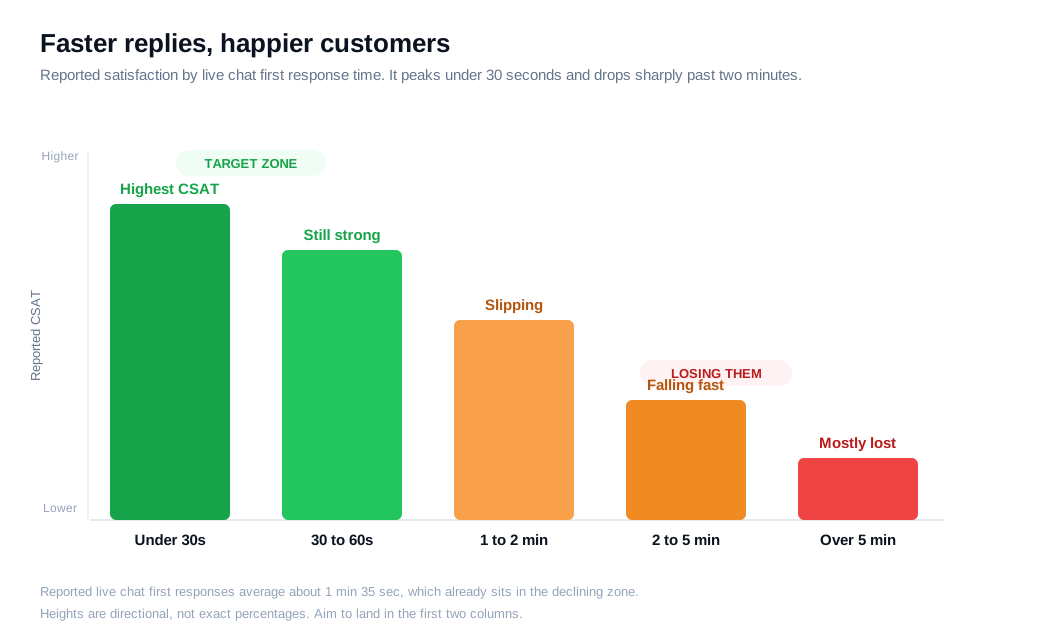
Here is the tradeoff in plain numbers. Say 1,000 people open your widget in a month. If your median first reply is 15 seconds, most of those conversations stay open and your engaged conversion rate holds.
Slip to a three-minute median and a meaningful slice abandons before anyone types back, so the same traffic produces fewer conversations and fewer deals from identical demand. Speed does not improve any single conversation. It changes how many conversations you actually get to have.
Should you use proactive or reactive chat?
Use both, and make proactive chat contextual and behavior-triggered, because a generic pop-up converts worse than simply waiting for a visitor to open the widget on their own. Reactive chat waits for the visitor to start. Proactive chat reaches out first, based on what the visitor is doing.
The upside of proactive chat is real when the trigger is smart. Contextual invitations, ones that reference the page or action a visitor is already engaged in, are reported to convert meaningfully higher than reactive-only setups, with vendor figures putting the lift near 40%.
The failure mode is just as real. A blanket "Hi, how can I help?" that fires on every page after five seconds trains people to close the box on reflex, and it can perform worse than no proactive chat at all.
Good triggers key off intent rather than a stopwatch. Time spent on a pricing or comparison page, a second or third visit in a week, a stalled checkout, or scrolling deep into a plans page all signal someone weighing a decision.
That is the moment a well-timed nudge helps rather than interrupts. A message that names the situation ("Comparing the Pro and Enterprise plans? I can walk you through the differences") outperforms a wave from a stranger. Tuning those proactive outreach nudges to real behavior, then leaving low-intent pages alone, is most of the work.
A worked comparison keeps this honest. Imagine 5,000 pricing-page sessions a month:
- Reactive-only might get 3% of them to open the widget (150 chats) and convert engaged chats at 15%, for about 22 deals.
- A contextual proactive invite could lift opens to 9% (450 chats), but those extra visitors skew slightly lower intent, so engaged conversion settles near 12%, for about 54 deals.
- The generic version also opens 9%, but the interruption sours the experience, engaged conversion drops to 5%, and you net roughly 22 deals for more annoyance and no gain.
Same reach, opposite result, decided entirely by whether the trigger respected context.
How should you staff and cover live chat?
Staff live chat to your actual traffic peaks and cap each agent at two to three concurrent chats, then decide honestly what happens when no one is online. Concurrency is where quality quietly erodes, so set a ceiling before volume forces one on you.
Most skilled agents hold quality across two to three simultaneous conversations. New agents should run one at a time until they build speed, and only your strongest people should push to four, and even then only on simple, repetitive questions.
Technical, billing, or emotionally charged chats demand lower concurrency, because tone and accuracy suffer when attention splits. Reported ranges land in the same place: two to three chats per agent as the sustainable default.
Coverage is the other half. Pull a week of chat volume by hour and you will see clear peaks, usually mid-morning and mid-afternoon on weekdays for B2B. Schedule your people against those peaks instead of spreading them evenly, so nobody is stuck juggling six chats during the rush while the widget sits idle at 8 a.m.
When a qualified conversation comes in, it should reach the right person fast, which is what lead routing and notifications are for: skills-based routing to whoever handles that product or region, plus a Slack ping so a rep can jump in within seconds.
Then handle the hours you cannot cover. For inbound sales, speed decides the outcome more than almost any other factor. The classic MIT and InsideSales lead-response study found that contacting a web lead within five minutes made a rep 21 times more likely to qualify it than waiting thirty.
When your team is offline, do not fake availability. Switch the widget to an offline state that sets expectations, captures the visitor's question and email, and, better still, lets an AI assistant answer the easy questions and book time so the lead never goes cold.
How do you measure live chat success?
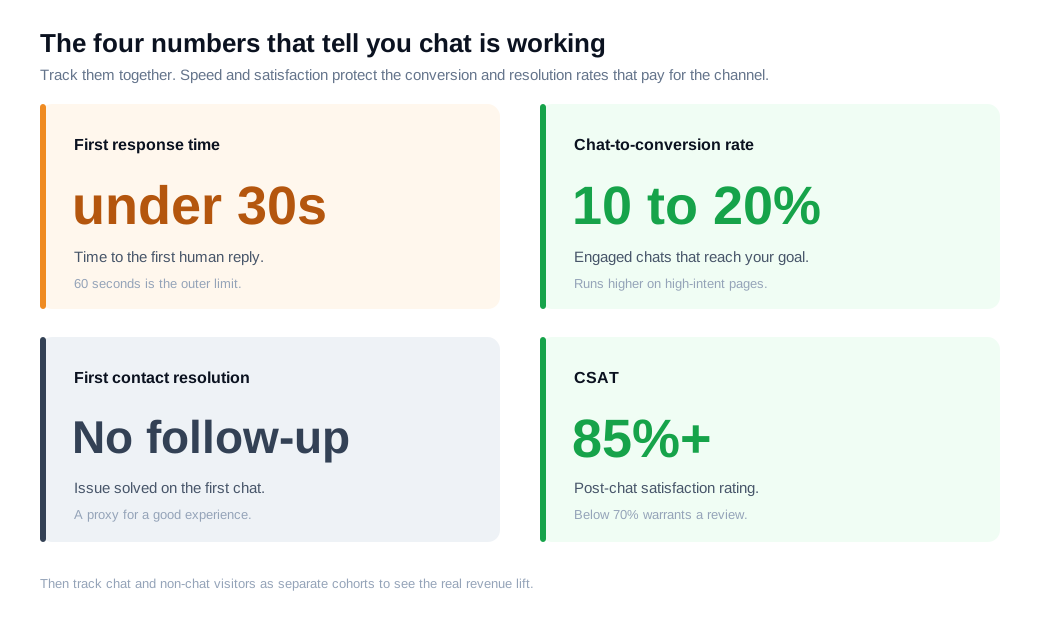
Measure live chat on four numbers, first response time, chat-to-conversion rate, first contact resolution, and CSAT, then connect those conversations to revenue. Anything you cannot see, you cannot improve, and chat generates enough data to manage it precisely.
- First response time you already have a target for: under 30 seconds.
- Chat-to-conversion rate is the share of chats that lead to the outcome you care about, a demo booked, a signup, a purchase. For engaged conversations it commonly lands in the 10% to 20% range, higher on high-intent B2B pages.
- First contact resolution measures how often a chat solves the issue without a follow-up, a proxy for whether visitors leave satisfied.
- CSAT, gathered from a quick rating after the chat, is the direct read on experience: 85% and above is considered excellent for live chat, and anything under 70% warrants a look at scripts, staffing, or speed.
Tie it to money with a worked example. Say your widget produces 2,000 chats a month, 60% of them engaged (1,200 real conversations), converting at 15%. That is 180 conversions from chat.
If your average deal is worth $2,000, chat is influencing $360,000 in monthly pipeline before you count assisted deals where chat was one touch among several.
Track chat and non-chat visitors as separate cohorts in your analytics, and you can see the conversion gap directly instead of guessing at it. That comparison, not a vendor's headline multiple, is what should justify the channel internally.
How do you write live chat messages that convert?
Write like a helpful human: open with context, keep replies short, use canned responses as a starting point rather than a script, and always move toward a next step. The mechanics of the message matter as much as the speed behind it.
Start with the greeting. A page-aware opener beats a generic one every time, and a good welcome message and flow sets the tone before a rep even joins.
Once a person is typing, keep your replies scannable, use their name, and mirror their language rather than pasting corporate phrasing. Canned responses save time on common questions, but send them as a base you personalize, not a wall of boilerplate, or visitors feel handled by a machine and disengage.
Two more habits lift conversion:
- Ask for contact information early and naturally, so a dropped chat still leaves you a lead to follow up.
- Escalate when text stops being enough. A complex setup question or a serious buyer often converts faster on a call, so offering live video and screen share in the same thread turns a stalled chat into a working demo.
Carry the full transcript into every handoff, whether to another rep or to a call, so nobody has to repeat themselves.
What are the most common live chat mistakes?
The most common live chat mistakes are slow or unstaffed widgets, generic proactive pop-ups, robotic scripted replies, and never measuring the outcome. Each one quietly caps how much the channel can return.
An unstaffed widget is the worst of them, because it advertises help and then delivers a wait. If you cannot cover a time slot, say so and capture the lead rather than leaving a hopeful visitor typing into silence.
Generic proactive chat is the second trap, and the fix is the contextual triggering covered above. Scripted, impersonal replies come third, and they undo the human advantage that made chat worth adding.
The fourth, flying blind on metrics, is the one that keeps the other three alive, since a team that does not track first response time or chat-to-conversion rate has no signal that anything is wrong. Most platforms, including Glimpze, offer a free tier, so you can test staffing and triggers against your own traffic before committing budget.
Key takeaways
- Speed sets the ceiling. Aim for a first response under 30 seconds and treat 60 seconds as the limit, because most abandonment happens before the second reply.
- Context beats volume. A message tied to the page a visitor is reading converts far better than a generic greeting, whether the chat is proactive or reactive.
- Make proactive chat behavioral. Trigger on intent signals like time on a pricing page or a stalled checkout, and leave low-intent pages alone, since generic pop-ups can convert worse than nothing.
- Staff to peaks and cap concurrency. Two to three chats per skilled agent protects quality, and honest offline states with lead capture beat a widget that fakes availability.
- Measure four numbers. First response time, chat-to-conversion rate, first contact resolution, and CSAT, then tie chat cohorts to revenue so the channel earns its budget on evidence.
- Keep it human and move to the next step. Personalize canned responses, ask for contact details early, and escalate to voice or video the moment text stops being enough.

Written by
Nilas MylerCo-founder & CTO, Glimpze
Nilas is the co-founder and CTO of Glimpze, an inbound sales tool that turns high-intent website visitors into live conversations. A former SEO consultant for some of the largest companies in Denmark, he writes about speed-to-lead, inbound sales, and conversion rate optimization — the technical and operational mechanics of turning traffic into pipeline.


