
On this page
A customer opens your help widget at 9pm and types, "How do I reset my password?" A live agent could answer that in ten seconds, but only after the customer waits in a queue, and only after you pay for the interaction.
So the answer arrives before an agent ever sees it. The AI reads the question, pulls the exact reset steps from your own docs, and the customer is back in their account a minute later. No ticket, no queue, no cost beyond a fraction of a cent.
That is ticket deflection, and it is one of the biggest cost levers in support. It is also easy to fake. A bot that ends a chat without solving anything looks identical, on a dashboard, to a bot that solved it, which means a deflection number can climb while your customers quietly get angrier.
Gartner found that only 14 percent of service issues are fully resolved in self-service, even though 73 percent of customers try it first. The gap between "handled without a human" and "actually solved" is the whole story of this metric.
This guide covers what ticket deflection is, how AI actually deflects a ticket, what a healthy deflection rate looks like, how to measure it without fooling yourself, how to keep customers from getting trapped, and which tickets AI should never try to close on its own.
What is ticket deflection?
Ticket deflection is the share of support contacts that get fully resolved through self-service or automation before they ever reach a human agent. Each deflected contact is a ticket that never enters the queue, so the customer skips the wait and the business skips the cost of an agent handling it.
The standard formula is simple: deflection rate equals deflected contacts divided by total contact attempts, times 100. If 10,000 people seek help in a month and 4,000 get a complete answer without a human, the raw deflection rate is 40 percent.
Kustomer and Decagon both define it this way, and both stress the same condition. A contact only counts as deflected when the issue is actually handled. Stopping the conversation is not the same as solving it.
The reason support leaders care is money. Gartner's research puts a fully self-served resolution at a fraction of the cost of a live interaction, and estimates that once a customer reaches a live channel, resolving the issue costs 80 to 100 times more than a self-service fix.
Cost-per-ticket benchmarks tell the same story from the ground. Lorikeet pegs the median assisted human ticket at about $13.50, against roughly $0.10 to a few dollars for a self-service resolution. An AI chat assistant that closes even a third of routine questions changes the shape of a support budget.
Deflection is close cousins with two other numbers, and they are worth keeping straight:
- Containment counts any chat the bot kept off human hands.
- Resolution counts the chats where the problem actually got solved.
- Deflection sits between them, and the whole skill of using it well is refusing to count a chat that a frustrated customer abandoned as a win.
How does AI deflect a ticket?
AI deflects a ticket by reading the intent behind a question, retrieving the matching answer from your own content, and writing a grounded reply in the customer's channel, all before a person is pulled in. The mechanism is three steps stacked on top of your knowledge base, and each step has to work for the deflection to be real.
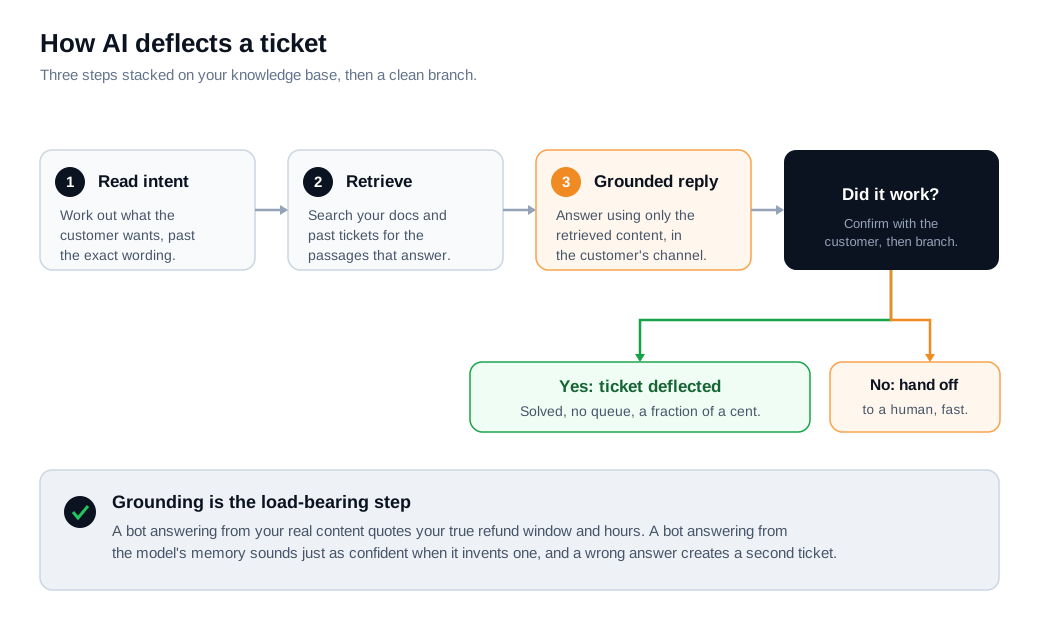
- Intent detection. A large language model reads the message and works out what the customer actually wants, past the exact wording, so "I'm locked out" and "reset my password" and "can't log in" all route to the same goal.
- Retrieval. The system turns the question into a search against your documentation and past resolved tickets, a technique usually called retrieval-augmented generation, and pulls the passages most likely to hold the answer.
- The grounded reply. The model writes an answer using only the retrieved material, so it quotes your real refund window instead of inventing a plausible one.
That grounding step is what separates a deflection you can trust from a liability. A bot answering from the model's general memory sounds just as confident when it is wrong, and a confident wrong answer about a refund or a shipping date creates a second ticket plus a disappointed customer.
Wiring the bot to a curated knowledge base is what makes the answers checkable, and keeping that content current is the ongoing work behind any AI assistant setup. eesel and other practitioners describe the same pattern: intent in, retrieval against real content, grounded answer out, with a clean handoff whenever confidence is low.
The last part of the loop is the branch. If the system has a grounded answer and the customer confirms it worked, the ticket is deflected. If it does not, or the customer pushes back, the job is to route to a person quickly rather than keep guessing.
What is a healthy AI ticket deflection rate?
A healthy deflection rate depends on your industry and your question mix, but most teams land somewhere between 25 and 60 percent, with e-commerce reaching higher and regulated industries sitting lower.
There is no single number to chase, because a bot fielding order-status questions lives in a different world from one fielding tax or medical questions.
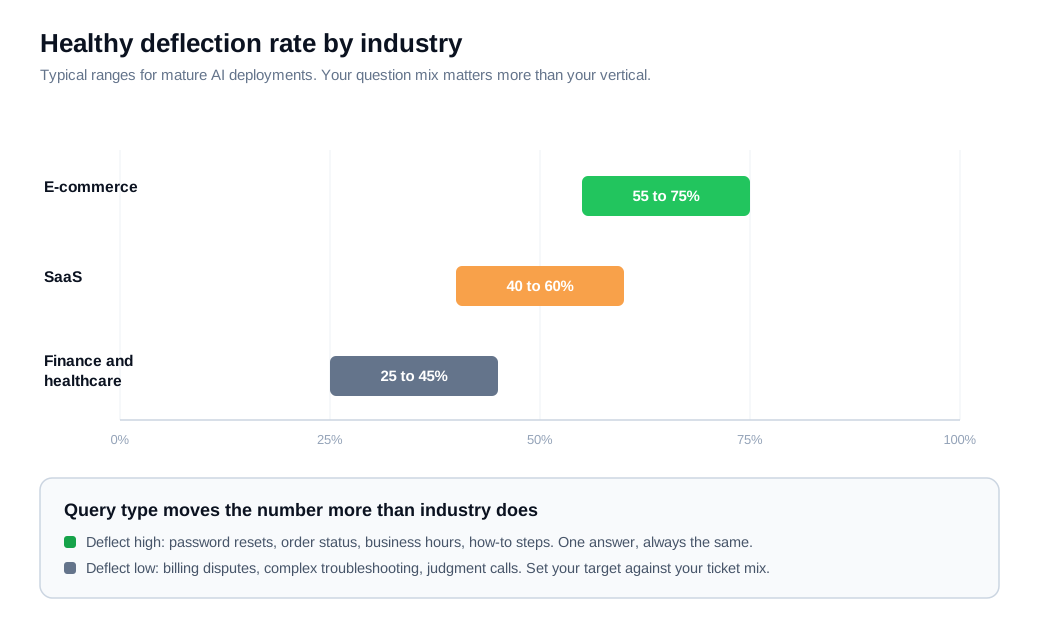
Decagon's benchmark ranges are a useful starting point:
- E-commerce teams with mature AI deployments report deflection in the 55 to 75 percent range.
- SaaS companies typically see 40 to 60 percent.
- Financial services and healthcare land around 25 to 45 percent, because compliance limits what a bot is allowed to resolve on its own.
Those bands reflect how much of each vertical's volume is simple and well documented.
Query type matters even more than industry. Password resets, order tracking, and account questions are highly deflectable because the answer is the same every time and lives in one place. Complex technical troubleshooting and anything requiring a judgment call deflect far less, even with a strong deployment.
If you want a realistic target, look at your ticket tags, estimate what share is genuinely repetitive, and set your goal against that rather than a headline number from a case study.
One warning sits under all of these figures. A high deflection rate is only good if customer satisfaction holds. Decagon's own guidance is blunt: if deflection climbs while CSAT slips, you are pushing customers away from human support without solving their problem.
Optimize for the highest deflection rate that keeps CSAT steady. Once CSAT starts to drop, the deflection gains are being paid for in lost customers.
How do you measure deflection without fooling yourself?
Measure deflection by counting only the contacts where the customer's issue was truly resolved and did not come back, rather than every chat the bot happened to end.
The most common way teams inflate the metric is by logging abandoned sessions as deflected. A customer talks to the bot, gets nothing useful, gives up, and never asks for a human, and naive tracking files that as a success.
The fix is to measure true deflection. Subtract the contacts that came back within a short window, usually 48 hours, with the same issue, then divide by total help-seeking attempts.
eesel notes that this adjusted number typically runs 15 to 25 percent lower than the raw figure, and that gap is a direct read on how much false deflection you are carrying. Zendesk makes the same point from the platform side: some tools count abandoned or incomplete chats as resolutions, which makes automation look stronger than it is, so you should track deflection and confirmed resolution together and watch the re-contact rate.
Here is the arithmetic on one month. A SaaS team logs 10,000 help-seeking contacts. The bot fully handles 4,800 of them with no human, a tidy 48 percent raw deflection.
Audit those 4,800 and you find 960 customers came back within 48 hours with the same problem. Subtract them and 3,840 were genuinely deflected, a true rate of 38 percent, ten points below the headline.
On the honest 3,840, at roughly $12.50 saved per contact versus a live agent, the bot is worth about $48,000 that month. The 960 false deflections cost you twice, because you pay for the human ticket anyway and the customer arrives more frustrated than if the bot had handed them off cleanly the first time.
Two habits keep the number honest:
- Ask a single post-chat question, "Did this solve your issue?", so resolution gets reported rather than assumed.
- Chart tickets opened, deflected, and confirmed-resolved on the same graph, so a rising deflection line that is really just shifting work to another channel shows up instead of hiding.
How do you avoid frustrating customers?
Avoid frustration by making the path to a human obvious at every step and escalating early, before the customer has to fight the bot to reach one.
Deflection goes wrong when it becomes a wall, and a bot that traps someone in a loop of "did that answer your question?" damages satisfaction faster than a long hold ever would.
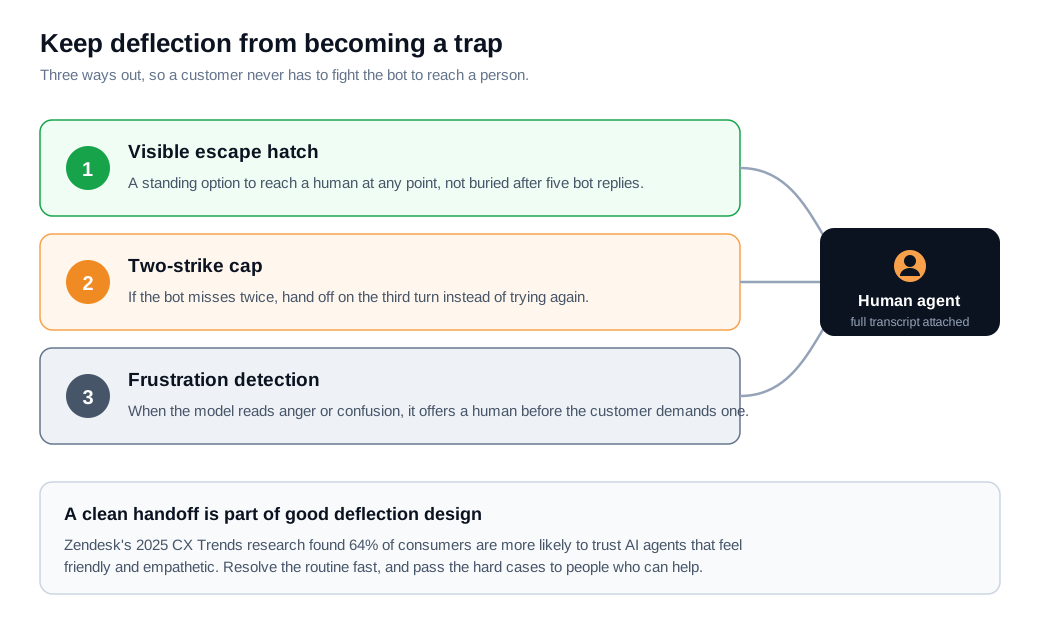
Three practices, drawn from escalation guidance like Cobbai's, keep deflection on the right side of that line:
- Make the escape hatch visible. Give the customer a standing option to reach a person at any point, not buried after five bot replies.
- Cap the failures. If the bot misses twice, hand off on the third turn instead of trying again.
- Detect frustration. When the model reads anger or confusion, it should offer a human before the customer has to demand one.
When the handoff happens, pass the full transcript so the customer never repeats themselves.
Customer expectations back this up. Zendesk's 2025 CX Trends research found that 64 percent of consumers are more likely to trust AI agents that feel friendly and empathetic, and the report frames the winning model as AI that resolves the routine fast and hands the rest to people who can help.
A clean handoff is part of good deflection design. Treating it as a failure is what leads teams to hide the escalation button, which is exactly the move that traps customers.
On a sales-driven site the calculus tips even further toward speed to a person. A high-intent visitor asking a pre-purchase question is an opportunity, so the right move is often to answer the quick question and then route a good-fit buyer to a rep on live chat while interest is hot, rather than deflecting them into a self-service loop.
Getting the right conversation to the right rep fast is its own discipline, covered in the routing and notifications guide.
Which tickets should AI deflect, and which should it not?
Let AI deflect high-volume, low-stakes, well-documented questions, and route judgment calls, emotional situations, and anything outside your verified content to a person. The dividing line is whether the answer is knowable and the stakes are bounded.
Strong candidates for deflection share three traits. They repeat often, they have one correct answer that lives in your docs, and getting them slightly wrong is cheap to fix.
Password resets, order status, business hours, how-to steps, and plan comparisons all fit. These are the questions that make up the bulk of most queues and the reason a well-scoped bot can clear a third or more of volume.
Poor candidates share the opposite traits. A billing dispute, a cancellation from an upset customer, a security concern, or an edge case that is not in your documentation all need a person, because the right answer requires reading a mood, weighing a trade-off, or bending a rule.
Pushing those at a bot is how deflection turns into churn. The healthiest programs deflect the boring, repetitive volume on purpose and route the hard cases to people on purpose, and they measure both halves so the boundary stays where it belongs.
Key takeaways
- A deflected ticket is one the customer no longer needs help with. A contact counts only when the customer's issue is actually resolved and does not come back, so an abandoned chat is a failure wearing a success badge.
- AI deflects in three steps. It reads intent, retrieves from your knowledge base, and writes a grounded answer, and the grounding is what keeps a confident reply from becoming a confidently wrong one.
- Healthy rates run 25 to 60 percent, driven by question mix. E-commerce reaches higher and regulated industries lower, and password resets deflect far better than judgment-heavy tickets.
- Measure true deflection. Subtract 48-hour re-contacts and confirm resolution with a one-question survey, since the raw number often runs 15 to 25 percent above the honest one.
- Make the exit obvious. A visible path to a human, a cap of two failed attempts, and proactive escalation on frustration keep deflection from becoming a trap that costs you the customer.
- Deflect the routine, escalate the rest. Aim AI at repetitive, well-documented, low-stakes questions and send emotional, high-stakes, or undocumented issues to a person on purpose.
TAGS

Written by
Nilas MylerCo-founder & CTO, Glimpze
Nilas is the co-founder and CTO of Glimpze, an inbound sales tool that turns high-intent website visitors into live conversations. A former SEO consultant for some of the largest companies in Denmark, he writes about speed-to-lead, inbound sales, and conversion rate optimization — the technical and operational mechanics of turning traffic into pipeline.


